
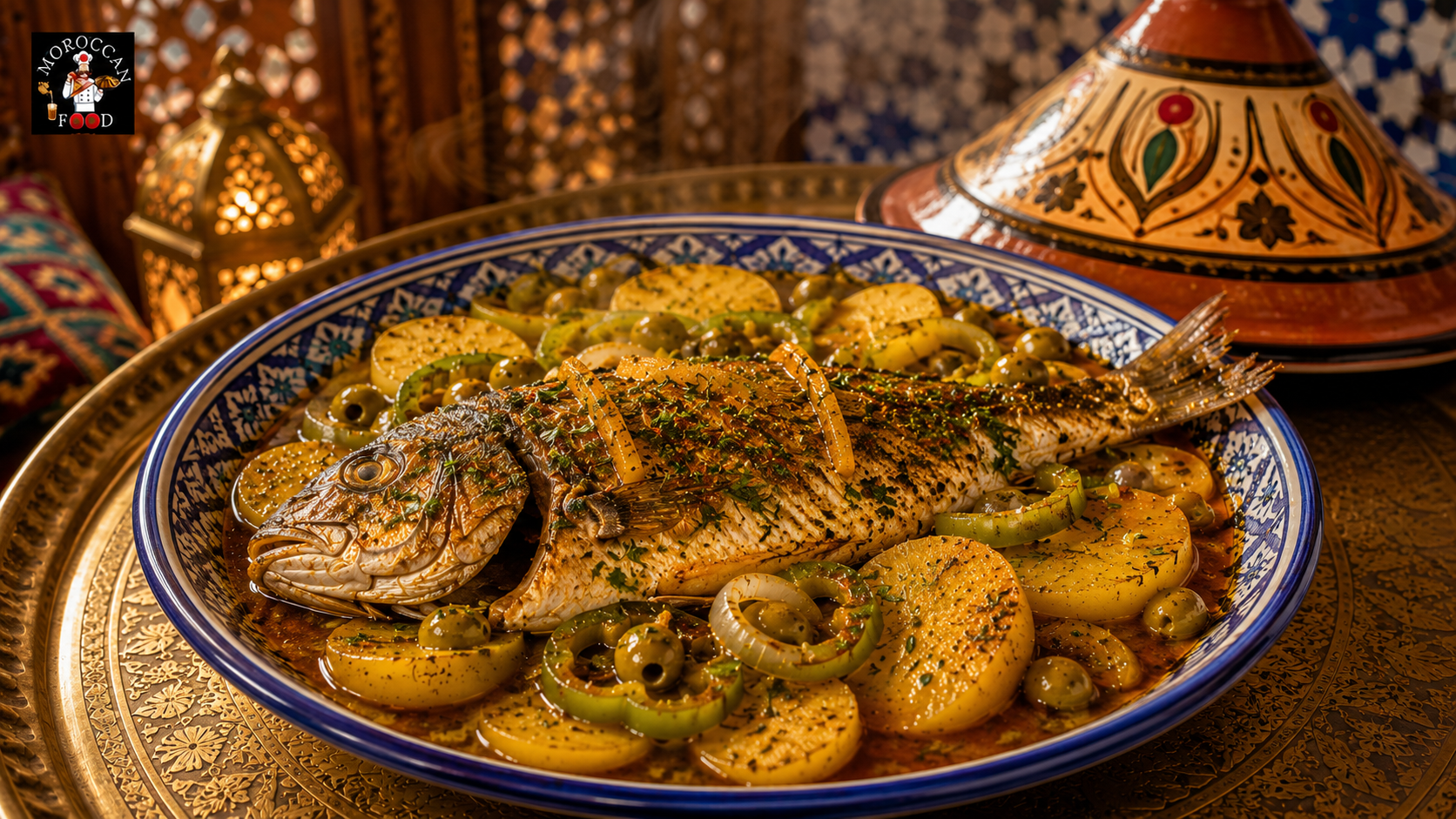
Moroccan Whole Sea Bream Tagine is a flavorful seafood dish featuring a 1 kg whole sea bream marinated in aromatic homemade chermoula, then gently cooked over a bed of onions and thin potato rounds with green bell peppers. Fresh herbs, garlic, lemon, saffron, cumin, paprika, ginger, and turmeric create a rich Moroccan flavor, while the slow cooking keeps the fish tender and allows the vegetables to absorb the fragrant sauce.
Recipe Information
| Detail | Information |
|---|---|
| Cuisine | Moroccan |
| Course | Main Course |
| Category | Fish and Seafood Tagines |
| Preparation Time | 25 minutes |
| Marinating Time | 30 minutes |
| Cooking Time | 50 minutes |
| Total Time | 1 hour 45 minutes |
| Servings | 4 servings |
| Yield | 1 large family-size tagine |
| Fish Quantity | 1 whole sea bream, approximately 1 kg (2.2 lb) |
| Cooking Method | Gentle stovetop cooking in a tagine |
| Difficulty Level | Intermediate |
| Estimated Calories | Approximately 545 kcal per serving |
| Dietary Information | Pescatarian, dairy-free and gluten-free as prepared |
| Best Served | Hot, directly from the tagine |
| Serving Suggestions | Moroccan bread, zaalouk, taktouka, carrot salad or beet salad |
Nutrition note: The estimated calories apply to one-quarter of the fish tagine and exclude bread and accompanying Moroccan salads.
Ingredients
For the Fish and Vegetables
- 1 whole sea bream, approximately 1 kg (2.2 lb), cleaned, scaled, and gutted
- 2 large onions, cut into thin rings
- 3 medium potatoes, approximately 600 g (1.3 lb), peeled and cut into 5 mm rounds
- 2 green bell peppers, seeded and cut into rings
- ½ preserved lemon, pulp removed and rind cut into thin strips
- 80 g (½ cup) green olives
- 1 tablespoon extra-virgin olive oil, for the tagine
- ¾ cup (180 ml) warm water
For the Moroccan Chermoula
- ½ cup finely chopped fresh cilantro
- ¼ cup finely chopped fresh parsley
- 4 garlic cloves, finely minced
- 2 teaspoons sweet paprika
- 1½ teaspoons ground cumin
- 1 teaspoon ground ginger
- ½ teaspoon ground turmeric
- ½ teaspoon freshly ground black pepper
- ¼ teaspoon cayenne pepper, optional
- 1 teaspoon salt, or to taste
- A generous pinch of saffron threads
- 2 tablespoons warm water, for soaking the saffron
- 3 tablespoons freshly squeezed lemon juice
- 4 tablespoons extra-virgin olive oil

Preparation
1. Prepare the Saffron
Place the saffron threads in a small bowl with 2 tablespoons of warm water. Allow them to infuse for approximately 10 minutes to release their color and aroma.
2. Make the Chermoula
In a medium bowl, combine the chopped cilantro, parsley, garlic, paprika, cumin, ginger, turmeric, black pepper, cayenne pepper, and salt.
Add the infused saffron and its water, lemon juice, and olive oil. Mix thoroughly until a smooth, aromatic chermoula forms.
3. Prepare and Marinate the Fish
Pat the cleaned sea bream dry with paper towels. Make three shallow diagonal cuts on each side of the fish, taking care not to cut through the bone.
Rub approximately half of the chermoula inside the cavity, over both sides of the fish, and into the diagonal cuts. Cover and refrigerate for 30–60 minutes so the fish absorbs the flavors.
Reserve the remaining chermoula for the vegetables and sauce.
4. Prepare the Tagine Base
Brush the base of a large tagine with 1 tablespoon of olive oil. Arrange the onion rings evenly across the bottom to create a protective and flavorful base.
Coat the potato rounds with approximately half of the reserved chermoula, then arrange them in slightly overlapping circles over the onions.
Mix the remaining reserved chermoula with ¾ cup of warm water and pour it gently around the potatoes.
5. Partially Cook the Vegetables
Cover the tagine and place it over low to medium-low heat. If using a traditional clay tagine on the stovetop, place a heat diffuser underneath it.
Allow the onions and potatoes to cook gently for 15–20 minutes, or until the potatoes begin to soften around the edges. This step helps the vegetables cook completely without overcooking the fish.
6. Add the Fish and Green Peppers
Place the marinated sea bream carefully over the partially cooked potatoes. Arrange the green pepper rings over and around the fish.
Decorate with the preserved lemon strips and green olives. Spoon a little of the sauce from the bottom of the tagine over the fish.
7. Cook the Tagine
Cover and cook over low heat for approximately 25–30 minutes. The sauce should simmer gently rather than boil rapidly.
Occasionally rotate the tagine carefully to distribute the heat evenly. Spoon a small amount of sauce over the fish once or twice during cooking without moving or breaking it.
The tagine is ready when the potatoes are tender, the fish flesh is opaque and flakes easily, and its thickest part reaches approximately 63°C (145°F).
8. Reduce the Sauce and Serve
If the sauce is too thin, remove the lid and cook for an additional 5–8 minutes over low heat until it becomes slightly concentrated.
Remove the tagine from the heat and let it rest for 5 minutes. Serve it hot directly from the tagine with Moroccan bread for enjoying the richly flavored chermoula sauce.

Serving Tagine :

Here are some of the most popular traditional Moroccan salads that are served with tagine as a main course.
Moroccan Roasted Tomato, Onion & Pepper Salad Recipe
Traditional Moroccan Tomato Cucumber and Onion Salad Recipe
Moroccan salad with tomatoes, onions, and roasted green peppers
Moroccan salad with onions, tomatoes, and roasted red and yellow peppers
Moroccan Lettuce, Tomato, Onion & Cucumber Salad
show Nutritional Value
Estimated Nutritional Value
Servings: 4
Serving size: ¼ of the tagine, including approximately 150 g of edible fish
| Nutrient | Per Serving | Approx. Daily Value |
|---|---|---|
| Calories | 545 kcal | — |
| Protein | 36 g | 72% |
| Total Carbohydrates | 42 g | 15% |
| Dietary Fiber | 7.8 g | 28% |
| Total Sugars | 7 g | — |
| Added Sugars | 0 g | 0% |
| Total Fat | 27.5 g | 35% |
| Saturated Fat | 4.2 g | 21% |
| Cholesterol | 98 mg | 33% |
| Sodium | 1,100 mg | 48% |
| Potassium | 1,500 mg | 32% |
| Calcium | 90 mg | 7% |
| Iron | 3.5 mg | 19% |
| Vitamin C | 55 mg | 61% |
Estimated Value for the Whole Tagine
- Calories: 2,180 kcal
- Protein: 144 g
- Carbohydrates: 168 g
- Fiber: 31 g
- Fat: 110 g

Frequently Asked Questions
1. What is Moroccan Sea Bream Tagine?
Moroccan Sea Bream Tagine is a traditional fish dish made by cooking a whole sea bream with onions, potato rounds, green bell peppers, olives, preserved lemon, and aromatic chermoula sauce. It is slowly cooked until the fish is tender and the vegetables have absorbed the flavorful sauce.
2. Is sea bream suitable for Moroccan fish tagine?
Yes. Sea bream is an excellent choice because its firm white flesh holds its shape during gentle cooking. Its mild flavor also pairs well with the herbs, lemon, garlic, saffron, and spices used in Moroccan chermoula.
3. What fish can I use instead of sea bream?
Sea bass, red snapper, meagre, grouper, cod, or another firm-fleshed white fish can be used. Choose a fish that will remain intact during slow cooking and adjust the cooking time according to its size and thickness.
4. Can I make Moroccan fish tagine with fish fillets?
Yes. Thick sea bream, sea bass, cod, or snapper fillets can replace the whole fish. Because fillets cook more quickly, partially cook the onions and potatoes first, then add the fillets during the final 12–18 minutes.
5. What is Moroccan chermoula?
Chermoula is a traditional Moroccan marinade and sauce commonly used with fish. It typically combines cilantro, parsley, garlic, lemon juice, olive oil, cumin, paprika, and other aromatic spices.
6. What spices are used in fish chermoula?
This recipe uses sweet paprika, ground cumin, ginger, turmeric, black pepper, cayenne pepper, saffron, and salt. Fresh cilantro, parsley, garlic, lemon juice, and olive oil complete the chermoula.
7. How long should sea bream marinate in chermoula?
Marinate the fish in the refrigerator for approximately 30–60 minutes. This gives the chermoula time to flavor the flesh without allowing the lemon juice to affect its texture excessively.
8. Why should the whole fish be scored before marinating?
Making three shallow diagonal cuts on each side helps the chermoula reach deeper into the flesh. It also promotes more even cooking in the thickest parts of the fish.
9. Why are onions placed at the bottom of the tagine?
The onion rings create a flavorful base and help protect the potatoes from direct heat. As they cook, they soften and release moisture that contributes to the chermoula sauce.
10. Why should the potatoes be partially cooked before adding the fish?
Potatoes usually need more cooking time than fish. Partially cooking them for 15–20 minutes helps ensure they become tender without overcooking or drying out the sea bream.
11. How thick should the potato rounds be?
Cut the potatoes into uniform rounds approximately 5 mm thick. Thin, evenly sized slices cook more consistently and absorb the chermoula sauce effectively.
12. Do I need a traditional clay tagine?
No. A wide Dutch oven, shallow casserole, heavy covered skillet, or oven-safe baking dish can be used. Choose a vessel large enough to hold the whole fish without bending or breaking it.
13. Do I need a heat diffuser under a clay tagine?
A heat diffuser is strongly recommended when using a traditional clay tagine on the stovetop. It distributes heat more evenly and reduces the risk of cracking the tagine or burning the onions and potatoes.
14. Can Moroccan Sea Bream Tagine be cooked in the oven?
Yes. Cover the onions, potatoes, chermoula, and water and bake at 190°C (375°F) for approximately 15–20 minutes. Add the marinated fish, peppers, olives, and preserved lemon, cover again, and bake for another 25–30 minutes or until fully cooked.
15. How long does a 1 kg whole sea bream take to cook?
After the vegetables have been partially cooked, a 1 kg whole sea bream generally needs 25–30 minutes over gentle heat. The exact time depends on the fish’s thickness, starting temperature, and cooking vessel.
16. How do I know when the sea bream is cooked?
The flesh should become opaque and separate easily with a fork near the thickest part. For food safety, the internal temperature should reach 63°C (145°F). Avoid cooking it much longer once this temperature is reached.
17. How can I prevent the fish from becoming dry?
Cook the tagine gently and keep it covered for most of the cooking time. Spoon a little sauce over the fish once or twice and remove the tagine from the heat as soon as the fish is fully cooked.
18. How can I prevent the bottom of the tagine from burning?
Use low heat, place onions beneath the potatoes, add the measured water and chermoula sauce, and use a heat diffuser with clay cookware. Check occasionally that a small amount of liquid remains around the vegetables.
19. Can I replace preserved lemon?
Yes. Use a small amount of fresh lemon zest with additional lemon juice. The flavor will be fresher and less salty, but it will not have the same fermented depth as Moroccan preserved lemon.
20. Can I omit the green olives?
Yes. The olives can be omitted if you do not enjoy them or want to reduce the sodium. You may add a little extra preserved lemon or fresh herbs to maintain a bright, aromatic flavor.
21. Is Moroccan fish tagine spicy?
This version is aromatic rather than very hot. The cayenne pepper provides mild heat and can be reduced or omitted. Add more cayenne only if you prefer a noticeably spicy tagine.
22. Can I prepare the chermoula in advance?
Yes. Prepare the chermoula up to 24 hours ahead and refrigerate it in an airtight container. Stir it well before using because the herbs, spices, lemon juice, and olive oil may naturally separate.
23. Can Moroccan Sea Bream Tagine be prepared ahead?
You can prepare the chermoula, slice the vegetables, and marinate the fish in advance. Keep every component properly refrigerated and assemble the tagine shortly before cooking for the best texture.
24. How should leftover fish tagine be stored?
Transfer leftovers to a clean, airtight container and refrigerate them within two hours of cooking. Properly refrigerated cooked fish can generally be kept for 3–4 days.
25. How should Moroccan fish tagine be reheated?
Reheat it gently in a covered pan or baking dish with a small spoonful of water or sauce to prevent the fish from drying out. Heat leftovers thoroughly to 74°C (165°F).
26. Can Moroccan fish tagine be frozen?
Yes, although the potatoes may become softer after thawing. Freeze cooled portions in airtight containers and thaw them overnight in the refrigerator before reheating gently.
27. Is Moroccan Sea Bream Tagine healthy?
It can form part of a balanced meal. Sea bream provides high-quality protein, while potatoes, onions, peppers, herbs, and spices contribute carbohydrates, fiber, potassium, vitamin C, and other micronutrients. Olive oil provides mostly unsaturated fat.
28. How many calories are in one serving?
One-quarter of this tagine contains an estimated 545 calories, assuming approximately 600 g of edible fish from the 1 kg whole sea bream and consumption of all the sauce. The value does not include bread or accompanying salads.
29. How can I reduce the sodium in fish tagine?
Rinse the olives and preserved lemon, reduce the added salt, and avoid adding extra salt at the table. Sodium levels vary considerably according to the saltiness of the preserved ingredients.
30. What should I serve with Moroccan Sea Bream Tagine?
Serve it with Moroccan bread and traditional salads such as zaalouk, taktouka, carrot salad, or beet salad. A simple fresh salad can also provide a lighter accompaniment.


Leave a Reply