
Secrets of Authentic Flavor and Traditional Marination Techniques (Part One)
Moroccan cuisine is globally renowned for its rich flavors and diverse dishes, where meat holds a special place—whether beef, lamb, camel, or goat. However, what truly gives these dishes their unique identity is not the meat alone, but the art of marination, a tradition passed down through generations, becoming a fundamental element in the success of every recipe.
When you taste lamb tagine with prunes, Marrakech-style tanjia, or charcoal-grilled meat, you will notice that each dish has its own personality and distinctive flavor, even though the main ingredient may be the same type of meat. This variation comes from the careful selection of spices, their blending methods, the timing of their addition, and the duration of marination before cooking.
In this comprehensive guide, we will explore in detail the secrets of meat marination in Moroccan cuisine, the most commonly used spices, famous spice blends, and the best methods for preparing various Moroccan meat dishes, along with professional tips to help you achieve an authentic flavor comparable to traditional Moroccan households.
Why Is Meat Marination So Important in Moroccan Cuisine?
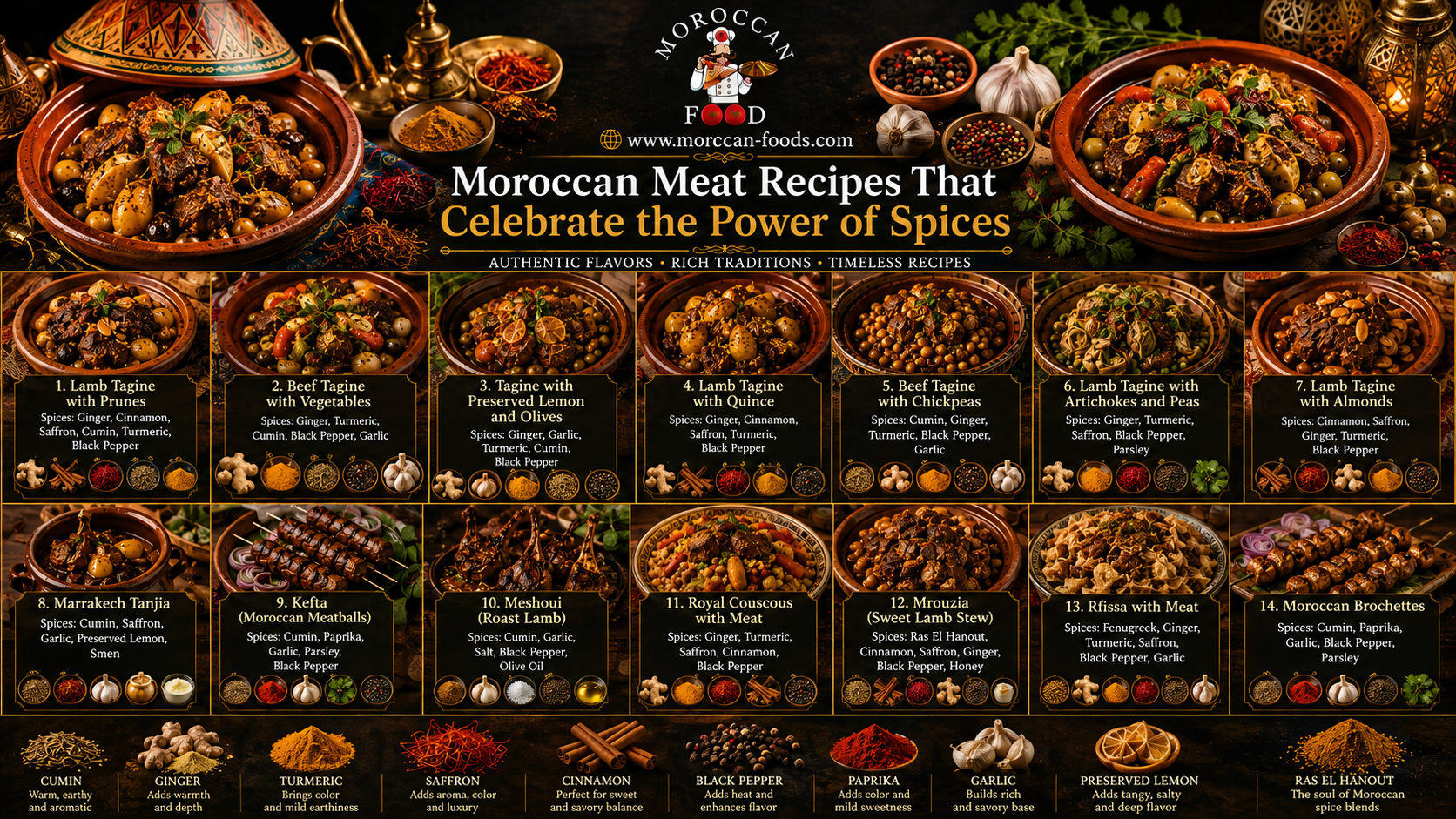
Moroccan chefs believe that marination is not just a step before cooking, but a stage that gives meat its identity and final taste. Spices do not only add aroma; they interact with other ingredients such as garlic, onion, olive oil, and traditional clarified butter (smen) to create a balanced flavor that gradually develops during cooking.
Moroccan marinades are characterized by balance rather than relying on a single overpowering spice. Each ingredient plays a specific role:
- Ginger adds warmth and depth of flavor.
- Turmeric provides a natural golden color.
- Black pepper enhances the taste of meat.
- Cumin adds an earthy richness and reduces strong odors.
- Saffron gives a refined aroma and luxurious color.
- Paprika adds mild sweetness and a warm tone.
- Cinnamon is used in sweet-and-savory dishes such as lamb tagine with prunes.
This philosophy of blending has made Moroccan cuisine one of the most famous in the world for its rich and well-balanced complexity of flavors.
Historical Overview of Spice Use with Meat in Morocco
The use of spices in Morocco dates back centuries, as the country’s geographical location served as a bridge between Africa, Europe, and the Middle East. Morocco was also an important stop along trade routes that transported spices from India and Asia.
Over time, Moroccans combined these imported spices with local ingredients such as olive oil, garlic, onion, coriander, and parsley, creating a unique style of meat seasoning distinct from other cuisines.
Amazigh (Berber), Arab, and Andalusian influences also enriched this culinary heritage, giving rise to traditional recipes still prepared today during celebrations, holidays, and family gatherings, while preserving marination secrets passed down from generation to generation.
The Philosophy of Marination in Moroccan Cuisine
Moroccan marinades are not based on the quantity of ingredients but on selecting the right ingredients for each type of meat and cooking method.
For example:
- Slow-cooked tagines require warm, aromatic spices that develop over time.
- Charcoal-grilled meat needs a balanced marinade that does not burn easily and enhances the natural flavor of the meat.
- Marrakech tanjia relies on a special blend of garlic, cumin, saffron, smen, and preserved lemon to achieve a rich and distinctive taste.
Therefore, there is no single marinade suitable for all dishes; instead, different blends are chosen depending on the recipe and desired outcome.
Most Common Types of Meat in Moroccan Cuisine
Moroccan cuisine is known for its variety of meats, each with its own characteristics that influence spice selection and marination methods.
1. Beef
Beef is the most commonly used meat in daily cooking. It has a balanced flavor and absorbs spices very well, making it ideal for many dishes such as:
- Vegetable meat tagine
- Moroccan couscous
- Grilled meat
- Meatballs (kefta)
- Moroccan stew
Preferred spices include ginger, turmeric, cumin, black pepper, garlic, and parsley.
2. Lamb
Lamb is known for its rich taste and natural fat, which gives it tenderness and a distinctive flavor. It is widely used in:
- Lamb tagine with prunes
- Quince tagine
- Moroccan grilled lamb
- Eid celebrations
- Family gatherings
It is usually seasoned with cumin, ginger, saffron, garlic, and smen, sometimes with hints of cinnamon in certain recipes.
3. Camel Meat
Camel meat is popular in some regions of Morocco, especially in the south and desert areas. It has a firm texture and strong flavor, requiring longer marination. It is used in:
- Traditional tagines
- Grilling
- Stews
- Desert regional recipes
4. Goat Meat
Although less common than beef and lamb, goat meat holds a special place in mountainous and rural areas. It has a strong flavor that requires a balanced marinade based on cumin, garlic, coriander, and thyme.
Basic Principles of Moroccan Meat Marination
Moroccan chefs follow several key rules to achieve the best results:
Choosing Fresh Meat
The fresher the meat, the better it absorbs the marinade, resulting in a more tender and flavorful dish.
Using Freshly Ground Spices
Grinding spices just before use preserves their aromatic oils, giving the dish a stronger aroma and deeper taste.
Balancing Spices
Overusing a single spice can overpower other flavors. Moroccan cuisine relies on balance rather than quantity.
Allowing Enough Marination Time
The longer the marination (within reasonable limits), the more the meat absorbs flavors, especially in large cuts and slow cooking.
Choosing the Right Marinade for the Cooking Method
A tagine marinade is not necessarily suitable for grilling or oven cooking, as each method requires different moisture levels and spice compositions.
Why Does Each Moroccan Recipe Have a Different Marinade?
Although ginger, cumin, and turmeric are common in many Moroccan dishes, the secret lies in proportions and blending techniques.
For example:
- In lamb tagine with prunes, cinnamon and saffron are added to balance sweet and savory flavors.
- Grilled meat focuses on cumin, black pepper, and garlic to highlight the natural taste of the meat.
- Marrakech tanjia uses a rich mixture of garlic, smen, preserved lemon, and saffron, with long slow cooking that produces extremely tender meat and deep flavor.
This diversity is what gives each Moroccan dish its unique identity, even when using the same type of meat.
Conclusion of Part One
Meat marination is one of the most important secrets of Moroccan cuisine. It is not simply about adding spices, but a complete culinary art based on carefully selecting ingredients, balancing them, and considering the type of meat and cooking method. By understanding these principles, anyone can prepare authentic Moroccan dishes with the deep flavor and aromatic richness that have made Moroccan cuisine famous for generations.
In Part Two, we will explore in detail all the spices used with meat in Moroccan cuisine, including their properties, benefits, the dishes they suit, ideal quantities, and the most famous traditional spice blends used by Moroccan chefs.
Show(Part Two)
Spices for Meat in Moroccan Cuisine: A Complete Guide to the Most Important Spices and How to Use Them (Part Two)

If meat is the foundation of many Moroccan dishes, then spices are the soul that give it its unique identity. Moroccan cuisine does not rely on the quantity of spices, but rather on carefully selecting them and using them at the right time and in the right way. This is why two dishes made with the same type of meat can taste completely different depending on the spice balance and preparation method.
In this part, we will explore the most commonly used spices with meat in Moroccan cuisine, their roles, the best dishes they suit, and professional tips for using them correctly.
1. Cumin
Cumin is one of the most widely used spices in Moroccan cooking and is almost always present in meat-based dishes, especially lamb and beef.
What does cumin add?
- A warm, earthy flavor to meat.
- Helps reduce strong meat odors.
- Enhances natural taste without overpowering it.
- Blends perfectly with garlic and olive oil.
Common dishes
- Moroccan meatballs (kefta).
- Grilled meat.
- Marrakech tanjia.
- Meat tagine with vegetables.
- Steamed meat (lfour).
- Traditional Moroccan broth.
Professional tip
Add part of the cumin during marination, then sprinkle a small amount after cooking to enhance its aroma.
2. Ground Ginger
Ginger is one of the secrets of Moroccan flavor, giving meat dishes depth without the sharpness of fresh ginger.
Benefits in seasoning
- Adds balanced warmth.
- Enhances other spices.
- Helps tenderize meat during slow cooking.
- Gives tagines a rich taste.
Common uses
- Prune meat tagine.
- Quince tagine.
- Moroccan couscous.
- Mrouzia.
- Traditional broth.
Professional tip
Use ginger in moderation, as too much can make the dish slightly bitter and overpower other spices.
3. Turmeric
Turmeric is known for its beautiful golden color, but it also plays an important role in building flavor.
Key features
- Gives dishes a natural golden color.
- Adds a mild, warm taste.
- Blends well with ginger and black pepper.
Best for
- Tagines.
- Couscous.
- Broths.
- Slow-cooked meat dishes.
Professional tip
Use in small amounts, as excess turmeric can create bitterness and an overly strong color.
4. Black Pepper
Black pepper is an essential ingredient in most Moroccan meat marinades.
Role in dishes
- Enhances the natural flavor of meat.
- Adds mild, balanced heat.
- Boosts the aroma of other spices.
Used with
- Kefta.
- Grilled meat.
- Tagines.
- Tanjia.
- All types of broth.
5. Paprika
Paprika has become a key spice in many modern Moroccan recipes and is also used in traditional dishes for its color and mild flavor.
It adds
- Rich red color.
- Slightly sweet taste.
- Balance with cumin and garlic.
Suitable for
- Grilling.
- Kefta.
- Oven-baked meat.
- Some tagines.
6. Saffron
Saffron is one of the most luxurious spices in the world and holds a special place in Moroccan cuisine, especially in festive dishes.
Why it is used
- Gives a rich golden color.
- Adds a unique, elegant aroma.
- Elevates the dish’s overall quality.
Famous dishes
- Marrakech tanjia.
- Prune meat tagine.
- Quince tagine.
- Festive meat dishes.
- Luxury couscous.
Professional tip
Soak saffron in a little warm water before adding it to release its full color and aroma.
7. Cinnamon
In Moroccan cuisine, cinnamon is not only used in desserts but also plays a key role in savory meat dishes that combine sweet and salty flavors.
It adds
- Warm aromatic depth.
- Balance with dried fruits.
- Rich complexity.
Used in
- Prune meat tagine.
- Mrouzia.
- Quince tagine.
- Festive dishes.
8. Ground Coriander
Although less used than cumin, coriander adds a light citrusy note and a subtle herbal touch.
Suitable for
- Goat meat.
- Grilled meat.
- Broths.
- Light tagines.
9. Nutmeg
Nutmeg is used in very small quantities to add depth and warmth, especially in kefta and minced meat dishes.
Tip
A small pinch is enough, as too much can overpower the dish.
10. Hot Chili
Chili is used according to preference and is more common in regions that enjoy spicy flavors.
Suitable for
- Kefta.
- Grilled meat.
- Some broths.
11. Ras El Hanout
Ras El Hanout is one of the most famous Moroccan spice blends, and its composition varies from region to region and even from family to family.
It may include:
- Cumin.
- Ginger.
- Turmeric.
- Cinnamon.
- Black pepper.
- Paprika.
- Nutmeg.
- Cloves.
- Cardamom.
- Saffron.
- Sweet spices.
- And other aromatic spices.
Used in
- Tagines.
- Couscous.
- Mrouzia.
- Slow-cooked meat.
- Festive dishes.
It is known for creating a complex, balanced flavor without needing many separate spices.
12. Cloves
Cloves are used in very small amounts to add a strong, warm aroma, especially in long-cooked dishes.
Suitable for
- Tanjia.
- Mrouzia.
- Rich tagines.
13. Cardamom
Although less common, cardamom is included in some Ras El Hanout blends and adds a distinctive aromatic note.
14. Fennel Seeds
Fennel seeds are used in some Moroccan regions to add a slightly sweet and fresh flavor, especially with lamb.
15. Anise Seeds
Anise seeds may be used in small amounts in traditional spice blends, especially for festive recipes.
Aromatic Herbs Used with Spices
In addition to spices, Moroccan cuisine relies on fresh herbs that complete the flavor profile, such as:
- Parsley.
- Fresh coriander.
- Thyme.
- Bay leaves.
These herbs add freshness and balance the warm, deep flavors of spices.
How Moroccan Chefs Choose Spices
There is no single spice mix for all dishes. The choice depends on three main factors:
- Type of meat: Lamb requires stronger spices, while beef needs a more balanced mix.
- Cooking method: Tagines differ from grilling or oven cooking.
- Accompanying ingredients: Ingredients like prunes, quince, olives, or chickpeas change the spice balance.
Professional Tips for Using Spices
- Buy spices from trusted sources to ensure quality.
- Store them in airtight glass containers away from light and moisture.
- Grind whole spices just before use whenever possible.
- Avoid using too many spices in one dish; balance is more important than quantity.
- Taste the marinade before cooking (if safe) to adjust seasoning.
Conclusion of Part Two
Spices are the foundation of Moroccan meat seasoning, with each spice playing a specific role in building flavor, color, and aroma. The real secret lies in knowing when, how, and how much to use them—not in overusing them. Mastering this balance allows you to create authentic Moroccan dishes that reflect the richness of the country’s culinary heritage.
In Part Three, we will explore in detail the liquid and fresh ingredients used in meat marinades, such as olive oil, smen (fermented butter), garlic, onion, preserved lemon, and fresh herbs, along with their roles and best uses in traditional Moroccan meat dishes.
Show Part Three
Spices for Meat in Moroccan Cuisine: The Essential Fresh Ingredients Behind Every Authentic Marinade (Part Three)

While spices form the foundation of Moroccan meat seasoning, they cannot create the rich, layered flavors of Moroccan cuisine on their own. The true magic happens when these spices are combined with fresh ingredients such as garlic, onions, olive oil, preserved lemons, herbs, and smen (traditional fermented butter). Together, they transform a simple spice blend into a marinade capable of tenderizing meat, enriching its flavor, and creating the unmistakable aroma of authentic Moroccan cooking.
In this chapter, we explore the essential ingredients that complete Moroccan meat marinades and explain how each contributes to the final dish.
Olive Oil: The Foundation of Every Moroccan Marinade
Extra virgin olive oil is one of the most important ingredients in Moroccan cooking. It acts as more than just a cooking fat—it is the medium that binds spices together and helps them coat every piece of meat evenly.
Why olive oil is essential
- Helps spices adhere to the meat.
- Protects the meat from drying during cooking.
- Carries the aromatic compounds of spices deep into the meat.
- Creates a smoother and richer marinade.
Moroccan cooks typically use high-quality olive oil in:
- Meat tagines.
- Grilled beef and lamb.
- Kefta.
- Oven-roasted meat.
- Slow-cooked stews.
Professional Tip
Avoid using excessive oil. The goal is to lightly coat the meat, not to drown it. Too much oil can prevent spices from penetrating properly.
Garlic: The Heart of Moroccan Meat Flavor
Few ingredients are as important in Moroccan meat dishes as garlic. It provides a savory depth that complements almost every spice used in Moroccan cuisine.
Garlic contributes
- A rich, aromatic flavor.
- Natural meat tenderizing properties.
- Better balance with cumin, ginger, and black pepper.
- Additional complexity during slow cooking.
Fresh garlic is preferred over garlic powder because it releases essential oils that become sweeter and milder as the meat cooks.
Best paired with
- Tanjia.
- Grilled lamb.
- Beef tagine.
- Kefta.
- Moroccan meat skewers.
- Slow-cooked beef.
Onion: Building Natural Sweetness
Onions may seem like a simple ingredient, but they are one of the secrets behind the deep flavor of Moroccan sauces.
As onions cook slowly, they release natural sugars that balance the warmth of spices and create a rich, velvety cooking liquid.
Why onions matter
- Add natural sweetness.
- Increase moisture.
- Create a flavorful cooking base.
- Blend beautifully with saffron and turmeric.
Some traditional tagines use finely grated onions directly in the marinade, while others cook sliced onions underneath the meat to create a flavorful bed during slow cooking.
Preserved Lemon: Morocco’s Signature Ingredient
Preserved lemon is one of the defining ingredients of Moroccan cuisine. Unlike fresh lemons, preserved lemons develop a mellow citrus aroma with a deep savory complexity after being cured in salt.
What preserved lemon adds
- Bright citrus notes.
- Gentle acidity.
- Salty depth.
- A uniquely Moroccan flavor profile.
It pairs especially well with:
- Beef tagines.
- Lamb tagines.
- Chicken dishes.
- Marrakech tanjia.
- Olive-based recipes.
Professional Tip
Only a small quantity is needed. Too much preserved lemon can overpower the delicate spice balance.
Smen (Traditional Fermented Butter)
Smen is one of the oldest ingredients in Moroccan cooking and is especially valued in festive and slow-cooked dishes.
Unlike ordinary butter, smen develops an intense aroma through fermentation and aging.
Why Moroccan chefs use smen
- Adds remarkable richness.
- Creates deep traditional flavor.
- Enhances slow-cooked meat.
- Produces an authentic aroma impossible to achieve with regular butter.
Classic dishes using smen include:
- Marrakech tanjia.
- Mrouzia.
- Festive lamb tagines.
- Royal couscous.
Because of its strong flavor, smen is always used in moderation.
Fresh Parsley
Fresh parsley is much more than a garnish in Moroccan cuisine.
It contributes
- Fresh herbal flavor.
- Natural color.
- Balance for rich meat dishes.
- Aroma that complements garlic and olive oil.
Parsley is often finely chopped and mixed directly into the marinade before cooking.
Fresh Cilantro (Coriander Leaves)
Fresh cilantro is one of Morocco’s most recognizable herbs.
Its bright, citrus-like freshness helps balance rich meat dishes and heavy spices.
It is especially common in:
- Beef tagines.
- Vegetable tagines.
- Meat stews.
- Kefta.
- Slow-cooked sauces.
Many Moroccan chefs combine parsley and cilantro in equal proportions for maximum flavor complexity.
Bay Leaves
Although bay leaves are not always visible in the finished dish, they contribute subtle aromatic notes during long cooking.
They are especially suitable for:
- Beef stews.
- Slow-cooked lamb.
- Traditional broths.
- Rich tagines.
Bay leaves are removed before serving.
Fresh Lemon Juice
Fresh lemon juice is occasionally used in marinades, particularly for grilled meats.
Its acidity helps
- Brighten flavors.
- Tenderize meat slightly.
- Balance fatty cuts.
However, unlike preserved lemons, fresh lemon juice should not remain in contact with meat for excessive periods, as prolonged exposure can affect texture.
Vinegar
Some Moroccan households add a small amount of vinegar when marinating tougher cuts of beef.
The acidity can help soften connective tissue while adding a subtle sharpness.
Apple cider vinegar and white vinegar are both occasionally used, though only in small quantities.
Water and Stock
While not technically marinade ingredients, small amounts of water or homemade stock are often added during cooking to help spices dissolve evenly and create a flavorful sauce.
Homemade beef stock provides much greater depth than plain water.
The Perfect Balance Between Dry and Wet Ingredients
An authentic Moroccan marinade is never simply a mixture of spices.
Instead, it combines:
- Dry spices for flavor.
- Fresh herbs for brightness.
- Garlic and onion for depth.
- Olive oil for richness.
- A small amount of liquid to bind everything together.
When properly mixed, the marinade should form a thick aromatic paste that clings evenly to every piece of meat.
Professional Marinade Ratios
Although every family has its own traditions, experienced Moroccan cooks generally aim for a balanced marinade where:
- Olive oil lightly coats the meat without making it greasy.
- Garlic enhances rather than dominates.
- Onion contributes moisture without becoming watery.
- Herbs remain fresh and vibrant.
- Spices complement one another instead of competing.
The result is a marinade that develops slowly during cooking, producing layers of flavor rather than a single overpowering taste.
Common Mistakes When Preparing Moroccan Marinades
Even excellent ingredients can produce disappointing results if used incorrectly.
Some common mistakes include:
- Using stale spices.
- Adding excessive oil.
- Overusing garlic.
- Using too much preserved lemon.
- Forgetting to finely chop fresh herbs.
- Marinating meat for too short a time.
- Using poor-quality olive oil.
Avoiding these mistakes greatly improves the final flavor and texture of Moroccan meat dishes.
Conclusion of Part Three
The true richness of Moroccan meat marinades comes not only from carefully selected spices but also from the harmonious combination of fresh ingredients that build flavor layer by layer. Olive oil binds the marinade, garlic and onion provide depth, herbs add freshness, preserved lemon introduces brightness, and smen contributes unmistakable traditional richness. Together, these ingredients create the foundation upon which Morocco’s most iconic meat dishes are built.
In Part Four, we will focus on how to marinate each type of meat individually, including beef, lamb, goat, and camel meat. You’ll learn the ideal spice combinations, recommended marinating times, cooking techniques, and professional chef secrets for achieving perfectly tender, flavorful meat every time.
Show Part Four
Spices for Meat in Moroccan Cuisine: How to Marinate Every Type of Meat Like a Moroccan Chef (Part Four)

One of the greatest secrets of Moroccan cuisine is that there is no universal marinade. Every type of meat has its own texture, fat content, flavor intensity, and cooking characteristics, requiring a carefully balanced combination of spices and fresh ingredients.
Experienced Moroccan cooks never season beef, lamb, goat, or camel meat in exactly the same way. Instead, they adjust the spice blend, the amount of fat, the marinating time, and even the cooking method to bring out the best qualities of each meat.
In this chapter, you’ll learn how Moroccan chefs approach every major type of meat and how to create authentic marinades that maximize flavor while preserving the natural character of the meat.
Beef: The Most Versatile Choice
Beef is the most widely used meat in everyday Moroccan cooking because of its balanced flavor and ability to absorb seasonings without becoming overpowering.
Unlike stronger meats, beef benefits from spice blends that enhance rather than mask its natural taste.
Characteristics of Beef
- Mild, balanced flavor.
- Moderate fat content depending on the cut.
- Excellent spice absorption.
- Suitable for both quick and slow cooking.
Traditional Moroccan Marinade for Beef
Typical ingredients include:
- Olive oil
- Garlic
- Fresh parsley
- Fresh cilantro
- Ground ginger
- Ground turmeric
- Ground cumin
- Black pepper
- Sweet paprika
- Salt
For festive dishes, saffron is often added to create a richer aroma and a beautiful golden color.
Best Cooking Methods
This marinade works particularly well for:
- Beef tagines.
- Couscous.
- Moroccan beef stew.
- Oven-roasted beef.
- Beef kebabs.
- Kefta.
Recommended Marinating Time
| Beef Cut | Recommended Time |
|---|---|
| Thin slices | 1–2 hours |
| Cubes for tagine | 4–8 hours |
| Large roasting cuts | Overnight |
| Kefta | 30 minutes to 2 hours |
Longer marinating times allow spices to penetrate deeper into larger cuts without overwhelming the meat.
Lamb: Rich Flavor Requires Balance
Lamb is one of Morocco’s most celebrated meats. Its natural richness allows it to stand up to more aromatic spices while still maintaining its distinctive character.
The goal is not to hide lamb’s flavor but to complement it.
Characteristics of Lamb
- Rich natural flavor.
- Higher fat content.
- Extremely tender when slow cooked.
- Perfect for festive dishes.
Traditional Moroccan Marinade for Lamb
A classic blend often includes:
- Olive oil
- Garlic
- Cumin
- Ginger
- Black pepper
- Turmeric
- Saffron
- Fresh parsley
- Fresh cilantro
For dishes such as lamb tagine with prunes, cinnamon is added to create the signature sweet-and-savory balance.
Best Cooking Methods
Ideal for:
- Lamb tagine with prunes.
- Quince tagine.
- Roasted lamb shoulder.
- Grilled lamb.
- Mrouzia.
- Festive couscous.
Recommended Marinating Time
| Lamb Cut | Recommended Time |
|---|---|
| Chops | 2–4 hours |
| Cubes | 6–12 hours |
| Shoulder | Overnight |
| Leg of lamb | 12–24 hours |
Because lamb contains more fat than beef, it develops even deeper flavor during extended marination.
Goat Meat: Bold but Delicate
Goat meat has a stronger flavor than beef but is leaner than lamb.
Moroccan cooks use carefully balanced spice blends that soften its intensity without hiding its distinctive taste.
Characteristics of Goat Meat
- Lean.
- Firm texture.
- Slightly earthy flavor.
- Excellent for slow cooking.
Traditional Marinade
Common ingredients include:
- Olive oil
- Garlic
- Ground cumin
- Ground coriander
- Ginger
- Black pepper
- Bay leaf
- Fresh parsley
Some regions also include thyme for additional herbal aroma.
Best Uses
- Mountain tagines.
- Rural stews.
- Slow-cooked casseroles.
- Traditional village recipes.
Recommended Marinating Time
Goat meat benefits from longer marination than beef.
Typical times range from:
- 8 hours for smaller pieces.
- Up to 24 hours for larger cuts.
Camel Meat: The Desert Specialty
Camel meat is highly valued in southern Morocco and Saharan regions.
Its firm texture requires patience, both during marination and cooking.
Characteristics
- Dense muscle fibers.
- Low fat content.
- Strong flavor.
- Excellent for long cooking.
Traditional Marinade
Typical ingredients include:
- Olive oil.
- Garlic.
- Cumin.
- Ginger.
- Black pepper.
- Turmeric.
- Paprika.
- Fresh herbs.
Some families add a small amount of vinegar to help tenderize tougher cuts.
Best Cooking Methods
Camel meat is traditionally used in:
- Desert tagines.
- Slow-cooked stews.
- Clay pot cooking.
- Charcoal grilling after long marination.
Recommended Marinating Time
Because of its firmness:
- Small pieces: 12 hours.
- Large cuts: 24 hours or longer.
Choosing the Right Marinade for the Cooking Method
Even the same meat requires different marinades depending on how it will be cooked.
For Tagines
Marinades should contain:
- Olive oil.
- Garlic.
- Fresh herbs.
- Moist spices.
- Aromatics that develop slowly.
These ingredients create flavorful cooking juices during the long simmering process.
For Grilling
Grilled meats benefit from:
- Slightly less onion.
- Moderate olive oil.
- Cumin.
- Paprika.
- Black pepper.
- Garlic.
Heavy marinades with excessive moisture may burn over charcoal.
For Oven Roasting
Roasted meats require:
- Olive oil.
- Butter or smen for richness.
- Garlic.
- Balanced spices.
- Herbs that withstand prolonged heat.
Should Salt Be Added Before Marinating?
This is one of the most debated questions in cooking.
In Moroccan kitchens, the answer depends on the recipe.
For slow-cooked tagines, salt is usually added during marination because it gradually seasons the meat throughout cooking.
For certain grilled meats, some cooks prefer adding part of the salt shortly before cooking to help preserve surface moisture.
Both methods are traditional, and the choice often depends on family preference and the specific recipe.
How Long Is Too Long?
Long marination improves flavor—but only up to a point.
Very acidic marinades left for excessive periods can eventually affect the texture of meat.
Traditional Moroccan marinades rely primarily on spices, herbs, garlic, and olive oil rather than strong acids, allowing longer marination without compromising texture.
Professional Moroccan Chef Tips
Experienced Moroccan cooks often follow several simple but effective rules:
- Always marinate meat under refrigeration.
- Bring meat closer to room temperature before cooking.
- Massage the marinade thoroughly into every surface.
- Cover the container tightly to preserve aromas.
- Turn large cuts once or twice during marination.
- Never reuse raw marinade unless it has been thoroughly cooked.
Summary Table
| Meat Type | Flavor Intensity | Best Cooking Style | Typical Marinating Time |
|---|---|---|---|
| Beef | Mild | Tagines, grilling, roasting | 2–12 hours |
| Lamb | Rich | Tagines, roasting, couscous | 6–24 hours |
| Goat | Medium-strong | Slow cooking | 8–24 hours |
| Camel | Strong | Long cooking, grilling | 12–24+ hours |
Conclusion of Part Four
Mastering Moroccan meat marinades begins with understanding that each type of meat deserves its own approach. Beef rewards balanced seasoning, lamb shines with aromatic spices, goat benefits from herbal freshness, and camel meat develops remarkable depth through patience and slow cooking. By adapting your marinade to both the meat and the cooking method, you can achieve the authentic flavors that define Morocco’s culinary heritage.
In Part Five, we’ll begin exploring Morocco’s most famous meat dishes one by one, starting with the country’s legendary tagines. You’ll discover the traditional marinade, spice ratios, cooking techniques, and regional variations behind classics such as Lamb Tagine with Prunes, Beef Tagine with Vegetables, Tagine with Preserved Lemons and Olives, Quince Tagine, and many more.
Show part Five
Spices for Meat in Moroccan Cuisine: Traditional Seasoning Secrets Behind Morocco’s Most Famous Tagines (Part Five)

Few dishes represent Moroccan cuisine as perfectly as the tagine. Named after the iconic earthenware cooking vessel in which it is prepared, the tagine is much more than a slow-cooked stew—it is a culinary tradition where spices, herbs, fresh ingredients, and time work together to create extraordinary depth of flavor.
Unlike many cuisines that rely on a single spice blend, Moroccan tagines use carefully balanced seasonings that change depending on the type of meat and accompanying ingredients. Every tagine has its own identity, and each requires a unique approach to marination.
In this chapter, we explore the spice combinations behind Morocco’s most famous meat tagines.
Lamb Tagine with Prunes (Tagine Barkouk)
Perhaps no Moroccan dish is more internationally recognized than Lamb Tagine with Prunes. It perfectly illustrates Morocco’s mastery of balancing sweet and savory flavors.
The rich flavor of lamb is complemented by caramelized prunes, toasted almonds, honey, and warm spices that create remarkable complexity.
Traditional Spice Blend
The classic seasoning typically includes:
- Ground ginger
- Ground cumin
- Turmeric
- Black pepper
- Saffron
- Cinnamon
- Garlic
- Olive oil
- Fresh parsley
- Fresh cilantro
- Salt
Cinnamon is not mixed heavily into the meat itself. Instead, it becomes increasingly important during the finishing stage when the prunes are cooked with honey and cinnamon, allowing sweet aromas to blend naturally with the savory sauce.
Why This Blend Works
Each ingredient has a purpose:
- Ginger builds warmth.
- Saffron creates elegance.
- Cinnamon balances sweetness.
- Cumin enhances the lamb.
- Garlic deepens the savory profile.
The result is one of Morocco’s most refined traditional dishes.
Beef Tagine with Vegetables
This everyday family favorite showcases the natural flavor of beef rather than overpowering it.
Seasoning focuses on freshness and balance.
Traditional Spice Blend
Common ingredients include:
- Ginger
- Turmeric
- Black pepper
- Cumin
- Garlic
- Olive oil
- Parsley
- Cilantro
- Salt
Unlike sweeter tagines, cinnamon is generally omitted because the vegetables already contribute natural sweetness.
Common Vegetables
Depending on the season, cooks may include:
- Potatoes
- Carrots
- Zucchini
- Tomatoes
- Turnips
- Pumpkin
- Green beans
- Peas
The vegetables slowly absorb the aromatic cooking liquid, becoming as flavorful as the meat itself.
Lamb Tagine with Quince
Quince is one of Morocco’s most treasured autumn fruits.
When cooked slowly, it develops a delicate sweetness that pairs beautifully with lamb.
Traditional Seasoning
The spice blend usually includes:
- Ginger
- Turmeric
- Saffron
- Black pepper
- Cinnamon
- Garlic
- Olive oil
Unlike prune tagine, honey is often used more sparingly, allowing the natural sweetness of the quince to shine.
Beef Tagine with Olives and Preserved Lemon
This dish demonstrates another defining characteristic of Moroccan cuisine—the harmony between savory, salty, and citrus flavors.
Traditional Marinade
Typical ingredients include:
- Ginger
- Turmeric
- Black pepper
- Garlic
- Olive oil
- Fresh parsley
- Fresh cilantro
During cooking, preserved lemons and green olives gradually infuse the sauce with bright, complex flavors.
Because preserved lemons already contain salt, experienced cooks adjust seasoning carefully throughout cooking rather than adding excessive salt at the beginning.
Beef Tagine with Chickpeas
This comforting dish is especially popular during colder months.
Chickpeas absorb the aromatic broth while adding richness and texture.
Traditional Spice Blend
The seasoning often consists of:
- Ground ginger
- Turmeric
- Black pepper
- Cumin
- Garlic
- Olive oil
- Fresh herbs
The spice profile remains relatively simple, allowing the natural flavors of the beef and chickpeas to dominate.
Lamb Tagine with Artichokes and Peas
A springtime classic in many Moroccan homes.
The delicate vegetables require lighter seasoning than heavier winter tagines.
Traditional Seasoning
Common ingredients include:
- Ginger
- Turmeric
- Black pepper
- Garlic
- Olive oil
- Fresh parsley
- Cilantro
- Saffron
The result is a fresh, vibrant tagine with a bright golden sauce.
Lamb Tagine with Almonds
Prepared mainly during celebrations and family gatherings, this luxurious dish combines tender lamb with toasted almonds.
Traditional Spice Blend
Typical seasonings include:
- Ginger
- Turmeric
- Black pepper
- Saffron
- Cinnamon
- Garlic
- Olive oil
Toasted almonds are added near the end of cooking to preserve their texture and aroma.
Regional Variations Across Morocco
One fascinating aspect of Moroccan cuisine is that the same tagine often tastes different depending on the region.
Marrakech
Marrakech cooks frequently use:
- Preserved lemons.
- Saffron.
- Smen.
- Rich aromatic spice blends.
Their tagines tend to have deep, luxurious flavors developed through long cooking.
Fez
Fassi cuisine is known for elegant spice combinations and refined sweet-and-savory dishes.
Tagines from Fez often feature:
- Cinnamon.
- Almonds.
- Prunes.
- Orange blossom water.
- Saffron.
The balance is delicate rather than heavy.
The Atlas Mountains
Mountain communities prepare simpler tagines using locally available ingredients.
Seasonings often emphasize:
- Garlic.
- Cumin.
- Fresh herbs.
- Olive oil.
The flavors are rustic, bold, and deeply satisfying.
Southern Morocco
In desert regions, stronger meats such as camel or goat are more common.
Seasoning often includes:
- Cumin.
- Paprika.
- Ginger.
- Garlic.
- Preserved butter (smen).
These dishes are designed for long, slow cooking.
Why Tagine Seasoning Is Different from Other Moroccan Meat Dishes
Unlike grilled meats or quick-cooked recipes, tagines cook slowly over gentle heat.
This allows spices to evolve gradually.
Instead of producing sharp, immediate flavors, the spices dissolve into the cooking liquid, creating a silky sauce that coats every ingredient.
For this reason, Moroccan tagines typically rely on:
- Moderate spice quantities.
- Fresh herbs.
- High-quality olive oil.
- Patience.
Time becomes one of the most important ingredients.
Professional Chef Tips
Experienced Moroccan cooks often follow these principles when preparing tagines:
- Brown the onions before adding liquid to develop sweetness.
- Avoid excessive stirring once the tagine begins simmering.
- Add delicate herbs near the beginning rather than the end so they fully perfume the sauce.
- Taste the sauce during cooking and adjust seasoning gradually.
- Allow the tagine to rest for several minutes before serving to let the flavors settle.
Summary Table
| Moroccan Tagine | Main Meat | Signature Spices | Defining Flavor |
|---|---|---|---|
| Lamb with Prunes | Lamb | Ginger, cinnamon, saffron, cumin | Sweet and savory |
| Beef with Vegetables | Beef | Ginger, turmeric, cumin | Balanced and hearty |
| Lamb with Quince | Lamb | Ginger, cinnamon, saffron | Fruity and aromatic |
| Beef with Olives | Beef | Ginger, turmeric, garlic | Savory and citrusy |
| Beef with Chickpeas | Beef | Ginger, cumin, turmeric | Rich and comforting |
| Lamb with Artichokes | Lamb | Saffron, ginger, herbs | Fresh and delicate |
| Lamb with Almonds | Lamb | Cinnamon, saffron, ginger | Elegant and festive |
Conclusion of Part Five
Moroccan tagines demonstrate the extraordinary versatility of the country’s spice traditions. Each recipe uses familiar ingredients—ginger, cumin, turmeric, saffron, garlic, olive oil, and fresh herbs—but adjusts their proportions to suit the meat, vegetables, fruits, and cooking time. This careful balance is what gives every tagine its own unmistakable personality while remaining unmistakably Moroccan.
In Part Six, we will move beyond tagines and explore the traditional spice blends used in Morocco’s other legendary meat dishes, including Marrakech Tanjia, Kefta, Meshoui, Royal Couscous with Meat, Mrouzia, Rfissa with Meat, and several regional specialties that showcase the remarkable diversity of Moroccan meat cuisine.
Show part sex
Spices for Meat in Moroccan Cuisine: Traditional Seasonings Behind Morocco’s Most Iconic Meat Dishes (Part Six)

While tagines are the best-known symbol of Moroccan cuisine, they represent only one chapter of Morocco’s rich culinary heritage. Across the country, every region has developed its own signature meat dishes, each with carefully balanced spice blends and cooking techniques that have been preserved for generations.
From the famous Marrakech Tanjia to smoky Meshoui, flavorful Kefta, and festive Mrouzia, every recipe demonstrates how Moroccan cooks use spices to complement—not overpower—the natural character of the meat.
In this chapter, we explore the traditional seasoning secrets behind Morocco’s most celebrated meat dishes.
Marrakech Tanjia
Tanjia is one of Morocco’s most legendary meat dishes and a culinary symbol of Marrakech. Traditionally cooked for many hours in a clay pot, it develops incredibly tender meat with a deep, aromatic sauce.
Traditional Spice Blend
A classic Tanjia marinade typically includes:
- Ground cumin
- Ground ginger
- Turmeric
- Black pepper
- Saffron
- Garlic
- Preserved lemon
- Smen (fermented butter)
- Olive oil
- Salt
Unlike many tagines, Tanjia relies on a relatively small number of spices, allowing slow cooking to develop extraordinary depth of flavor.
Chef’s Secret
The distinctive taste comes from the combination of preserved lemon and smen rather than from using a large quantity of spices.
Moroccan Kefta
Kefta is one of the most versatile dishes in Moroccan cuisine. It can be grilled, cooked in tomato sauce, served in tagines, or shaped into skewers.
Because kefta is made from minced meat, the spices are mixed directly into the meat, ensuring even flavor throughout.
Traditional Seasoning
Typical ingredients include:
- Ground cumin
- Sweet paprika
- Black pepper
- Ground ginger
- Garlic
- Fresh parsley
- Fresh cilantro
- Olive oil
- Salt
Some families also add a small pinch of cinnamon or Ras El Hanout for additional complexity.
Meshoui (Moroccan Roast Lamb)
Meshoui is traditionally prepared for weddings, religious celebrations, and large family gatherings.
Unlike many Moroccan recipes, Meshoui celebrates the natural flavor of lamb rather than masking it with heavy seasoning.
Traditional Seasoning
The classic preparation often includes only:
- Ground cumin
- Salt
- Black pepper
- Garlic
- Olive oil
- Smen (optional)
After roasting, diners often dip pieces of lamb into a simple mixture of cumin and salt, a tradition found throughout Morocco.
Royal Moroccan Couscous with Meat
Couscous is considered Morocco’s national dish and is traditionally served on Fridays and during celebrations.
The meat, vegetables, and broth are seasoned separately to produce balanced flavors.
Traditional Spice Blend
Common seasonings include:
- Ground ginger
- Turmeric
- Black pepper
- Saffron
- Garlic
- Olive oil
- Fresh parsley
- Fresh cilantro
The broth should be aromatic and delicate rather than heavily spiced.
Mrouzia
Mrouzia is one of Morocco’s oldest festive dishes, traditionally prepared during Eid al-Adha.
It is famous for combining savory meat with honey, raisins, and warm spices.
Traditional Spice Blend
Typical ingredients include:
- Ras El Hanout
- Cinnamon
- Ginger
- Saffron
- Black pepper
- Garlic
- Smen
- Olive oil
The balance between sweetness and spice is the defining feature of this historic dish.
Rfissa with Meat
Rfissa is a comforting family meal consisting of shredded msemen or trid pastry topped with meat, lentils, and a fragrant broth.
Its seasoning is more aromatic than spicy.
Traditional Seasoning
The spice blend usually includes:
- Ginger
- Turmeric
- Black pepper
- Fenugreek seeds
- Saffron
- Garlic
- Fresh herbs
Fenugreek gives Rfissa its distinctive aroma and sets it apart from other Moroccan dishes.
Moroccan Meat Broth (Marqa)
Marqa forms the base of many traditional meals and is valued for its rich yet balanced flavor.
Traditional Seasoning
Typical ingredients include:
- Ginger
- Turmeric
- Black pepper
- Garlic
- Olive oil
- Fresh parsley
- Fresh cilantro
The seasoning is intentionally simple, allowing the broth to complement a wide variety of vegetables and legumes.
Brochettes (Moroccan Meat Skewers)
Brochettes are popular street food and are also common at family barbecues.
Because they cook quickly over charcoal, the marinade is designed to enhance the meat without burning.
Traditional Marinade
Common ingredients include:
- Olive oil
- Garlic
- Cumin
- Paprika
- Black pepper
- Fresh parsley
- Salt
The meat is usually marinated for several hours before grilling.
Regional Specialties
Northern Morocco
Northern recipes often feature lighter spice blends with greater use of fresh herbs and olive oil.
Central Morocco
The heart of the country is known for balanced combinations of cumin, ginger, turmeric, saffron, and garlic that form the backbone of many classic recipes.
Southern Morocco
Southern dishes often use stronger seasonings for camel and goat meat, including:
- Cumin
- Paprika
- Ginger
- Garlic
- Smen
These dishes are typically cooked slowly to develop rich, concentrated flavors.
Why Moroccan Recipes Use Different Spice Ratios
Although many dishes share the same core spices, each recipe changes the proportions to achieve a unique result.
For example:
- Tanjia emphasizes preserved lemon and smen.
- Kefta highlights cumin and paprika.
- Meshoui relies on simplicity.
- Mrouzia combines cinnamon with honey and Ras El Hanout.
- Couscous favors delicate, fragrant broth rather than bold spice intensity.
This flexibility allows Moroccan cuisine to create remarkable diversity using a familiar pantry of ingredients.
Professional Chef Tips
Experienced Moroccan cooks often recommend:
- Toast whole spices lightly before grinding them for maximum aroma.
- Prepare fresh herb mixtures immediately before use.
- Add saffron after soaking it in warm water.
- Allow roasted meats to rest before carving.
- Taste sauces during cooking and adjust seasoning gradually rather than adding large amounts at once.
Summary Table
| Moroccan Dish | Main Meat | Signature Seasoning | Defining Character |
|---|---|---|---|
| Marrakech Tanjia | Beef or Lamb | Cumin, saffron, preserved lemon, smen | Deep, slow-cooked flavor |
| Kefta | Beef or Lamb | Cumin, paprika, garlic | Bold and aromatic |
| Meshoui | Lamb | Cumin, garlic, salt | Pure roasted lamb flavor |
| Royal Couscous | Beef or Lamb | Ginger, turmeric, saffron | Delicate and balanced |
| Mrouzia | Lamb | Ras El Hanout, cinnamon, honey | Sweet and savory |
| Rfissa | Chicken or Meat | Fenugreek, ginger, saffron | Rich and comforting |
| Brochettes | Beef or Lamb | Cumin, paprika, garlic | Smoky and flavorful |
Conclusion of Part Six
Morocco’s famous meat dishes demonstrate that great cooking is not about using the greatest number of spices but about using the right spices in the right proportions. Whether preparing the luxurious aroma of Marrakech Tanjia, the rustic simplicity of Meshoui, the vibrant flavor of Kefta, or the festive richness of Mrouzia, every recipe reflects centuries of culinary knowledge and regional tradition.
In Part Seven, we will reveal the professional techniques used by Moroccan chefs to create unforgettable meat dishes, including the correct order for adding spices, when to season with salt, how to achieve deep color naturally, how to maximize tenderness, and the traditional cooking methods that unlock the full potential of Moroccan spice blends.
show part seven
Spices for Meat in Moroccan Cuisine: Professional Techniques for Perfect Seasoning and Flavor Development (Part Seven)

Mastering Moroccan meat dishes is about much more than knowing which spices to use. Professional Moroccan cooks understand that timing, technique, temperature, and patience are just as important as the ingredients themselves. The same spice blend can produce dramatically different results depending on when it is added, how the meat is prepared, and how the dish is cooked.
In this chapter, you’ll discover the professional methods used in Moroccan kitchens to build deep, authentic flavors and consistently tender meat.
Layering Flavors Instead of Adding Everything at Once
One of the defining characteristics of Moroccan cooking is the gradual development of flavor.
Rather than combining every ingredient at once and hoping for the best, experienced cooks build flavor in layers.
A typical sequence looks like this:
- Coat the meat with the marinade.
- Brown onions and aromatics.
- Add the marinated meat.
- Allow the spices to bloom gently in the cooking fat.
- Add liquid only after the spices become fragrant.
- Introduce delicate ingredients later in the cooking process.
This gradual approach creates a sauce with remarkable depth instead of a flat, one-dimensional flavor.
The Correct Order for Adding Ingredients
Although every recipe is unique, most traditional Moroccan meat dishes follow a similar order.
Step 1 — Prepare the Marinade
Combine:
- Olive oil
- Garlic
- Fresh herbs
- Dry spices
Massage the mixture thoroughly into the meat.
Step 2 — Allow the Meat to Rest
Marinating allows the spices to penetrate the surface while olive oil carries aromatic compounds deeper into the meat.
Skipping this stage often produces meat that tastes seasoned only on the outside.
Step 3 — Build the Aromatic Base
Most tagines begin by slowly cooking onions.
This stage creates natural sweetness that balances warming spices like ginger and cumin.
Step 4 — Brown the Meat
Gentle browning develops complex roasted flavors through caramelization.
The goal is light golden color—not deep frying.
Step 5 — Slow Cooking
Once liquid is added, patience becomes essential.
Low heat allows spices to blend gradually while collagen breaks down into rich gelatin.
Why Low Heat Produces Better Flavor
Traditional Moroccan cooking favors gentle heat over aggressive boiling.
Slow cooking offers several advantages:
- Prevents meat from drying out.
- Gives spices time to release aromatic oils.
- Produces silky sauces.
- Creates exceptionally tender meat.
- Allows vegetables to absorb flavor naturally.
This explains why authentic tagines often cook for several hours.
The Secret Behind Tender Moroccan Meat
Many visitors to Morocco notice that restaurant and home-cooked meat is remarkably tender.
The secret is rarely a special ingredient.
Instead, tenderness comes from combining several traditional techniques:
- Choosing suitable cuts.
- Proper marination.
- Gentle cooking.
- Adequate cooking time.
- Maintaining moisture.
Every step contributes to the final texture.
When Should Salt Be Added?
Salt timing depends on the cooking method.
Slow-Cooked Tagines
Salt is commonly included in the marinade because long cooking distributes seasoning evenly throughout the dish.
Grilled Meat
Some Moroccan grill masters season lightly before cooking and make final adjustments immediately after grilling.
This approach preserves surface moisture while maintaining strong flavor.
Why Moroccan Chefs Rarely Overuse Spices
One misconception about Moroccan cuisine is that it depends on large quantities of spices.
In reality, professional cooks focus on balance.
Too much ginger masks saffron.
Too much cumin hides the sweetness of onions.
Too much cinnamon dominates delicate sauces.
Each spice has a purpose, and every ingredient should remain recognizable in the finished dish.
Fresh Herbs: Timing Matters
Fresh parsley and cilantro are central to Moroccan cooking.
However, their flavor changes dramatically depending on when they are added.
Early Addition
Cooking herbs from the beginning allows them to perfume the sauce deeply.
Late Addition
Adding herbs near the end preserves brighter, fresher aromas.
Many chefs use both techniques, adding some herbs at the beginning and reserving the rest for the final minutes.
How Moroccan Chefs Achieve Rich Color Naturally
Authentic Moroccan dishes rarely rely on artificial coloring.
Instead, beautiful color develops naturally through ingredients such as:
- Turmeric.
- Saffron.
- Paprika.
- Slowly caramelized onions.
- Olive oil.
- Meat juices.
These ingredients create warm golden, amber, and reddish tones without overwhelming the flavor.
Why Resting the Meat Is Important
Whether roasting or grilling, experienced Moroccan cooks allow meat to rest before serving.
Resting helps:
- Redistribute juices.
- Preserve tenderness.
- Improve texture.
- Enhance overall flavor.
Cutting meat immediately after cooking causes valuable juices to escape.
Matching Spices to Cooking Time
Some spices tolerate long cooking exceptionally well.
Ideal for long cooking:
- Ginger.
- Turmeric.
- Cumin.
- Black pepper.
- Garlic.
Others require more careful timing.
For example:
- Cinnamon often finishes sweet tagines.
- Fresh herbs may be divided between the beginning and end.
- Preserved lemon is frequently added later to preserve its bright aroma.
The Importance of Clay Tagines
Traditional clay tagines cook differently from metal cookware.
Their heavy ceramic walls distribute heat slowly and evenly, preventing rapid boiling.
This gentle cooking environment allows spices to infuse the meat gradually while reducing moisture loss.
Although excellent results can be achieved with modern cookware, clay tagines remain one of the defining features of authentic Moroccan cuisine.
Common Mistakes That Reduce Flavor
Even quality ingredients cannot compensate for poor technique.
Common mistakes include:
- Cooking over high heat.
- Skipping marination.
- Adding too much water.
- Overcrowding the pot.
- Using stale spices.
- Constantly stirring the tagine.
- Cooking too quickly.
Avoiding these mistakes dramatically improves the final dish.
Professional Moroccan Kitchen Tips
Experienced Moroccan cooks often recommend:
- Grind spices shortly before use whenever possible.
- Allow refrigerated meat to warm slightly before cooking.
- Taste sauces gradually rather than correcting everything at once.
- Use fresh herbs generously but thoughtfully.
- Let spices bloom gently in oil instead of scorching them.
- Keep the cooking temperature steady throughout the process.
- Never rush a traditional tagine.
Summary Table
| Technique | Why It Matters | Result |
|---|---|---|
| Marinate before cooking | Allows flavors to penetrate | Richer seasoning |
| Brown onions slowly | Develops natural sweetness | More complex sauce |
| Cook over low heat | Preserves moisture | Tender meat |
| Bloom spices gently | Releases aromatic oils | Deeper flavor |
| Rest cooked meat | Redistributes juices | Better texture |
| Use fresh herbs wisely | Adds freshness and aroma | Balanced finish |
Traditional Moroccan Cooking Philosophy
Perhaps the greatest lesson Moroccan cuisine teaches is that exceptional flavor cannot be rushed.
Time is treated as an ingredient.
Spices are selected with purpose.
Fresh herbs provide balance.
Gentle heat develops complexity.
Patience transforms simple ingredients into memorable meals.
This philosophy explains why traditional Moroccan meat dishes continue to captivate cooks and food lovers around the world.
Conclusion of Part Seven
Authentic Moroccan meat dishes are the result of careful technique as much as carefully selected spices. By understanding when to marinate, how to layer flavors, when to add herbs, how to control heat, and why patience matters, anyone can recreate the rich aromas and remarkable depth that define Morocco’s culinary tradition.
In Part Eight, we’ll explore the most common seasoning mistakes people make when preparing Moroccan meat dishes, explain how to avoid them, and share expert solutions that ensure consistently delicious results every time.
Show part Eight
Spices for Meat in Moroccan Cuisine: Common Seasoning Mistakes and How Moroccan Chefs Avoid Them (Part Eight)

Even when using high-quality meat and authentic Moroccan spices, small mistakes during seasoning or cooking can significantly affect the final result. Meat may become dry, sauces may lose their balance, or the delicate aroma of saffron and herbs may disappear altogether.
The good news is that most of these problems are easy to avoid. Experienced Moroccan cooks rely on a few simple principles that preserve the natural flavor of the meat while allowing every spice to contribute its intended role.
In this chapter, we explore the most common mistakes made when preparing Moroccan meat dishes and explain the traditional techniques that consistently produce better results.
Mistake 1: Using Too Many Spices
Many people assume that Moroccan cuisine is famous because it uses a large number of spices.
In reality, Moroccan cooking is famous because it uses spices in balance.
Adding excessive amounts of cumin, ginger, turmeric, cinnamon, or Ras El Hanout creates competition rather than harmony.
The result is often:
- A muddy flavor.
- Loss of the meat’s natural taste.
- Overpowering aromas.
- Difficulty identifying individual ingredients.
Professional Solution
Use each spice with a clear purpose.
Every ingredient should support the others rather than dominate the dish.
Mistake 2: Marinating for Too Short a Time
Spices need time to interact with the meat.
Cooking immediately after seasoning often produces flavorful sauce but bland meat.
Professional Solution
Allow sufficient marinating time based on the meat and recipe.
As a general guide:
- Thin cuts: 1–2 hours.
- Cubes: 4–8 hours.
- Large cuts: Overnight.
Longer marination allows spices and herbs to penetrate more evenly.
Mistake 3: Using Old Spices
Ground spices gradually lose their essential oils.
Although they may still provide color, their aroma becomes noticeably weaker over time.
Professional Solution
Purchase spices in small quantities and store them properly.
Whenever possible:
- Buy whole spices.
- Grind them shortly before use.
- Store them in airtight containers away from heat, moisture, and sunlight.
Fresh spices produce dramatically better results.
Mistake 4: Cooking Over High Heat
One of the fastest ways to ruin a traditional Moroccan dish is rushing the cooking process.
High heat can:
- Burn garlic.
- Scorch spices.
- Toughen meat.
- Reduce sauce quality.
Professional Solution
Cook gently over low to medium heat.
Traditional tagines develop their remarkable flavor because they cook slowly, not because they cook hotter.
Mistake 5: Skipping Fresh Herbs
Some cooks focus only on dry spices and forget parsley or cilantro.
Without fresh herbs, many Moroccan dishes lose freshness and aromatic balance.
Professional Solution
Use generous amounts of fresh herbs.
Many Moroccan families combine parsley and cilantro in equal proportions for maximum flavor.
Mistake 6: Adding Too Much Preserved Lemon
Preserved lemon is one of Morocco’s signature ingredients, but it is also one of the easiest to overuse.
Too much can dominate every other flavor in the dish.
Professional Solution
Use preserved lemon sparingly.
Taste the sauce before adding additional pieces.
Remember that preserved lemons also contribute salt.
Mistake 7: Using Poor-Quality Olive Oil
Olive oil forms the foundation of many Moroccan marinades.
Low-quality oil often lacks aroma and may introduce unwanted bitterness.
Professional Solution
Choose extra virgin olive oil with a clean, fruity flavor.
Even modest improvements in oil quality noticeably enhance the finished dish.
Mistake 8: Constantly Stirring the Tagine
Traditional tagines are designed for slow, gentle cooking.
Frequent stirring breaks vegetables, damages meat fibers, and prevents ingredients from settling naturally.
Professional Solution
Arrange ingredients carefully at the beginning and disturb them as little as possible.
Allow gentle simmering to do the work.
Mistake 9: Adding Too Much Liquid
Many beginners worry that the tagine will dry out and add excessive water.
However, vegetables and meat naturally release moisture during cooking.
Too much liquid creates a watery sauce that dilutes the spices.
Professional Solution
Begin with only a modest amount of liquid.
Add more only if necessary as cooking progresses.
Mistake 10: Ignoring the Type of Meat
Using the same marinade for every meat ignores important differences in flavor, fat content, and texture.
For example:
- Lamb tolerates richer spices.
- Beef benefits from balanced seasoning.
- Goat requires longer marination.
- Camel meat often benefits from extended slow cooking.
Professional Solution
Adapt both seasoning and cooking time to the specific meat being prepared.
Mistake 11: Adding Salt Without Considering Other Ingredients
Several Moroccan ingredients already contain significant salt, including:
- Preserved lemons.
- Olives.
- Smen.
Adding too much salt early can make the final dish overly salty.
Professional Solution
Season gradually.
Taste the cooking liquid during preparation and adjust near the end if necessary.
Mistake 12: Not Allowing Meat to Rest
Many people serve grilled or roasted meat immediately after cooking.
Doing so causes flavorful juices to escape onto the serving plate.
Professional Solution
Allow meat to rest for several minutes before slicing.
This simple step improves both texture and juiciness.
Mistake 13: Burning Garlic
Garlic is essential in Moroccan cuisine, but burned garlic develops bitterness that affects the entire dish.
Professional Solution
Cook garlic gently alongside onions or within the marinade.
Avoid exposing chopped garlic to very high heat before other ingredients are added.
Mistake 14: Forgetting That Sweet Tagines Need Balance
Dishes such as Lamb Tagine with Prunes or Mrouzia combine sweet and savory elements.
Adding excessive honey or cinnamon can overwhelm the meat.
Professional Solution
Allow sweetness to complement—not replace—the savory spice blend.
The meat should always remain the centerpiece of the dish.
Mistake 15: Rushing the Cooking Process
Perhaps the biggest mistake is simply trying to cook too quickly.
Authentic Moroccan cuisine is built on patience.
Time allows:
- Spices to bloom.
- Meat to become tender.
- Sauces to concentrate.
- Aromas to blend naturally.
No shortcut fully replaces slow cooking.
Professional Moroccan Kitchen Checklist
Before serving any traditional meat dish, experienced Moroccan cooks often ask themselves:
✔ Is the meat tender?
✔ Is the sauce balanced?
✔ Can each spice still be recognized?
✔ Do the herbs taste fresh?
✔ Does the dish smell inviting before the first bite?
✔ Has the meat rested after cooking?
If the answer to each question is yes, the dish is usually ready to serve.
Summary Table
| Common Mistake | Effect | Professional Solution |
|---|---|---|
| Too many spices | Confused flavor | Prioritize balance |
| Short marination | Bland meat | Marinate longer |
| Old spices | Weak aroma | Use fresh spices |
| High heat | Dry meat | Cook slowly |
| No fresh herbs | Flat flavor | Add parsley and cilantro |
| Too much preserved lemon | Overpowering acidity | Use moderately |
| Excess liquid | Thin sauce | Add liquid gradually |
| Constant stirring | Broken texture | Stir minimally |
| Poor olive oil | Reduced richness | Choose quality oil |
| Rushing the recipe | Shallow flavor | Be patient |
Final Thoughts
Moroccan cuisine is often admired for its rich spices, but its true greatness lies in restraint, balance, and respect for ingredients. Every spice has a purpose, every herb has a role, and every stage of cooking contributes to the final harmony of the dish.
By avoiding these common mistakes and applying the traditional techniques passed down through generations, home cooks can achieve authentic Moroccan flavors that rival those found in family kitchens across the country.
In Part Nine, we’ll bring everything together with practical reference tables, including recommended spice combinations for different meats, ideal marinating times, suggested cooking methods, and quick seasoning guides that readers can use whenever preparing Moroccan meat dishes.
Show part Nine
Spices for Meat in Moroccan Cuisine: Complete Reference Tables for Marinades, Seasonings, and Cooking Methods (Part Nine)

After exploring Moroccan spices, fresh ingredients, traditional meat dishes, and professional cooking techniques, it is helpful to have a practical reference that brings everything together in one place.
This chapter serves as a quick guide that home cooks, professional chefs, and anyone interested in Moroccan cuisine can use whenever preparing meat. Rather than memorizing every recipe, readers can simply refer to these tables to choose the right seasoning, marinating time, and cooking method for any dish.
Quick Guide: Which Spices Match Each Type of Meat?
| Meat Type | Essential Spices | Optional Spices | Fresh Ingredients |
|---|---|---|---|
| Beef | Ginger, cumin, turmeric, black pepper | Paprika, saffron | Garlic, parsley, cilantro, olive oil |
| Lamb | Ginger, cumin, saffron, black pepper | Cinnamon, Ras El Hanout | Garlic, parsley, cilantro, smen |
| Goat | Cumin, coriander, ginger, black pepper | Thyme, paprika | Garlic, olive oil, parsley |
| Camel | Cumin, ginger, paprika, turmeric | Black pepper, Ras El Hanout | Garlic, olive oil, preserved lemon |
Recommended Marinating Times
Proper marination allows spices to penetrate the meat while helping it retain moisture during cooking.
| Meat Cut | Minimum Time | Ideal Time | Maximum Recommended |
|---|---|---|---|
| Beef cubes | 4 hours | 8 hours | Overnight |
| Beef roast | 8 hours | Overnight | 24 hours |
| Lamb chops | 2 hours | 4 hours | Overnight |
| Lamb shoulder | 8 hours | 12–24 hours | 24 hours |
| Goat meat | 8 hours | Overnight | 24 hours |
| Camel meat | 12 hours | 24 hours | 36 hours |
| Kefta | 30 minutes | 2 hours | 4 hours |
Best Cooking Methods for Each Meat
| Meat | Tagine | Grilling | Roasting | Slow Cooking | Couscous |
|---|---|---|---|---|---|
| Beef | ✓ | ✓ | ✓ | ✓ | ✓ |
| Lamb | ✓ | ✓ | ✓ | ✓ | ✓ |
| Goat | ✓ | ✓ | ✓ | ✓ | — |
| Camel | ✓ | ✓ | — | ✓ | — |
Which Moroccan Dish Uses Which Spice Blend?
| Moroccan Dish | Main Meat | Signature Seasoning |
|---|---|---|
| Lamb Tagine with Prunes | Lamb | Ginger, saffron, cinnamon, cumin |
| Beef Tagine with Vegetables | Beef | Ginger, turmeric, cumin |
| Tagine with Preserved Lemon & Olives | Beef or Lamb | Ginger, garlic, turmeric |
| Quince Tagine | Lamb | Cinnamon, saffron, ginger |
| Marrakech Tanjia | Beef or Lamb | Cumin, saffron, preserved lemon, smen |
| Kefta | Beef or Lamb | Cumin, paprika, garlic |
| Meshoui | Lamb | Cumin, garlic, salt |
| Royal Couscous | Beef or Lamb | Ginger, saffron, turmeric |
| Mrouzia | Lamb | Ras El Hanout, cinnamon, saffron |
| Brochettes | Beef or Lamb | Cumin, paprika, garlic |
Choosing the Right Spice Blend
Different cooking methods require different seasoning approaches.
Slow-Cooked Tagines
Best spices include:
- Ginger
- Turmeric
- Saffron
- Black pepper
- Garlic
- Fresh herbs
These ingredients slowly infuse the sauce during long cooking.
Charcoal Grilling
Ideal seasonings include:
- Cumin
- Paprika
- Garlic
- Olive oil
- Black pepper
These spices tolerate direct heat while enhancing the meat’s natural flavor.
Oven Roasting
Recommended ingredients:
- Olive oil
- Garlic
- Saffron
- Ginger
- Black pepper
- Smen (optional)
This combination creates a flavorful crust while keeping the meat juicy.
Which Ingredients Should Be Added Early?
Some ingredients require long cooking to release their full flavor.
Add near the beginning:
- Onions
- Garlic
- Ginger
- Turmeric
- Black pepper
- Olive oil
These ingredients form the aromatic foundation of many Moroccan dishes.
Which Ingredients Are Better Added Later?
Certain ingredients retain their aroma better when added during the final stages.
These include:
- Preserved lemon
- Fresh parsley (final portion)
- Fresh cilantro (final portion)
- Cinnamon (for sweet tagines)
- Toasted almonds
- Honey
This approach preserves freshness while maintaining balance.
Essential Ingredients Every Moroccan Kitchen Keeps
A well-stocked Moroccan pantry usually includes:
Spices
- Ground cumin
- Ground ginger
- Turmeric
- Black pepper
- Paprika
- Cinnamon
- Saffron
- Ras El Hanout
Fresh Ingredients
- Garlic
- Onions
- Fresh parsley
- Fresh cilantro
- Olive oil
- Preserved lemons
Traditional Ingredients
- Smen
- Green olives
- Bay leaves
- Honey
- Toasted almonds
These staples allow cooks to prepare the vast majority of traditional Moroccan meat dishes.
Quick Troubleshooting Guide
| Problem | Possible Cause | Solution |
|---|---|---|
| Meat lacks flavor | Marination too short | Increase marinating time |
| Sauce is watery | Too much liquid | Simmer uncovered to reduce |
| Meat is tough | Cooking too quickly | Lower the heat and cook longer |
| Sauce tastes flat | Not enough herbs | Add fresh parsley and cilantro |
| Flavor is too strong | Too many spices | Reduce spice quantities next time |
| Dish is too salty | Excess preserved lemon or olives | Balance with more liquid or additional vegetables |
Professional Shopping Checklist
When buying spices for Moroccan cooking, look for:
✔ Bright natural color
✔ Strong aroma
✔ Recent packaging date
✔ Whole spices whenever possible
✔ Airtight packaging
Fresh, high-quality spices make a noticeable difference in both flavor and aroma.
Moroccan Chef’s Golden Rules
Professional Moroccan cooks often summarize their approach with a few simple principles:
- Respect the natural flavor of the meat.
- Use spices to enhance, not dominate.
- Cook slowly whenever possible.
- Choose fresh herbs over dried when appropriate.
- Allow sauces to develop naturally.
- Taste and adjust gradually.
- Be patient.
These principles apply whether preparing an everyday family meal or an elaborate feast.
Conclusion of Part Nine
Understanding Moroccan spices is only part of mastering the country’s remarkable meat dishes. Equally important is knowing how to combine ingredients, choose the correct cooking method, adjust seasoning to the type of meat, and avoid common mistakes. The reference tables in this chapter provide a practical framework that readers can use again and again, making Moroccan cooking more approachable without sacrificing authenticity.
In Part Ten, we’ll conclude this guide with answers to the most frequently asked questions about Moroccan meat seasoning, expert recommendations, serving suggestions, storage advice, and practical tips that help readers confidently recreate authentic Moroccan flavors in their own kitchens.
Show part ten
Spices for Meat in Moroccan Cuisine: Frequently Asked Questions, Expert Tips, and Final Thoughts (Part Ten)

After exploring the history of Moroccan meat seasoning, traditional spices, fresh ingredients, marinating techniques, regional specialties, cooking methods, and professional chef secrets, one thing becomes clear: Moroccan cuisine is built on balance rather than complexity.
Every spice, herb, and ingredient has a purpose. Rather than overwhelming the meat, Moroccan cooking enhances its natural character through carefully chosen combinations that have been refined over centuries.
This final chapter answers the questions most frequently asked by home cooks while offering practical advice to help you confidently prepare authentic Moroccan meat dishes.
Frequently Asked Questions (FAQ)
What is the most important spice in Moroccan meat dishes?
There is no single “most important” spice because Moroccan cuisine relies on balanced combinations rather than individual ingredients.
However, the spices most commonly used include:
- Ground cumin
- Ground ginger
- Turmeric
- Black pepper
- Saffron
- Cinnamon (for selected dishes)
Together, these spices form the foundation of countless Moroccan meat recipes.
What is Ras El Hanout?
Ras El Hanout is Morocco’s most famous spice blend.
Rather than following one fixed recipe, every region—and often every family—has its own version.
Typical ingredients may include:
- Cumin
- Ginger
- Turmeric
- Cinnamon
- Paprika
- Black pepper
- Nutmeg
- Cloves
- Cardamom
- Saffron
Its purpose is to create depth and complexity while maintaining balance.
Should meat always be marinated?
For most Moroccan dishes, yes.
Marinating allows spices, herbs, garlic, and olive oil to coat the meat evenly and develop richer flavor during cooking.
Quick-cooking dishes benefit from shorter marination, while large cuts and slow-cooked recipes benefit from several hours or overnight marination.
Which meat is most commonly used in Moroccan cuisine?
The most popular choices include:
- Beef
- Lamb
- Goat
- Camel (particularly in southern Morocco)
Each meat requires a slightly different seasoning approach.
Why does Moroccan meat taste so tender?
Tenderness comes from several traditional practices rather than a single ingredient.
These include:
- Proper marination
- Slow cooking
- Gentle heat
- Appropriate meat cuts
- Sufficient cooking time
Patience is one of the most important ingredients in Moroccan cooking.
Is preserved lemon necessary?
Not for every recipe.
However, preserved lemon is essential in many classic Moroccan dishes such as:
- Tagines with olives
- Marrakech Tanjia
- Certain slow-cooked beef and lamb dishes
Its distinctive citrus aroma cannot be fully replaced by fresh lemon.
Can fresh ginger replace ground ginger?
While both are flavorful, they produce different results.
Traditional Moroccan recipes usually rely on ground ginger, which provides warm, even seasoning throughout long cooking.
Fresh ginger contributes brighter, sharper notes and is less common in classic meat dishes.
Is saffron always required?
No.
Saffron is often reserved for festive dishes or recipes where its aroma and color play a central role.
Excellent Moroccan dishes can still be prepared without it, although the flavor profile will differ slightly.
Why is cinnamon used with meat?
In Moroccan cuisine, cinnamon is not considered only a dessert spice.
It balances naturally sweet ingredients such as:
- Prunes
- Quince
- Raisins
- Honey
This creates the famous sweet-and-savory combinations found in many traditional tagines.
How should spices be stored?
To preserve freshness:
- Store them in airtight containers.
- Keep them away from heat.
- Protect them from direct sunlight.
- Avoid moisture.
- Replace ground spices periodically for maximum aroma.
Whole spices generally retain their flavor longer than pre-ground versions.
Can Moroccan spice blends be used for grilling?
Absolutely.
Many Moroccan marinades are ideal for:
- Beef skewers
- Lamb chops
- Kefta
- Grilled steaks
- Barbecue
For grilling, marinades usually contain slightly less onion and moisture than tagine marinades.
What is the biggest mistake beginners make?
The most common mistake is assuming that more spices automatically produce better flavor.
Authentic Moroccan cooking values balance, patience, and careful seasoning far more than quantity.
Expert Recommendations
Professional Moroccan cooks often recommend following these principles:
- Buy high-quality spices from reliable sources.
- Grind whole spices whenever possible.
- Use fresh herbs generously.
- Marinate meat according to its cut and cooking method.
- Cook slowly and avoid rushing traditional recipes.
- Taste and adjust seasoning gradually.
- Respect the natural flavor of the meat.
These simple habits consistently produce better results than relying on large quantities of seasoning.
Building Your Moroccan Spice Collection
If you are just beginning to explore Moroccan cooking, start with these essential spices:
- Ground cumin
- Ground ginger
- Turmeric
- Black pepper
- Sweet paprika
- Cinnamon
- Saffron (when available)
- Ras El Hanout
Alongside these, always keep:
- Garlic
- Fresh parsley
- Fresh cilantro
- Olive oil
- Preserved lemons
With these ingredients alone, you can prepare the majority of traditional Moroccan meat dishes.
Serving Moroccan Meat Dishes
Traditional Moroccan meals are designed to be shared.
Many meat dishes are served alongside:
- Fresh Moroccan bread
- Couscous
- Seasonal vegetables
- Simple salads
- Mint tea after the meal
The focus is not only on flavor but also on hospitality and bringing people together around the table.
The Philosophy Behind Moroccan Seasoning
Perhaps the greatest lesson Moroccan cuisine offers is that excellent food comes from harmony rather than excess.
Spices should complement the meat.
Herbs should brighten the dish.
Slow cooking should develop complexity.
Every ingredient should contribute without overwhelming the others.
This philosophy has allowed Moroccan cuisine to preserve its identity while earning international recognition as one of the world’s great culinary traditions.
Final Summary
Throughout this guide, we explored:
- The history of meat seasoning in Morocco.
- The country’s most important spices.
- Fresh ingredients used in traditional marinades.
- How different meats require different seasoning techniques.
- The spice blends behind Morocco’s most famous tagines.
- Traditional meat dishes beyond the tagine.
- Professional cooking techniques.
- Common mistakes and how to avoid them.
- Practical reference tables for everyday cooking.
- Frequently asked questions and expert advice.
Together, these chapters provide a comprehensive understanding of how Moroccan cooks transform simple ingredients into dishes celebrated for their depth, warmth, and unmistakable character.
Final Thoughts
Moroccan cuisine is more than a collection of recipes—it is a living tradition shaped by geography, history, trade, and generations of culinary knowledge. The careful use of spices, fresh herbs, olive oil, preserved lemons, and slow cooking has created a style of meat preparation unlike any other in the world.
Whether you are preparing a comforting family tagine, a festive lamb dish, or a simple grilled kefta, understanding the principles behind Moroccan seasoning allows you to recreate authentic flavors with confidence. As you continue exploring Moroccan cuisine, remember that the true secret is not using more spices, but using each one thoughtfully, patiently, and in perfect balance.
We hope this guide inspires you to bring the timeless flavors of Morocco into your own kitchen and to continue discovering the remarkable traditions that make Moroccan food one of the world’s most admired cuisines.


Leave a Reply