
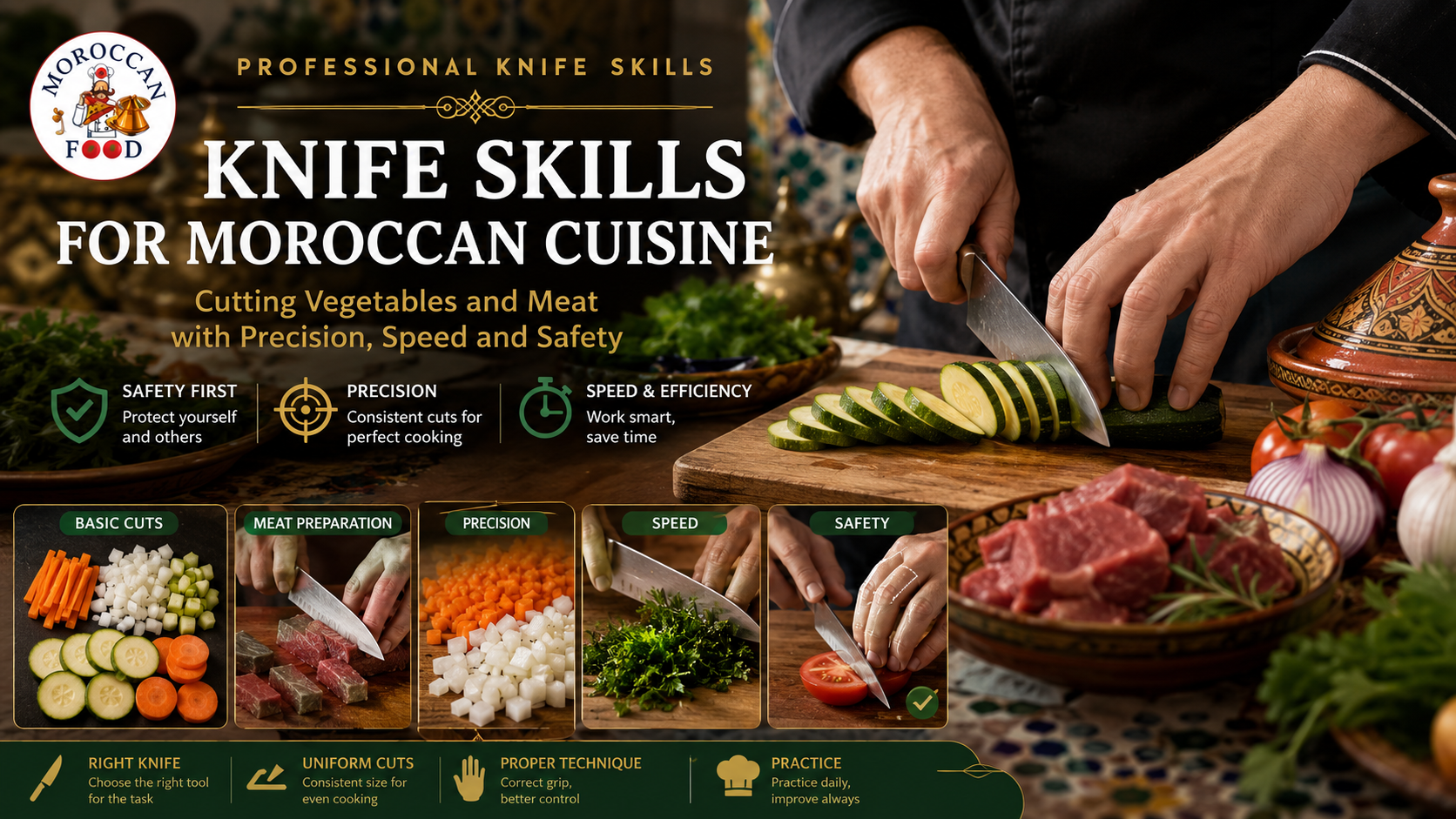
Knife skills are among the most fundamental techniques every culinary student must master. Before learning advanced cooking methods, a professional cook needs to know how to hold a knife correctly, prepare ingredients efficiently, make consistent cuts, work safely, and maintain an organized workstation.
In Moroccan cuisine, these skills are particularly important because many traditional dishes depend on carefully prepared vegetables, meat, herbs, and aromatic ingredients. The size and shape of an ingredient can influence its cooking time, texture, appearance, and ability to absorb flavors.
This guide introduces the essential knife skills that culinary students should develop, with practical examples from Moroccan cuisine.
1. Why Knife Skills Matter in Professional Cooking
Knife skills are not simply about cutting food quickly. They involve four fundamental principles:
Safety → Accuracy → Consistency → Speed
A beginner should focus on safety and accuracy first. With regular practice, consistency and speed naturally improve.
Good knife skills allow a cook to:
- Prepare ingredients efficiently.
- Achieve consistent cooking results.
- Control cooking times.
- Improve the presentation of dishes.
- Reduce unnecessary food waste.
- Work more efficiently during professional service.
- Minimize the risk of cuts and other kitchen injuries.
For culinary students, developing these skills early creates a foundation for almost every other cooking technique.

2. Choosing the Right Knife
Different culinary tasks require different knives. Students should understand the purpose of each knife rather than simply collecting many types.
Chef’s Knife
The chef’s knife is the primary general-purpose knife in a professional kitchen. It can be used for chopping, slicing, dicing, and many vegetable-preparation tasks.
Paring Knife
A paring knife is useful for small and precise tasks such as peeling, trimming, and preparing small fruits and vegetables.
Boning Knife
A boning knife is designed for separating meat from bones and trimming certain cuts of meat.
Bread Knife
A serrated bread knife is designed to cut bread without crushing its structure.
The most important principle is simple:
Choose the knife according to the task, not according to the number of knives available.

3. Preparing the Workstation
Before beginning any cutting task, a professional cook should prepare the workstation.
A basic setup includes:
- A clean and stable cutting board.
- A properly maintained knife.
- The ingredients to be prepared.
- A suitable container for prepared ingredients.
- A separate container for waste and trimmings.
- A clean and organized work surface.
The cutting board should remain stable throughout the process. A damp cloth or suitable non-slip mat underneath the board can help prevent movement.
An organized workstation improves both efficiency and safety.

4. Basic Knife Grip
The way a cook holds the knife directly affects control and safety.
For many professional cutting tasks, the pinch grip is useful. The cook holds the blade near the handle between the thumb and index finger while wrapping the remaining fingers around the handle.
This provides better control over the knife than simply holding the handle loosely.
The other hand is responsible for stabilizing the ingredient.

5. The Claw Grip
One of the most important techniques for culinary students is the claw grip.
When holding an ingredient, the fingertips are curled inward while the knuckles provide a guide for the side of the knife.
This position keeps the fingertips away from the cutting edge while allowing the cook to move the ingredient gradually toward the knife.
The claw grip should become a natural habit when chopping or slicing vegetables.

6. Essential Vegetable Cutting Techniques

Professional kitchens use standardized cutting techniques because consistent pieces cook more evenly and create a more professional presentation.
Julienne
Julienne refers to cutting vegetables into thin, elongated strips.
It can be used with ingredients such as:
- Carrots
- Bell peppers
- Zucchini
- Cucumber
Julienne cuts are particularly useful for salads, garnishes, and some vegetable preparations.
Brunoise
Brunoise is a very small dice produced from vegetables that have first been cut into uniform strips.
Common ingredients include:
- Carrots
- Celery
- Peppers
- Onions
Brunoise is useful when small pieces are desired for sauces, salads, fillings, and garnishes.
Dice
Dicing involves cutting an ingredient into relatively uniform cubes.
The exact dimensions may vary depending on the culinary application.
Uniform diced vegetables are particularly important in dishes where several ingredients need to reach an appropriate level of doneness at approximately the same time.
Rondelle
Rondelle refers to round slices, commonly produced from cylindrical vegetables.
Examples include:
- Carrots
- Cucumbers
- Zucchini
The thickness should be consistent according to the recipe and cooking method.
Chiffonade
Chiffonade is commonly used for leafy ingredients such as herbs and leafy vegetables.
The leaves are arranged, rolled, and sliced into fine strips.
This technique can be useful for:
- Mint
- Coriander
- Lettuce
- Basil
In Moroccan cooking, finely cut fresh herbs such as parsley and coriander are frequently used to add aroma and freshness.
7. Why Uniform Cutting Matters

One of the most important principles in professional cooking is uniformity.
Imagine preparing a Moroccan vegetable tagine with:
- Potatoes
- Carrots
- Zucchini
- Bell peppers
If the potato pieces are very large while the zucchini pieces are very small, the zucchini may become soft before the potatoes are properly cooked.
Therefore, the cook needs to consider both:
Ingredient + Cutting Size + Cooking Method
The objective is not necessarily to make every vegetable exactly the same shape, but to choose a suitable size that allows each ingredient to cook appropriately.
8. Cutting Meat Professionally

Meat requires different techniques from vegetables because its structure contains muscle fibers, connective tissue, and sometimes fat and bone.
Before cutting meat, the cook may need to:
- Remove unwanted connective tissue.
- Trim excessive fat when appropriate.
- Remove bones when required.
- Identify the direction of the muscle fibers.
- Select an appropriate cutting size.
The intended cooking method should determine the final cut.
9. Cutting Against the Grain

One important principle when preparing meat is understanding the grain.
The grain refers to the direction in which the muscle fibers run.
When appropriate for the particular cut and preparation, slicing across the grain shortens the muscle fibers and can produce a more tender eating experience.
This principle is particularly useful when preparing meat that will be sliced and served directly.
10. Cutting Meat for Moroccan Tagines

Moroccan tagines commonly use meat cut into pieces suitable for slow cooking.
The pieces should generally be:
- Relatively uniform.
- Appropriate for the cooking vessel.
- Large enough to remain intact during long cooking.
- Properly trimmed.
For example, if preparing a meat tagine, cutting pieces to a similar size helps create more consistent cooking.
The goal is not simply to make the meat look attractive. The cut should correspond to the cooking time and method.
11. Cutting Meat for Brochettes

Moroccan brochettes require a different approach.
Meat is generally cut into relatively uniform pieces so that the pieces cook at a similar rate when placed on skewers.
If some pieces are very small and others are very large, the smaller pieces may become overcooked while the larger pieces are still cooking.
Uniformity is therefore essential for both quality and consistency.
12. Preparing Liver

Liver requires careful preparation because of its soft texture.
Before cooking, the cook can:
- Inspect the liver.
- Remove undesirable membranes or connective tissue when necessary.
- Cut it into appropriate pieces.
- Keep the pieces relatively consistent in size.
- Maintain good hygiene throughout preparation.
For grilled liver, pieces that are too small may dry out quickly, while excessively large pieces may cook unevenly.
13. Precision in Culinary Cutting

Precision means controlling:
- Size
- Shape
- Thickness
- Direction
- Consistency
A culinary student should not focus exclusively on speed.
For example, producing 50 poorly cut pieces quickly is less useful professionally than producing 50 consistent pieces safely and efficiently.
The professional progression is:
Safety
Learn to handle the knife correctly.
↓
Accuracy
Learn the correct cutting technique.
↓
Consistency
Repeat the same cut reliably.
↓
Speed
Increase efficiency through practice.
14. Developing Cutting Speed

Speed should develop naturally through repetition.
Students can improve their efficiency by:
- Using the same cutting motion repeatedly.
- Keeping the workstation organized.
- Preparing ingredients before starting.
- Maintaining a comfortable posture.
- Using the correct knife for the task.
- Avoiding unnecessary movements.
A professional cook should aim for controlled speed, not uncontrolled rapid movement.
15. Knife Safety Rules

Knife safety is a fundamental part of culinary education.
Essential rules include:
- Keep the cutting board stable.
- Keep your fingers away from the blade.
- Use the claw grip when appropriate.
- Keep the knife properly maintained.
- Never attempt to catch a falling knife.
- Do not leave a knife hidden under food, towels, or other objects.
- Do not place a knife in a sink where someone may not see it.
- Carry a knife with the blade directed safely downward and away from others.
- Keep the cutting area clean and organized.
- Clean and sanitize equipment appropriately after handling raw meat.
Safety should never be sacrificed for speed.
16. Preventing Cross-Contamination

Knife skills are also connected to food safety.
When working with raw meat, students must avoid transferring microorganisms from raw ingredients to ready-to-eat foods.
This means paying attention to:
- Cutting boards
- Knives
- Work surfaces
- Hands
- Storage containers
Raw meat should be kept separate from foods that will be eaten without further cooking.
After handling raw meat, hands, equipment, and surfaces should be cleaned and sanitized appropriately.
17. Applying Knife Skills to Moroccan Cuisine

Knife skills become especially interesting when applied to traditional Moroccan dishes.
Moroccan Couscous
Vegetables such as carrots, potatoes, turnips, pumpkin, and zucchini need to be prepared in sizes appropriate to their different cooking characteristics.
Moroccan Tagine
The size of onions, potatoes, carrots, zucchini, and meat influences cooking time, texture, and presentation.
Moroccan Salads
Fine dicing can create attractive and consistent vegetable salads.
Moroccan Brochettes
Meat should be divided into relatively uniform pieces to promote consistent cooking.
Moroccan Soups
Vegetables may be diced or chopped according to the desired texture of the final soup.
Moroccan Herbs
Parsley and coriander can be finely chopped to distribute their aroma throughout the dish.
18. Common Mistakes Made by Beginners

Cutting too quickly
Trying to imitate the speed of a professional before mastering technique increases the risk of injury.
Using a dull knife
A poorly maintained knife can make cutting more difficult and reduce control.
Uneven cutting
Different sizes can lead to inconsistent cooking.
Poor workstation organization
Searching for ingredients or equipment while holding a knife creates unnecessary risk.
Incorrect grip
Holding the knife or ingredient incorrectly reduces control.
Ignoring the grain of meat
Cutting meat without considering its muscle structure can negatively affect texture.
19. How Culinary Students Can Practice

A simple progression can help students develop their skills.
Exercise 1: Julienne
Practice cutting carrots into evenly sized strips.
Exercise 2: Brunoise
Turn the julienne strips into small, consistent cubes.
Exercise 3: Dice
Practice producing uniform potato or carrot cubes.
Exercise 4: Rondelle
Practice producing consistent slices from carrots or zucchini.
Exercise 5: Meat Cubes
Practice preparing uniform pieces suitable for a tagine or brochettes.
The objective is not to waste ingredients by repeatedly cutting them without purpose. Instead, students should practice with appropriate ingredients and focus on control, consistency, and safe technique.
20. How to Evaluate Your Knife Skills

A culinary student can evaluate their progress using five criteria:
| Skill | Question |
|---|---|
| Safety | Am I controlling the knife safely? |
| Precision | Are my cuts close to the intended dimensions? |
| Consistency | Are the pieces similar to one another? |
| Efficiency | Am I avoiding unnecessary movements? |
| Speed | Can I work faster without losing control? |
A professional standard is achieved when speed does not compromise safety or consistency.
Conclusion
Professional knife skills form the foundation of culinary education. Learning how to cut vegetables and meat correctly allows a cook to control cooking time, texture, presentation, efficiency, and food safety.
For students studying Moroccan cuisine, these skills have direct applications in dishes such as couscous, tagines, Moroccan salads, soups, brochettes, and grilled liver.
The most important lesson is that professional knife work is not about cutting as quickly as possible. It is about developing a controlled sequence:
Safety → Precision → Consistency → Efficiency → Speed
Once these principles become habitual, students can approach more advanced Moroccan cooking techniques with greater confidence and professional control.


Leave a Reply