
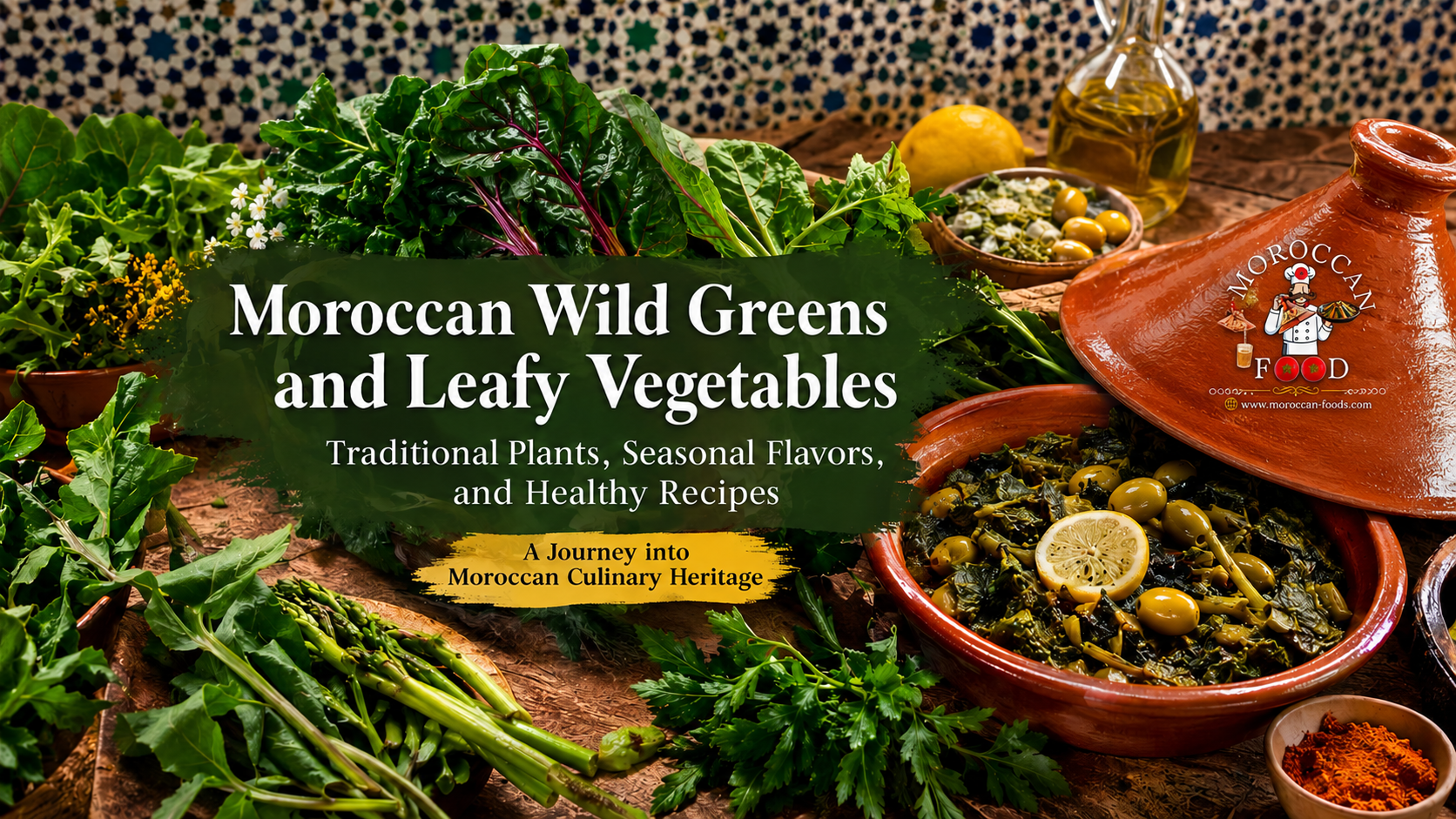
Moroccan cuisine is famous for its vibrant spices, fragrant tagines, couscous, fresh salads, and slow-cooked dishes. Yet some of its most distinctive flavors come from much simpler ingredients: the tender green plants that appear in Moroccan fields, gardens, and local markets with the changing seasons.
For generations, Moroccan families have gathered and prepared a remarkable variety of leafy vegetables and wild edible plants. Some are cultivated, while others appear naturally after the rains or during specific seasons. They are transformed into flavorful cooked salads, side dishes, couscous, tagines, and traditional vegetable preparations.
Among the best known are mallow, purslane, Swiss chard, asparagus, and guernina, along with several other seasonal wild greens.
These plants are more than humble vegetables. They represent an important part of Morocco’s culinary heritage, connecting seasonal produce, traditional cooking techniques, and generations of local knowledge. Research in Morocco has documented numerous wild edible plants traditionally consumed as vegetables, including Malva sylvestris, Portulaca oleracea, Scolymus hispanicus, Nasturtium officinale, Silene vulgaris, and Emex spinosa. (ResearchGate)
What Are Moroccan Wild Greens?
Moroccan wild greens are a diverse group of edible plants traditionally collected or cultivated for their tender leaves, stems, shoots, or young parts.
They should not all be called legumes. In botanical terms, legumes belong to the Fabaceae family and include foods such as lentils, chickpeas, beans, peas, and alfalfa. Mallow, purslane, Swiss chard, and guernina belong to different botanical families.
What brings them together in Moroccan cuisine is their role as seasonal green vegetables used in traditional cooking.
Their preparation is often wonderfully simple. Fresh greens are cleaned, chopped, steamed or cooked until tender, then combined with olive oil, garlic, cumin, paprika, parsley, lemon, preserved lemon, and olives.
This simple combination allows the natural character of each plant to shine.
1. Mallow — Khobiza

English name: Mallow
Moroccan name: Khobiza, Khobiza
Scientific name: Malva sylvestris
Mallow is one of the most recognizable wild greens in Moroccan cuisine. Known locally as khobiza, it has long been gathered as a seasonal vegetable and cooked into one of Morocco’s beloved traditional salads: bakoula.
Mallow is particularly associated with the cooler months and the period following seasonal rainfall. In traditional Moroccan communities, it has often been collected during winter and spring, when young leaves are tender and suitable for cooking. Ethnobotanical research among Moroccan communities confirms the seasonal use of mallow during the colder months. (PubMed Central (PMC))
Mallow in Moroccan Cooking
The classic preparation is Moroccan Bakoula, a cooked green salad traditionally prepared with chopped mallow, garlic, olive oil, herbs, spices, lemon, preserved lemon, and olives.
The greens are usually cleaned carefully, chopped, and steamed or cooked until tender before being seasoned and finished with olive oil and aromatic ingredients.
The result is a deeply flavorful salad with a soft texture, fragrant garlic, bright citrus notes, and the warm character of Moroccan spices.
Bakoula is commonly served as part of a selection of Moroccan cooked salads and makes an excellent accompaniment to bread, tagines, grilled foods, and couscous. (Zaffaron)
Nutritional Benefits of Mallow
Mallow contributes fiber, vitamins, minerals, and various naturally occurring plant compounds to the diet. Moroccan research has specifically examined the nutritional composition of Malva sylvestris among traditionally consumed wild vegetables. (ResearchGate)
Adding mallow to meals can therefore be a delicious way to increase the variety of leafy vegetables in a balanced diet.
Explore the recipe:
[Moroccan Mallow Salad — Bakoula]
2. Purslane — Rjla

English name: Purslane
Moroccan name: Rjla, Rojla
Scientific name: Portulaca oleracea
Purslane is another treasured seasonal green in Morocco. Its small, succulent leaves and tender stems give it a distinctive texture and a mild, slightly tangy flavor.
Unlike mallow, which is strongly associated with the colder season, purslane is traditionally gathered mainly during spring and summer, particularly in irrigated agricultural areas. Ethnobotanical research in northern Morocco describes purslane as an important seasonal wild vegetable collected during spring and summer and prepared after washing by boiling or steaming. (DOI)
Purslane in Moroccan Cuisine
Purslane can be prepared on its own or combined with other seasonal greens.
One of its most traditional uses is Rojla, a cooked green salad prepared with garlic, parsley, olive oil, lemon, and Moroccan spices. It can be served warm or at room temperature alongside bread and other Moroccan dishes.
Its succulent leaves absorb seasoning beautifully, making it especially well suited to preparations based on olive oil, garlic, lemon, and spices.
Purslane can also be incorporated into mixed cooked-green salads, where its texture adds variety to softer leafy vegetables. Moroccan culinary traditions have long used different seasonal greens interchangeably depending on availability. (DOI)
Nutritional Benefits of Purslane
Purslane is naturally rich in water and provides dietary fiber, minerals, vitamins, and a variety of plant compounds. It is one of several Moroccan wild vegetables that have been studied for their nutritional composition. (ResearchGate)
Explore the recipe:
[Moroccan Purslane Salad — Rojla]
3. Swiss Chard — Selk

English name: Swiss chard
Moroccan name: Selk
Scientific name: Beta vulgaris var. cicla
Swiss chard, known in Morocco as selk, is one of the most versatile leafy vegetables used in Moroccan cooking.
Its broad green leaves and firm stems make it suitable for a variety of preparations, from cooked salads to vegetable dishes and fillings.
Swiss chard is particularly well suited to cooler seasons, with Moroccan ethnobotanical research documenting seasonal use of Beta species during winter and spring. (DOI)
Swiss Chard in Moroccan Cooking
Moroccan cooks use chard in many ways. The leaves can be cooked and seasoned with garlic, olive oil, cumin, paprika, lemon, and herbs. They can also be combined with other greens to create a richer version of a traditional cooked vegetable salad.
Chard can also appear in:
- Moroccan cooked salads
- Vegetable fillings
- Soups
- Lentil dishes
- Bean dishes
- Mixed seasonal greens
- Savory pastries and stuffed preparations
Its mild flavor makes it particularly adaptable to Moroccan spices.
Nutritional Benefits of Swiss Chard
Swiss chard is a nutrient-dense leafy vegetable that provides fiber, minerals, vitamins, and naturally occurring plant compounds.
Including it regularly as part of a varied diet can add both nutritional diversity and color to Moroccan meals.
Explore the recipe:
[Moroccan Swiss Chard Salad — Selk Salad]
4. Asparagus — Sperge

English name: Asparagus
Moroccan name: Sperge
Scientific name: Asparagus officinalis
Asparagus has a very different appearance and texture from mallow, purslane, and chard. Instead of tender leaves, its young shoots are prized for their delicate texture and fresh, earthy flavor.
Asparagus is particularly associated with spring, when young shoots are at their best.
Asparagus in Moroccan Cooking
In a Moroccan kitchen, asparagus can be prepared simply and allowed to absorb the flavors of traditional ingredients.
One particularly appealing combination is asparagus with eggs, where tender asparagus is cooked with eggs, olive oil, garlic, and Moroccan seasonings.
The result is simple, nourishing, and deeply satisfying—a good example of how Moroccan cooking can transform a seasonal vegetable into an elegant everyday meal.
Explore the recipe:
[Moroccan Asparagus with Eggs]
5. Guernina — Spanish Salsify / Golden Thistle

English name: Spanish Salsify, Golden Thistle
Moroccan name: Guernina
Scientific name: Scolymus hispanicus
Guernina is one of the most fascinating wild edible plants found in Moroccan food traditions.
Unlike supermarket vegetables that are available throughout the year, guernina belongs to the seasonal world of wild greens. Young leaves and tender shoots are collected when the plant is still suitable for eating, before tougher and more strongly spiny parts develop.
Moroccan ethnobotanical studies have documented Scolymus hispanicus as a traditionally consumed wild vegetable, particularly in rural communities. (ResearchGate)
The Season for Guernina
Guernina is associated mainly with the late winter and spring period, depending on rainfall, local climate, and region.
Traditional knowledge is especially important when dealing with wild plants because the edible stage can depend on the age and condition of the plant.
Guernina in Moroccan Cuisine
Young guernina shoots and leaves can be carefully cleaned and prepared as a vegetable.
Traditional uses include:
- Cooked green salads
- Mixed seasonal greens
- Beqoul
- Couscous
- Tagines
- Vegetable preparations
Recent ethnobotanical research in Morocco has documented guernina among the important plants used in Beqoul, a traditional preparation made from a mixture of young seasonal wild greens. The exact combination can change according to what is available during the season. (DOI)
Guernina has also been documented in traditional fish and meat tagines after the young shoots are carefully cleaned and prepared. (DOI)
Nutritional Value of Guernina
Research on Moroccan wild edible plants has examined the nutritional composition of Scolymus hispanicus, including its macronutrients, minerals, and naturally occurring bioactive compounds. (ResearchGate)
Its culinary importance, however, goes beyond nutrition. Guernina represents the traditional Moroccan knowledge of seasonal foraging and the ability to turn wild plants into flavorful family meals.
Explore the recipe:
[Cook in the same way]
6. Beqoul — Morocco’s Seasonal Wild Greens Tradition
One of the most beautiful expressions of Morocco’s wild-vegetable tradition is Beqoul.
Rather than being limited to one plant, Beqoul can be understood as a traditional cooked preparation of tender seasonal greens. The exact ingredients may change from one region or season to another.
Modern ethnobotanical research among communities in northern Morocco has documented mixtures containing plants such as mallow, Rumex species, Beta species, and Scolymus species, alongside other seasonal wild greens. (DOI)
The greens are typically chopped and steamed or cooked until tender, then seasoned with:
- Olive oil
- Garlic
- Parsley
- Lemon
- Salt
- Spices
This cooking style perfectly reflects the Moroccan approach to seasonal vegetables: use what nature provides, cook it gently, and build flavor with a few carefully chosen ingredients.
7. Other Moroccan Wild Greens Worth Discovering
Morocco’s traditional edible-plant heritage extends far beyond the best-known greens.
Ethnobotanical research has documented many wild plants that have been consumed as vegetables in different Moroccan regions. Among them are watercress, Silene vulgaris, Emex spinosa, and several species of Scolymus and Rumex. (ResearchGate)
Watercress — Nasturtium officinale
Watercress is associated with moist environments and is among the wild edible plants documented in Morocco.
Its fresh, peppery character makes it particularly suitable for salads and green preparations.
Silene vulgaris
This wild edible plant is traditionally consumed in parts of the Mediterranean region and has also been documented among Moroccan wild vegetables.
Rumex Species
Some Rumex species are traditionally gathered as seasonal greens and can contribute a characteristic tangy flavor to mixed vegetable preparations.
Dandelion — Jemra
Some Moroccan communities traditionally consume species of Taraxacum, locally known in certain areas as Jemra. Ethnobotanical research has recorded its consumption among Moroccan wild edible plants. (PubMed Central (PMC))
These plants demonstrate just how diverse Morocco’s edible botanical heritage can be.
8. Alfalfa — Fessa

English name: Alfalfa, Lucerne
Moroccan name: Fessa
Scientific name: Medicago sativa
Alfalfa is botanically different from the leafy vegetables discussed above because it belongs to the Fabaceae family, the same botanical family that includes lentils, chickpeas, peas, and beans.
In Morocco, however, alfalfa is primarily known as an important forage crop rather than one of the country’s principal traditional cooked salad greens.
Its leaves and young sprouts have food applications in other culinary contexts, but it should not be confused with the classic Moroccan greens used for Beqoul and Bakoula.
The Health Benefits of Moroccan Leafy Greens
Traditional Moroccan greens offer an appealing combination of flavor, variety, and nutritional value.
Although every plant has its own nutritional profile, leafy vegetables and wild edible greens can contribute:
Dietary Fiber
Fiber is an important part of a balanced diet and supports normal digestive health.
Vitamins and Minerals
Many green vegetables provide varying amounts of minerals and vitamins, including potassium, magnesium, calcium, iron, and several vitamins.
Plant Compounds
Wild edible plants can contain naturally occurring polyphenols, flavonoids, and other bioactive compounds. Moroccan research has investigated the nutritional and chemical composition of several traditionally consumed wild vegetables. (ResearchGate)
The nutritional value of these plants makes them a valuable part of a diverse diet, especially when prepared with wholesome ingredients such as olive oil, garlic, herbs, and fresh citrus.
Why Moroccan Cooking Works So Well with Wild Greens
The secret is not complicated.
Moroccan cuisine has developed a remarkably effective way of bringing out the character of vegetables through a small number of ingredients.
Olive Oil
Extra-virgin olive oil provides richness and helps carry the aromas of spices and herbs.
Garlic
Garlic adds depth and warmth to delicate leafy vegetables.
Cumin
Earthy cumin pairs naturally with cooked greens and is one of the defining flavors of Moroccan vegetable salads.
Paprika
Sweet paprika adds color and gentle warmth.
Lemon and Preserved Lemon
Citrus balances the earthy flavor of greens and brings brightness to the dish.
Olives
Olives add saltiness and a distinctive Moroccan character.
Together, these ingredients can transform a simple bunch of seasonal greens into a memorable dish.
Steaming: A Traditional Way to Cook Moroccan Greens
Steaming is particularly well suited to leafy vegetables.
In traditional Moroccan cooking, tender greens can be placed in a couscoussier, allowing steam from the lower pot to cook the vegetables gently.
This technique helps soften the greens while avoiding prolonged immersion in water.
It is especially useful for preparations such as Beqoul and cooked green salads.
Research on Scolymus hispanicus has also examined different cooking methods and found differences in the retention of phenolic compounds and antioxidant activity depending on the cooking technique. (ResearchGate)
Seasonal Cooking: Eating with the Moroccan Calendar
One of the most beautiful characteristics of these plants is their connection to the seasons.
Winter and early spring bring tender mallow and many other wild greens.
Spring and summer offer purslane and other seasonal plants.
Spring is also associated with young asparagus shoots and the tender stages of several wild plants.
This seasonal rhythm means that traditional Moroccan cooking naturally changes throughout the year.
A dish prepared in winter may be completely different from one prepared in summer—not because the cooking tradition has changed, but because the landscape has.
From Traditional Markets to the Modern Moroccan Kitchen
Today, these plants continue to appear in Moroccan markets, homes, and traditional kitchens.
At the same time, documenting them has become increasingly important.
Traditional knowledge of wild edible plants has declined in some communities as lifestyles, agriculture, and food habits change. Researchers studying Moroccan communities have highlighted the importance of preserving this knowledge before it disappears. (Springer Link)
Recording the names, seasons, preparation methods, culinary uses, and recipes of these plants creates a bridge between generations.
It also introduces international food lovers to a side of Moroccan cuisine that is often overlooked.
Moroccan Wild Greens Recipe Collection
This guide is the starting point for a growing collection of Moroccan recipes featuring seasonal leafy vegetables and wild edible plants.
Mallow Recipes
- Moroccan Mallow Salad — Bakoula
- Mallow with Garlic and Preserved Lemon
- Traditional Moroccan Mixed Greens
Purslane Recipes
- Moroccan Purslane Salad — Rojla
- Purslane with Garlic and Olive Oil
- Moroccan Mixed Purslane Greens
Swiss Chard Recipes
- Moroccan Swiss Chard Salad
- Swiss Chard with Garlic and Cumin
- Moroccan Mixed Greens with Chard
Asparagus Recipes
- Moroccan Asparagus with Eggs
- Asparagus with Moroccan Spices
- Seasonal Asparagus Salad
Guernina Recipes
- Moroccan Guernina Salad
- Guernina Beqoul
- Guernina with Moroccan Spices
Mixed Wild Greens
- Traditional Moroccan Beqoul
- Seasonal Moroccan Wild Greens Salad
- Mixed Wild Greens with Preserved Lemon and Olives
As each recipe is added to the collection, this guide can serve as a central reference point, bringing together the traditional plants, their seasons, their culinary uses, and the dishes prepared with them.
Preserving a Delicious Part of Moroccan Culinary Heritage
Moroccan wild greens tell a story that goes far beyond the plate.
They tell the story of seasonal rain, rural landscapes, local markets, family kitchens, traditional knowledge, and a cuisine that has always known how to make the most of what the land provides.
Khobiza, Rjla, Selk, Sperge, Guernina, and other seasonal greens each bring a different texture, flavor, and tradition to the Moroccan table.
Prepared with olive oil, garlic, herbs, spices, lemon, preserved lemon, and olives, they become some of the most flavorful vegetable dishes in Moroccan cuisine.
Exploring these plants is therefore not simply a journey into healthy eating. It is a journey into Moroccan culinary heritage—one seasonal green at a time.
Frequently Asked Questions About Moroccan Wild Greens
1. What are the most common wild greens used in Moroccan cuisine?
Some of the best-known Moroccan wild and leafy greens include mallow (khobiza), purslane (rjla), Swiss chard (selk), guernina (Spanish salsify/golden thistle), and watercress. Their availability and culinary uses vary according to the region and season.
2. Is mallow (khobiza) commonly used in Moroccan cooking?
Yes. Mallow, or khobiza, is one of the most traditional leafy greens in Morocco. It is especially famous for bakoula, a cooked Moroccan green salad seasoned with garlic, olive oil, cumin, lemon, preserved lemon, and olives.
3. What is rjla in Moroccan cuisine?
Rjla is the Moroccan name commonly used for purslane (Portulaca oleracea). Its tender, succulent leaves have a slightly tangy flavor and are commonly cooked with garlic, olive oil, herbs, and Moroccan spices.
4. What is selk?
Selk is the Moroccan name for Swiss chard. Its tender leaves can be cooked as a Moroccan salad, combined with other seasonal greens, or incorporated into soups, fillings, and vegetable dishes.
5. What is guernina?
Guernina is a traditional Moroccan wild edible plant identified botanically as Scolymus hispanicus and known in English as Spanish salsify or golden thistle. Its young, tender parts can be used in cooked salads, Beqoul, couscous, and other traditional dishes.
6. What is Beqoul in Moroccan cuisine?
Beqoul refers to a traditional Moroccan preparation made with seasonal leafy and wild greens. The exact plants can vary depending on the region and season. The greens are generally cooked or steamed and seasoned with ingredients such as garlic, olive oil, parsley, lemon, and Moroccan spices.
7. When is the best season for Moroccan wild greens?
The season depends on the plant. Mallow and many other wild greens are commonly associated with winter and spring, purslane is more abundant during spring and summer, while asparagus is mainly associated with spring. Rainfall, climate, and region can also influence availability.
8. Are Moroccan wild greens nutritious?
Yes. Many leafy and wild edible plants provide dietary fiber, vitamins, minerals, and naturally occurring plant compounds. Their nutritional composition varies considerably from one plant to another, so consuming a variety of greens is the best approach.
9. What are the health benefits of Moroccan leafy greens?
Depending on the plant, Moroccan leafy greens can contribute to digestive health, normal immune function, heart health, and overall nutritional quality because they provide fiber, vitamins, minerals, and various plant compounds.
10. What is the best way to cook Moroccan wild greens?
Many Moroccan greens are traditionally steamed or gently cooked first, then seasoned with olive oil, garlic, cumin, paprika, lemon, preserved lemon, herbs, and olives. This approach produces flavorful dishes while allowing the natural character of the greens to remain noticeable.
11. Can different Moroccan greens be cooked together?
Yes. Combining seasonal greens is a traditional approach, particularly when preparing Beqoul or mixed cooked salads. Mallow, purslane, chard, and other suitable edible greens can be combined according to availability and regional traditions.
12. Can these greens be used in Moroccan salads?
Absolutely. Cooked green salads are an important part of Moroccan cuisine. Mallow, purslane, Swiss chard, guernina, and other seasonal greens can be prepared with Moroccan seasonings and served alongside bread, tagines, couscous, grilled dishes, and other meals.
13. Is alfalfa (fessa) a Moroccan leafy vegetable?
Alfalfa (Medicago sativa) is botanically a legume, unlike mallow, purslane, and Swiss chard. In Morocco, it is primarily known as an important forage crop. Its sprouts and young parts have food uses, but they should not be confused with the traditional greens commonly used to prepare Moroccan Beqoul or Bakoula.
14. Are all wild plants safe to eat?
No. Only plants that have been correctly identified as edible should be consumed. Wild plants can resemble other species, including plants that may be unsuitable or toxic. Plants collected from potentially contaminated areas should also be avoided.
15. Why are seasonal wild greens important to Moroccan culinary heritage?
Seasonal greens preserve an important connection between Moroccan agriculture, local landscapes, traditional knowledge, and family cooking. Their recipes reflect the Moroccan tradition of using seasonal ingredients and transforming simple plants into flavorful dishes with olive oil, garlic, spices, citrus, and herbs.
16. Where can I find Moroccan recipes using these plants?
This guide serves as a central reference for Moroccan wild and leafy greens. As individual recipes are added, you can explore dedicated recipes for khobiza, rjla, selk, asparagus, guernina, Beqoul, and other seasonal Moroccan greens.


Leave a Reply