
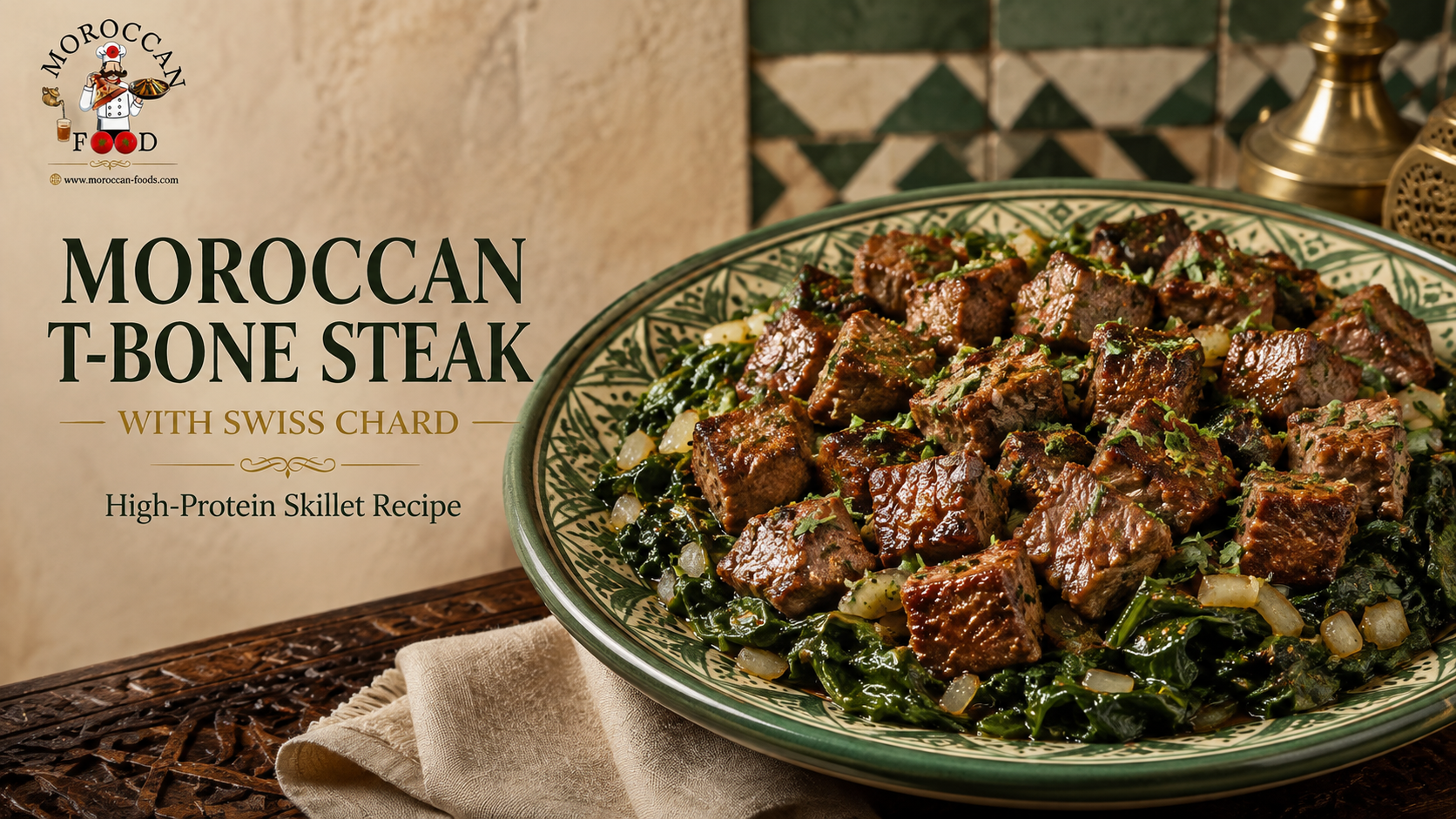
Moroccan Sautéed Chard with T-Bone Steak Cubes is a flavorful and satisfying skillet meal combining tender pieces of beef with nutritious leafy greens. The T-bone steak meat is cut into bite-sized cubes and cooked with finely chopped onion, garlic, fresh herbs, and warm Moroccan spices.
Once the steak cubes are browned and tender, they are removed from the skillet. The chard is then cooked in the same pan with the remaining onion and its own blend of seasonings, allowing it to absorb the flavorful juices left by the meat. To serve, the sautéed chard is spread over a Moroccan platter and topped with the seasoned T-bone steak cubes.
Recipe Information
- Preparation Time: 20 minutes
- Cooking Time: 25–30 minutes
- Total Time: 45–50 minutes
- Servings: 4
- Difficulty: Easy
- Cooking Method: Skillet
Ingredients
For the T-Bone Steak Cubes
- 600 g (1.3 lb) boneless meat cut from T-bone steaks, weighed after removing the bones
- ½ medium onion, finely chopped
- 2 tablespoons olive oil
- 2 garlic cloves, finely minced
- 1 teaspoon paprika
- ½ teaspoon ground ginger
- ½ teaspoon ground cumin
- ¼ teaspoon ground turmeric
- ½ teaspoon ground black pepper
- ½ teaspoon salt, or to taste
- 1 tablespoon finely chopped fresh parsley
- 1 tablespoon finely chopped fresh cilantro
For the Chard
- 700 g (1.5 lb) fresh chard
- Remaining ½ onion, finely chopped
- 2 tablespoons olive oil
- 2 garlic cloves, finely minced
- 1 teaspoon paprika
- ½ teaspoon ground cumin
- ¼ teaspoon ground black pepper
- ½ teaspoon salt, or to taste
- 1 tablespoon finely chopped fresh parsley
- 1 tablespoon finely chopped fresh cilantro

Preparation
1. Prepare the T-Bone Steak
Remove the meat carefully from both sides of the T-bone steaks and discard or reserve the bones for another use. Cut the meat into evenly sized bite-sized cubes.
Pat the cubes dry with a paper towel. Removing excess surface moisture helps the meat develop a better golden crust in the skillet.
2. Prepare the Chard
Wash the chard thoroughly under cold running water, then drain it well.
Separate the thick stems from the leaves. Slice the stems into small pieces and roughly chop the leaves. Keep them separate because the stems require slightly more cooking time.
3. Sauté the Onion
Heat 2 tablespoons of olive oil in a large skillet over medium-high heat.
Add half of the finely chopped onion and cook for 2–3 minutes, stirring regularly, until softened. Add the minced garlic and cook for approximately 30 seconds.
4. Cook the T-Bone Steak Cubes
Add the steak cubes in a single layer. Season them with paprika, ground ginger, cumin, turmeric, black pepper, and salt.
Allow the cubes to sear briefly before turning them. Cook for approximately 6–9 minutes, stirring occasionally, until browned on the outside and cooked to your preferred doneness.
Avoid overcrowding the skillet because excess moisture can cause the meat to steam instead of brown. If your skillet is small, cook the steak in two batches.
Add the chopped parsley and cilantro during the final minute and mix well. For food safety, whole cuts of beef should reach at least 145°F (63°C) followed by a three-minute rest. FoodSafety.gov temperature guidance
5. Remove and Rest the Meat
Transfer the cooked T-bone steak cubes to a clean plate and cover them lightly. Allow the meat to rest while preparing the chard.
Do not wash the skillet; the seasoned juices remaining in the pan will add flavor to the greens.
6. Cook the Remaining Onion
Reduce the heat to medium and add the remaining 2 tablespoons of olive oil to the same skillet.
Add the other half of the finely chopped onion and cook for 2–3 minutes until soft. Add the minced garlic and stir for approximately 30 seconds without allowing it to burn.
7. Add the Chard Stems
Add the sliced chard stems and cook them with the onion for 3–4 minutes, stirring occasionally, until they begin to soften.
8. Add the Chard Leaves and Seasonings
Add the chopped chard leaves gradually, stirring after each addition until they begin to wilt.
Season with paprika, cumin, black pepper, and salt. Add the chopped parsley and cilantro, then mix everything thoroughly.
9. Finish Cooking the Chard
Cook uncovered over medium-low heat for 8–12 minutes, stirring occasionally, until the leaves and stems are tender and most of the released liquid has evaporated.
Taste and adjust the seasoning if necessary. The cooked chard should be tender and flavorful without being watery.
10. Assemble and Serve
Spread the sautéed chard evenly over a Moroccan serving platter. Arrange the warm T-bone steak cubes generously on top.
Serve immediately with Moroccan tomato, onion, and roasted green pepper salad or another traditional side dish.

Serve Sautéed Chard with T-Bone Steak Cubes recipe:
If you exercise, you can eat this meal after your training session with traditional Moroccan salads as a nutritious and protein-rich meal.

You can serve this recipe in the Moroccan style as a light and quick lunch or dinner.

Here are some of the most popular traditional Moroccan salads that are served with a main course.
Moroccan Roasted Tomato, Onion & Pepper Salad Recipe
Traditional Moroccan Tomato Cucumber and Onion Salad Recipe
Moroccan salad with tomatoes, onions, and roasted green peppers
Moroccan salad with onions, tomatoes, and roasted red and yellow peppers
Moroccan Lettuce, Tomato, Onion & Cucumber Salad
In Morocco, fruits, some types of melon, and some drinks from the juice menu in Moroccan cuisine are served as dessert after the meal.In Morocco, fruits, some types of melon, and some drinks from the juice menu in Moroccan cuisine are served as dessert after the meal.
Show Health Benefits and Nutritional Value
This Moroccan-inspired T-bone steak and Swiss chard recipe combines high-quality protein, leafy greens, aromatic herbs, and olive oil in a satisfying, nutrient-dense meal.
Health Benefits
- Supports muscle recovery: T-bone steak provides complete protein containing all the essential amino acids needed to maintain and repair muscle tissue. This makes the dish particularly suitable after strength training.
- Supports healthy oxygen transport: Beef is a valuable source of heme iron, which is absorbed more efficiently than plant-based iron. Iron is essential for producing hemoglobin and transporting oxygen throughout the body. NIH Office of Dietary Supplements
- Contributes to normal immune function: Beef provides zinc, a mineral involved in immune function, wound healing, and the production of proteins and DNA. NIH Office of Dietary Supplements
- Provides important leafy-green nutrients: Swiss chard supplies vitamin A, vitamin K, magnesium, potassium, and antioxidants. Vitamin A supports normal vision and immune function, while vitamin K contributes to normal blood clotting and bone metabolism. Vitamin A · Vitamin K
- Supports digestion and satiety: The fiber in Swiss chard, onion, garlic, herbs, and spices helps make the meal more filling and supports normal digestive function.
- Contains unsaturated fats: Olive oil provides mainly unsaturated fatty acids and helps the body absorb the fat-soluble vitamins found in Swiss chard.
Estimated Nutritional Value
Approximate values per serving — recipe makes 4 servings:
| Nutrient | Amount per serving |
|---|---|
| Energy | 520 kcal |
| Protein | 34 g |
| Carbohydrates | 12 g |
| Dietary fiber | 4 g |
| Natural sugars | 3 g |
| Total fat | 38 g |
| Saturated fat | 11 g |
| Cholesterol | 95 mg |
| Sodium | 1,050 mg |
| Potassium | 1,200 mg |
| Iron | 6–7 mg |
These estimates are based on 600 g of boneless T-bone steak meat, 700 g of fresh Swiss chard, one onion, four tablespoons of olive oil, garlic, herbs, spices, and one teaspoon of salt. They do not include the accompanying Moroccan salads, bread, or beverages.
Nutritional Considerations
T-bone steak naturally contains more fat than leaner cuts. Trimming the visible fat and using only three tablespoons of olive oil can significantly reduce the total calories, saturated fat, and overall fat content.
The recipe is rich in protein but relatively low in carbohydrates. After a long or intense workout, it can be served with a moderate portion of whole-grain bread, brown rice, potatoes, or couscous to replenish energy stores.
To lower the sodium content, reduce the total salt to half a teaspoon and enhance the flavor with lemon juice, garlic, cumin, paprika, fresh coriander, and parsley.
Important: Because Swiss chard is rich in vitamin K, people taking warfarin or similar anticoagulant medication should keep their vitamin K intake consistent and consult their healthcare professional before making major dietary changes.

Frequently Asked Questions
1. What is T-Bone Steak with Swiss Chard?
T-Bone Steak with Swiss Chard is a protein-rich skillet meal made with browned T-bone steak cubes, sautéed Swiss chard, finely chopped onion, garlic, olive oil, fresh herbs, and Moroccan spices. The cooked chard is placed on a serving plate and topped with the tender beef cubes.
2. Can T-bone steak be cut into cubes?
Yes. Remove the meat from the bone, trim any excess visible fat, and cut it into evenly sized cubes. Cubes measuring approximately 2–3 cm cook quickly and brown evenly in the skillet.
3. Should the T-bone steak be weighed before or after removing the bone?
For this recipe, use 600 g of boneless meat weighed after removing the T-shaped bone. Weighing only the usable meat produces more accurate serving sizes and nutritional estimates.
4. Which spices work best with the T-bone steak?
Paprika, ground ginger, cumin, turmeric, black pepper, salt, garlic, parsley, and cilantro complement the flavor of the beef. The seasoning can be adjusted according to personal taste.
5. Can I replace T-bone steak with another cut of beef?
Yes. Sirloin, ribeye, strip steak, tenderloin, or another tender beef cut can be used. Cooking time and fat content will vary depending on the selected cut.
6. Why is the beef cooked before the Swiss chard?
Cooking the beef first allows the cubes to develop a flavorful browned surface. Removing them from the skillet while the chard cooks also helps prevent the meat from becoming dry or overcooked.
7. How do I obtain nicely browned beef cubes?
Pat the meat dry, avoid overcrowding the skillet, and cook it over medium-high heat. If necessary, brown the cubes in two batches so they sear instead of steaming.
8. How do I know when the beef is safely cooked?
Use a food thermometer for the most reliable result. Whole cuts of beef should reach a minimum internal temperature of 145°F (63°C) and rest for at least three minutes. FoodSafety.gov
9. Why is the onion divided into two portions?
One half is cooked with the T-bone steak to flavor the meat, while the other half is sautéed with the Swiss chard. This distributes the onion flavor evenly between both components of the dish.
10. How should Swiss chard be cleaned?
Separate the leaves, rinse them carefully under cold running water, and check the folds for any remaining soil. Drain and dry the chard well before slicing it.
11. Can I use the Swiss chard stems?
Yes. The stems are edible and add texture to the recipe. Chop them finely and cook them with the onion for a few minutes before adding the leaves because they require slightly more cooking time.
12. Does Swiss chard need to be boiled before sautéing?
No. Fresh Swiss chard can be cooked directly in the skillet. It naturally releases moisture and wilts as it cooks, so boiling it beforehand is unnecessary.
13. How do I prevent the Swiss chard from becoming watery?
Drain the washed chard thoroughly, use a wide skillet, cook it uncovered, and avoid adding extra water. If the chard releases too much liquid, continue cooking until the excess moisture evaporates.
14. Can frozen Swiss chard be used?
Yes. Thaw it completely and squeeze out as much excess water as possible before adding it to the skillet. Frozen chard may have a softer texture than fresh chard.
15. Can Swiss chard be replaced with another leafy green?
Yes. Spinach, kale, beet greens, or collard greens can be used, but the flavor, texture, and cooking time will change. Spinach cooks more quickly, while kale and collard greens generally require additional time.
16. Is this recipe high in protein?
Yes. One serving provides approximately 34 g of protein, mainly from the T-bone steak. The exact amount depends on the cut, trimming, and serving size.
17. Is T-Bone Steak with Swiss Chard low in carbohydrates?
The main dish is relatively low in carbohydrates, providing approximately 12 g per serving. Bread, couscous, potatoes, rice, salads, and beverages served alongside it will change the total nutritional value.
18. Is this recipe naturally gluten-free?
The basic ingredients are naturally gluten-free. However, check packaged spices and other prepared ingredients if cooking for someone with celiac disease or severe gluten sensitivity.
19. Is this meal suitable after exercise?
It can be served as a post-workout meal because it provides high-quality protein. After prolonged or intense exercise, add a suitable carbohydrate source such as potatoes, brown rice, couscous, or whole-grain bread.
20. What Moroccan salads pair well with this dish?
It pairs well with Moroccan tomato and onion salad, roasted green pepper salad, carrot salad, beetroot salad, or zaalouk. Choose lighter salads if you want to keep the complete meal balanced.
21. Can the recipe be prepared in advance?
Yes. The beef and Swiss chard can be prepared in advance and stored separately. Reheat them gently and place the beef over the warm chard immediately before serving.
22. How should leftovers be stored?
Allow the food to cool promptly, transfer it to a clean airtight container, and refrigerate it at 40°F (4°C) or below. Cooked meat leftovers should generally be consumed within 3–4 days. FoodSafety.gov
23. How should the dish be reheated?
Reheat it in a covered skillet over low to medium heat with a small splash of water. Stir occasionally until evenly hot. FoodSafety.gov recommends reheating leftovers to 165°F (74°C).
24. Can T-Bone Steak with Swiss Chard be frozen?
Yes, although the Swiss chard may become softer after thawing. Freeze the cooled dish in an airtight container and use it within approximately two months for the best texture and flavor.
25. How many servings does this recipe make?
The recipe makes approximately four servings, based on 600 g of boneless T-bone steak meat and 700 g of fresh Swiss chard.


Leave a Reply