
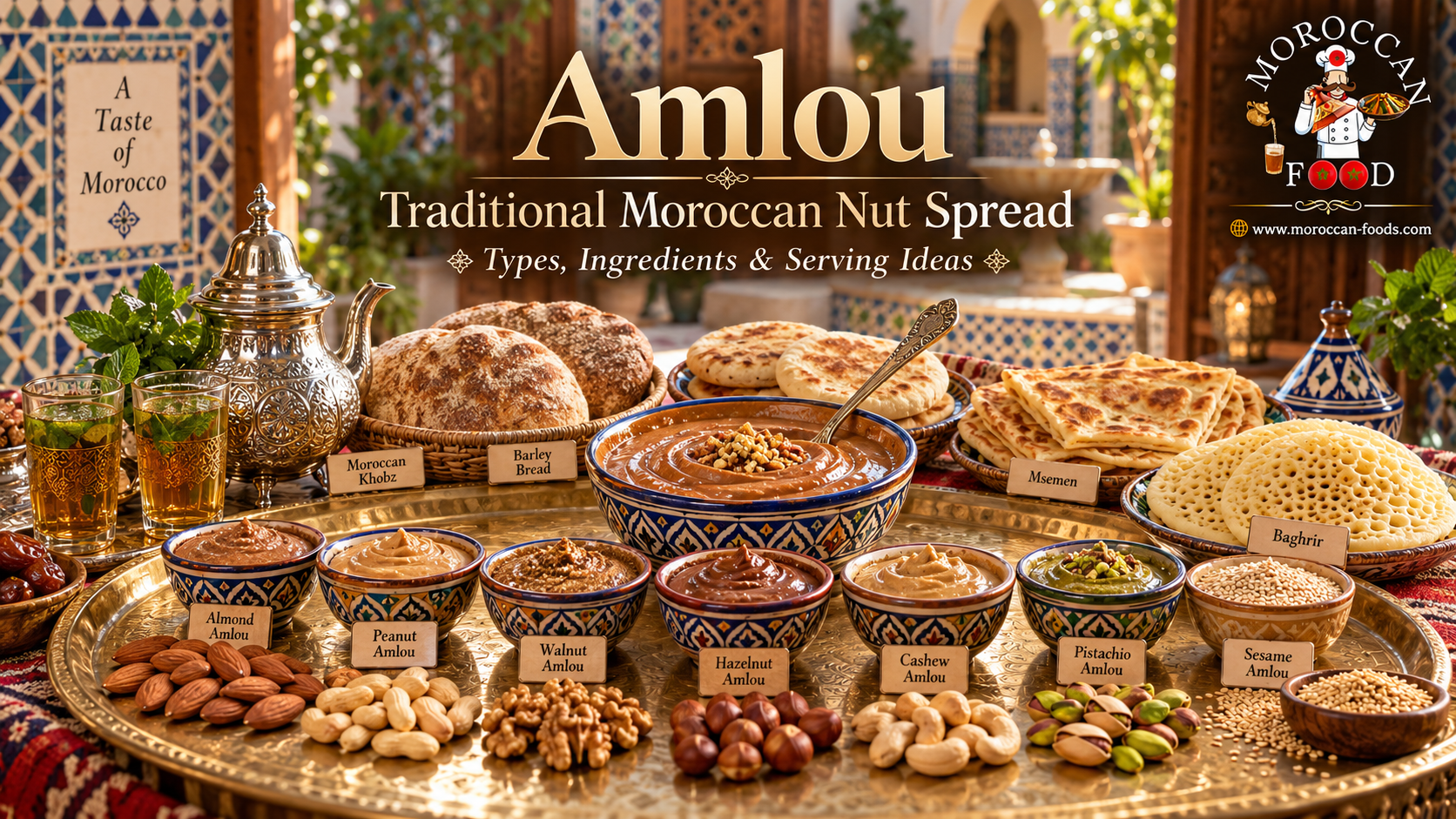
What Is Amlou?
Amlou is a rich Moroccan spread traditionally prepared with roasted almonds, culinary argan oil, and honey. It is especially associated with southern Morocco and the Souss region, where argan trees and argan oil form an important part of local food culture.
Its texture can range from slightly coarse and rustic to very smooth and creamy, depending on how finely the roasted almonds are ground and how much argan oil is added.
Traditional almond Amlou has a distinctive combination of flavors: the deep nuttiness of roasted almonds, the toasted character of culinary argan oil, and the natural sweetness of honey.
In Morocco, Amlou is commonly served at breakfast, brunch, afternoon tea, family gatherings, and special Moroccan tables, usually alongside bread, pancakes, tea, honey, olive oil, butter, cheese, and other spreads.
Although authentic traditional Amlou is made with almonds, many households and modern kitchens prepare Amlou-style spreads with other nuts and seeds, including peanuts, walnuts, hazelnuts, cashews, pistachios, sesame seeds, or combinations of several nuts.
Traditional Moroccan Amlou Ingredients
The classic version requires only three main ingredients:
- Roasted almonds
- Culinary argan oil
- Natural honey
The proportions can be adjusted according to the desired consistency and sweetness.
Basic Traditional Amlou Formula
For approximately one medium jar:
- 250 g raw almonds
- 80–120 ml culinary argan oil
- 60–100 g natural honey, or to taste
Important Note About Argan Oil
Use food-grade culinary argan oil, not cosmetic argan oil.
Culinary argan oil has a deep toasted and nutty flavor that is one of the defining characteristics of authentic Moroccan Amlou.

How to Make Traditional Moroccan Almond Amlou
Step 1: Roast the Almonds
Preheat the oven to approximately 170°C / 340°F.
Spread the almonds in a single layer on a baking tray.
Roast for approximately 10–15 minutes, stirring once or twice, until fragrant and lightly golden.
Avoid burning them, as this can make the finished Amlou bitter.
Allow the almonds to cool slightly.
Step 2: Grind the Almonds
Place the roasted almonds in a powerful food processor.
Process until finely ground.
Continue blending. The almonds will gradually move from a dry meal to a thicker paste as their natural oils are released.
Scrape down the sides of the processor when necessary.
Step 3: Add the Argan Oil
With the processor running, gradually add the culinary argan oil.
Continue blending until the mixture reaches the desired consistency.
For thick Amlou, use less oil. For a more fluid, pourable spread, add a little more.
Step 4: Add the Honey
Add the honey gradually and blend briefly until evenly incorporated.
Taste and adjust the sweetness.
Avoid adding excessive honey at once, as traditional Amlou should preserve the characteristic flavor of roasted almonds and argan oil.
Step 5: Transfer to a Jar
Transfer the Amlou to a clean jar.
Natural separation can occur during storage, particularly because of the oil. Simply stir the mixture before serving.

Different Types of Amlou
The following variations are useful for modern home preparation, but it is important to distinguish them from the classic Moroccan almond Amlou.
1. Traditional Almond Amlou
This is the reference version and the one most closely associated with authentic Moroccan Amlou.
Main Ingredients
- Roasted almonds
- Culinary argan oil
- Natural honey
Flavor
Rich, nutty, slightly toasted, naturally sweet, and deeply aromatic.
Best Served With
Moroccan bread, Msemen, Baghrir, Harcha, toast, or fresh fruit.
2. Peanut Amlou
Peanuts provide a more economical alternative and create an especially creamy spread.
Strictly speaking, this is better described as peanut Amlou or an Amlou-style peanut spread, rather than the traditional almond version.
Ingredients
- 250 g roasted unsalted peanuts
- 70–100 ml culinary argan oil
- 60–90 g honey
Flavor
Creamy, intensely roasted, and similar in richness to natural peanut butter but with the distinctive flavor of argan oil and honey.
Preparation
Blend the roasted peanuts until they release their natural oils and form a paste. Gradually add argan oil, followed by honey.
3. Almond and Peanut Amlou
Combining almonds and peanuts is a useful way to preserve some of the traditional almond character while producing a creamier and more economical spread.
Ingredients
- 150 g roasted almonds
- 100 g roasted peanuts
- 80–110 ml culinary argan oil
- 60–90 g honey
This version is especially good with Msemen and Moroccan tea.
4. Walnut Amlou
Walnuts create a deeper and slightly earthy flavor.
Ingredients
- 250 g lightly roasted walnuts
- 70–100 ml culinary argan oil
- 60–90 g honey
Because walnuts contain considerable natural oil, they may require less argan oil than almonds.
Flavor
Rich, earthy, slightly bitter, and particularly good with honey.
Avoid over-roasting walnuts, as they can become bitter.
5. Hazelnut Amlou
Hazelnuts produce an especially aromatic spread with a smooth, dessert-like character.
Ingredients
- 250 g roasted hazelnuts
- 70–100 ml culinary argan oil
- 60–90 g honey
Remove as much of the loosened hazelnut skin as practical after roasting for a smoother flavor and texture.
This variation works particularly well with Baghrir, pancakes, toast, and fruit.
6. Cashew Amlou
Cashews create one of the creamiest Amlou-style spreads.
Ingredients
- 250 g roasted unsalted cashews
- 60–90 ml culinary argan oil
- 50–80 g honey
Flavor
Mild, naturally sweet, creamy, and delicate.
Because cashews have a softer flavor than almonds, use argan oil gradually so it does not overpower them.
7. Pistachio Amlou
Pistachio Amlou is a more luxurious modern variation.
Ingredients
- 250 g roasted unsalted pistachios
- 60–90 ml culinary argan oil
- 50–80 g honey
Flavor
Rich, aromatic, slightly sweet, and distinctly pistachio-forward.
It is particularly attractive for special breakfasts, brunches, and Moroccan dessert tables.
8. Almond and Walnut Amlou
A combination of almonds and walnuts creates a more complex nut flavor.
Suggested Ratio
- 175 g roasted almonds
- 75 g roasted walnuts
- 70–100 ml culinary argan oil
- Honey to taste
The almonds provide structure while the walnuts contribute richness and additional natural oils.
9. Almond and Hazelnut Amlou
This version combines the familiar character of almond Amlou with the strong aroma of roasted hazelnuts.
Suggested Ratio
- 150 g almonds
- 100 g hazelnuts
- 70–100 ml culinary argan oil
- 60–90 g honey
It is particularly good as a breakfast spread.
10. Almond and Cashew Amlou
For a smoother and milder version, combine:
- 150 g almonds
- 100 g cashews
- 70–100 ml culinary argan oil
- Honey to taste
Cashews soften the texture while almonds retain more of the traditional nut profile.
11. Almond and Pistachio Amlou
This is an excellent premium variation for special occasions.
Use approximately:
- 175 g almonds
- 75 g pistachios
- 70–100 ml culinary argan oil
- Honey to taste
The almonds keep the flavor balanced while pistachios provide a distinctive aroma and color.
12. Mixed-Nut Amlou
Amlou can also be prepared with several nuts.
For example:
- Almonds
- Walnuts
- Hazelnuts
- Cashews
- Pistachios
A practical mixture would be:
- 100 g almonds
- 50 g walnuts
- 50 g hazelnuts
- 50 g cashews
- 80–110 ml culinary argan oil
- 60–90 g honey
The proportions can be changed according to preference.
For the most recognizably Moroccan flavor, keep almonds as the dominant nut.
13. Almond and Sesame Amlou
Although sesame is a seed rather than a nut, it pairs particularly well with almonds and Moroccan flavors.
Ingredients
- 200 g roasted almonds
- 50 g toasted sesame seeds
- 70–100 ml culinary argan oil
- 60–90 g honey
The sesame adds another roasted layer of flavor and creates a slightly denser spread.
14. Peanut and Sesame Amlou
Another economical variation can be made with:
- 200 g roasted peanuts
- 50 g toasted sesame seeds
- Culinary argan oil
- Honey
It produces a deeply toasted spread that works particularly well with Moroccan pancakes and bread.

What Nuts Can Be Used to Make Amlou?
The classic nut is almond, but Amlou-style spreads can be prepared with:
- Almonds
- Peanuts
- Walnuts
- Hazelnuts
- Cashews
- Pistachios
- Pecans
- Macadamia nuts
- Mixed nuts
Sesame seeds can also be combined with nuts.
However, when discussing Moroccan culinary tradition, it is useful to make one distinction clear:
Almond + culinary argan oil + honey is the traditional Moroccan Amlou.
The other combinations are best regarded as variations inspired by traditional Amlou.

Which Oil Should Be Used for Amlou?
For authentic Moroccan flavor, culinary argan oil is the preferred choice.
Its toasted aroma is central to the flavor of traditional Amlou.
Some homemade modern versions use other oils when argan oil is unavailable, but these will not reproduce the same traditional flavor.
If the purpose of your recipe is authenticity, culinary argan oil should remain the first recommendation.
Honey in Moroccan Amlou
Honey sweetens Amlou but also affects its thickness.
Natural honey can be added according to taste.
A lightly sweetened Amlou allows the flavors of the almonds and argan oil to remain prominent, while adding more honey creates a sweeter breakfast spread.
Different Moroccan honeys can also produce noticeably different flavors.
Smooth Amlou vs. Rustic Amlou
There is no need for every homemade Amlou to have exactly the same texture.
Smooth Amlou
Process the nuts for longer and add sufficient argan oil to create a creamy, flowing consistency.
Rustic Amlou
Stop blending earlier so that tiny pieces of roasted nuts remain visible.
Both textures can be delicious.
How Is Amlou Served in Morocco?
Amlou is particularly associated with the Moroccan breakfast and tea table.
It is usually served in a small bowl or dish so that pieces of bread or pancakes can be dipped into it or spread with it.
A traditional-style breakfast table may include Amlou alongside:
- Olive oil
- Honey
- Butter
- Cheese
- Jam
- Olives
- Moroccan tea
- Fresh bread
- Moroccan pancakes
Amlou can therefore be served as one component of a larger Moroccan breakfast rather than necessarily being eaten alone.
Moroccan Breads to Serve with Amlou
Amlou pairs beautifully with many types of Moroccan bread.
Moroccan Barley Bread
The nutty flavor of Moroccan barley bread works particularly well with almond Amlou.
The combination of barley, roasted almonds, argan oil, and honey creates a hearty breakfast with strong Moroccan flavors.
Khobz
Traditional round Moroccan bread can be torn into pieces and dipped directly into Amlou.
Its relatively neutral flavor makes it an excellent carrier for the rich spread.
Whole Wheat Moroccan Bread
Whole wheat bread provides a rustic flavor that complements almond and walnut Amlou particularly well.
Batbout
Soft skillet-cooked Batbout can be opened and filled with Amlou or simply torn into pieces and dipped into it.
Barley Batbout
Barley Batbout creates an especially nutty combination when paired with classic almond Amlou.
Amlou with Msemen
Msemen is one of the most enjoyable foods to pair with Amlou.
The warm, flaky layers of Msemen absorb the creamy mixture of almond, argan oil, and honey.
Different versions can be served with Amlou, including:
- Traditional plain Msemen(Discover the recipe)
- Whole wheat Msemen
- Barley-enriched Msemen
- Small individual Msemen
- Large family-style Msemen
Serve the Msemen warm and place Amlou in a small bowl beside it.
You can either spread the Amlou over individual pieces or dip them directly into the spread.
Amlou with Baghrir
Baghrir, the famous Moroccan thousand-hole pancake, is another excellent pairing.
The many tiny holes on the surface absorb liquid toppings exceptionally well.
Amlou can be:
- Spread directly over warm Baghrir.(Discover the recipe)
- Drizzled over the surface if the Amlou is relatively fluid.
- Served alongside honey and butter.
- Combined with sliced fruit for a more modern breakfast.
The combination of soft Baghrir and nutty Amlou creates an especially rich breakfast or afternoon snack.
Amlou with Harcha
Moroccan semolina Harcha(Discover the recipe) is also delicious with Amlou.
Its slightly crumbly texture contrasts beautifully with the smooth nut spread.
Serve Harcha warm and spread a small amount of Amlou over each piece.
Amlou for Moroccan Breakfast
Breakfast is one of the most natural occasions for serving Amlou.
A Moroccan-inspired breakfast can include:
Moroccan bread + Msemen + Baghrir + Amlou + olive oil + honey + butter + cheese + jam + olives + Moroccan mint tea.
Fresh fruit, dates, eggs, or dairy products can also be added depending on the household and occasion.
Rather than covering every bread with Amlou in advance, it is often more attractive to place the spread in a central bowl and let everyone serve themselves.

Amlou with Moroccan Mint Tea
A glass of Moroccan mint tea(Discover how to prepare Moroccan tea) is a classic companion to Moroccan breads and spreads.
The freshness of mint tea contrasts with the richness of almonds and argan oil.
For a traditional-style presentation, serve the tea in decorated Moroccan glasses alongside a Moroccan teapot, with Amlou, breads, pancakes, honey, and olive oil arranged around the table.
Amlou as an Afternoon Snack
Amlou is not limited to breakfast.
It can also be served during an afternoon tea or snack with:
- Moroccan mint tea
- Coffee
- Bread
- Msemen
- Baghrir
- Harcha
- Fresh fruit
- Dates
A smaller portion is usually sufficient because Amlou is naturally rich and concentrated.
Amlou for Guests and Family Gatherings
Amlou can be included on a generous Moroccan table prepared for guests.
Present it in a decorative bowl surrounded by several breads and pancakes.
For a premium presentation, offer two or three varieties, for example:
Traditional Almond Amlou
Walnut Amlou
Pistachio Amlou
This allows guests to compare different nut flavors while the traditional almond version remains the centerpiece.

Other Ways to Eat Amlou
Although serving Amlou with Moroccan bread remains one of the most traditional approaches, it is also versatile enough for modern recipes.
Try it with:
- Toast
- Pancakes
- Waffles
- Oatmeal
- Yogurt
- Apples
- Bananas
- Pears
- Dates
- Smoothie bowls
It can also be used as a filling or topping for certain desserts, provided its strong nutty flavor complements the other ingredients.
Is Amlou the Same as Peanut Butter?
No.
Traditional Amlou differs substantially from ordinary peanut butter.
Classic Amlou contains:
Roasted almonds + culinary argan oil + honey.
Peanut butter is primarily made from ground peanuts and may contain salt, sugar, or added oil depending on the product.
Amlou has a distinct Moroccan character because of culinary argan oil.
Is Amlou the Same as Almond Butter?
Not exactly.
Almond butter is generally produced primarily from ground almonds.
Traditional Amlou combines almonds with argan oil and honey, giving it a more fluid texture, sweeter flavor, and distinctive toasted aroma.
How to Adjust the Consistency of Amlou
If Amlou Is Too Thick
Gradually add a little more culinary argan oil.
Start with approximately one teaspoon at a time.
If Amlou Is Too Thin
Add additional finely ground roasted almonds or allow the mixture to stand briefly before adjusting it.
If Amlou Is Too Sweet
Add additional ground almonds and a small amount of argan oil.
If Amlou Is Not Sweet Enough
Add honey gradually and taste after each addition.
Tips for Making Better Amlou
Use fresh nuts, because stale nuts can produce unpleasant flavors.
Roast the nuts carefully to develop flavor without burning them.
Allow freshly roasted nuts to cool slightly before processing.
Use a sufficiently powerful food processor and stop periodically to prevent overheating.
Add argan oil gradually rather than pouring in the entire quantity at once.
Add honey after the nuts have already formed a paste.
Taste before making final adjustments.
For the best traditional flavor, choose culinary Moroccan argan oil.
How to Store Homemade Amlou
Transfer homemade Amlou to a clean, dry, airtight jar.
Because homemade recipes do not contain commercial stabilizers, some natural separation can occur.
Stir thoroughly before serving if the oil rises to the surface.
Always use a clean, dry spoon to reduce contamination.
Storage time can vary depending on the ingredients, preparation method, temperature, and freshness of the nuts and oil, so discard the spread if its aroma, flavor, or appearance becomes unusual.
Traditional Amlou vs. Modern Amlou Variations
The growing popularity of nut butters has encouraged many new Amlou-inspired combinations.
This creativity can be delicious, but understanding the distinction helps preserve the identity of the Moroccan recipe.
Traditional Moroccan Amlou
Almonds + culinary argan oil + honey
Modern Amlou Variations
Can include:
Peanuts, walnuts, hazelnuts, cashews, pistachios, sesame, or mixtures of several nuts.
Both approaches can have a place in the kitchen, but the almond version remains the essential starting point for understanding authentic Moroccan Amlou.
A Moroccan Spread with Endless Possibilities
Amlou demonstrates how a small number of ingredients can create an exceptionally distinctive Moroccan food.
At its heart, traditional Amlou remains a simple combination of roasted almonds, culinary argan oil, and honey. Its rich flavor makes it a natural companion for Moroccan bread, Msemen, Baghrir, Harcha, and mint tea.
At the same time, the basic preparation method can inspire many variations using peanuts, walnuts, hazelnuts, cashews, pistachios, sesame seeds, and mixed nuts.
Whether served at breakfast with warm Moroccan barley bread, spooned over fresh Baghrir, spread across flaky Msemen, or presented to guests alongside a pot of Moroccan mint tea, Amlou remains one of the most distinctive spreads of the Moroccan table.
Health Benefits and Nutritional Value of Amlou Variations
1. Traditional Almond Amlou
Traditional Moroccan Amlou combines roasted almonds, culinary argan oil, and natural honey.
Estimated Nutrition per 30 g
- Calories: 177 kcal
- Protein: 3.9 g
- Fat: 15.2 g
- Carbohydrates: 8.5 g
- Dietary Fiber: 2.3 g
Health Benefits
Almonds provide vitamin E, magnesium, plant protein, fiber, and unsaturated fats. Culinary argan oil contributes predominantly unsaturated fats and naturally occurring antioxidant compounds, while honey provides carbohydrates and sweetness.
2. Peanut Amlou
Estimated Nutrition per 30 g
- Calories: 175 kcal
- Protein: 4.8 g
- Fat: 15.1 g
- Carbohydrates: 7.5 g
- Dietary Fiber: 1.6 g
Health Benefits
Peanuts are particularly rich in plant protein, niacin, magnesium, phosphorus, and healthy fats. This variation generally provides slightly more protein than classic almond Amlou.
3. Almond and Peanut Amlou
Estimated Nutrition per 30 g
- Calories: 176 kcal
- Protein: 4.3 g
- Fat: 15.2 g
- Carbohydrates: 8.1 g
- Dietary Fiber: 2.0 g
Health Benefits
This combination brings together the vitamin E and fiber of almonds with the relatively high plant-protein content of peanuts, creating a balanced and satisfying spread.
4. Walnut Amlou
Estimated Nutrition per 30 g
- Calories: 191 kcal
- Protein: 2.8 g
- Fat: 18.1 g
- Carbohydrates: 7.1 g
- Dietary Fiber: 1.2 g
Health Benefits
Walnuts are notable for providing ALA omega-3 fatty acids, along with copper, manganese, magnesium, and polyphenols.
This variation is one of the richest in fat and calories, but much of that fat comes from unsaturated fatty acids.
5. Hazelnut Amlou
Estimated Nutrition per 30 g
- Calories: 186 kcal
- Protein: 2.8 g
- Fat: 17.2 g
- Carbohydrates: 7.6 g
- Dietary Fiber: 1.8 g
Health Benefits
Hazelnuts are an excellent source of vitamin E, manganese, copper, and monounsaturated fats. They also contribute fiber and naturally occurring antioxidants.
6. Cashew Amlou
Estimated Nutrition per 30 g
- Calories: 172 kcal
- Protein: 3.4 g
- Fat: 14.1 g
- Carbohydrates: 10.1 g
- Dietary Fiber: 0.6 g
Health Benefits
Cashews contribute copper, magnesium, phosphorus, zinc, and plant protein. Their naturally creamy texture also allows this version to achieve a smooth consistency without requiring excessive processing.
7. Pistachio Amlou
Estimated Nutrition per 30 g
- Calories: 174 kcal
- Protein: 3.7 g
- Fat: 14.4 g
- Carbohydrates: 9.6 g
- Dietary Fiber: 1.9 g
Health Benefits
Pistachios provide plant protein, fiber, vitamin B6, potassium, phosphorus, and antioxidant compounds such as lutein and zeaxanthin.
8. Almond and Walnut Amlou
Estimated Nutrition per 30 g
- Calories: 181 kcal
- Protein: 3.6 g
- Fat: 16.1 g
- Carbohydrates: 8.1 g
- Dietary Fiber: 2.0 g
Health Benefits
This variation combines the vitamin E and fiber from almonds with the ALA omega-3 fats found in walnuts.
It is a particularly nutrient-dense combination.
9. Almond and Hazelnut Amlou
Estimated Nutrition per 30 g
- Calories: 181 kcal
- Protein: 3.5 g
- Fat: 16.0 g
- Carbohydrates: 8.2 g
- Dietary Fiber: 2.1 g
Health Benefits
Almonds and hazelnuts are both rich in vitamin E and unsaturated fats, making this variation especially notable for its antioxidant nutrients.
10. Almond and Cashew Amlou
Estimated Nutrition per 30 g
- Calories: 175 kcal
- Protein: 3.7 g
- Fat: 14.8 g
- Carbohydrates: 9.2 g
- Dietary Fiber: 1.6 g
Health Benefits
Almonds contribute fiber and vitamin E, while cashews provide copper, magnesium, zinc, and phosphorus.
This is one of the milder and creamier combinations.
11. Almond and Pistachio Amlou
Estimated Nutrition per 30 g
- Calories: 176 kcal
- Protein: 3.9 g
- Fat: 15.0 g
- Carbohydrates: 8.9 g
- Dietary Fiber: 2.2 g
Health Benefits
This variation provides a useful combination of protein, fiber, vitamin E, vitamin B6, potassium, and unsaturated fats.
12. Mixed-Nut Amlou
A mixed-nut version may contain almonds, walnuts, hazelnuts, cashews, and pistachios.
Estimated Nutrition per 30 g
- Calories: 181 kcal
- Protein: 3.4 g
- Fat: 16.0 g
- Carbohydrates: 8.4 g
- Dietary Fiber: 1.7 g
Health Benefits
Using several nuts broadens the nutritional profile and can provide a combination of:
- Vitamin E
- Magnesium
- Copper
- Manganese
- Plant protein
- Fiber
- Monounsaturated and polyunsaturated fats
13. Almond and Sesame Amlou
Estimated Nutrition per 30 g
- Calories: 177 kcal
- Protein: 3.8 g
- Fat: 15.2 g
- Carbohydrates: 8.6 g
- Dietary Fiber: 2.3 g
Health Benefits
Sesame contributes calcium, copper, magnesium, iron, lignans, and unsaturated fats, while almonds add vitamin E and fiber.
14. Peanut and Sesame Amlou
Estimated Nutrition per 30 g
- Calories: 175 kcal
- Protein: 4.5 g
- Fat: 15.1 g
- Carbohydrates: 7.8 g
- Dietary Fiber: 1.7 g
Health Benefits
This variation is relatively rich in plant protein and provides nutrients including magnesium, phosphorus, niacin, copper, and healthy fats.
General Health Benefits of Amlou
Across its different versions, Amlou can provide several nutritional advantages because it combines nuts or seeds with culinary argan oil.
Depending on the variety, Amlou can be a source of:
- Unsaturated fats
- Plant-based protein
- Dietary fiber
- Vitamin E
- Magnesium
- Copper
- Manganese
- Phosphorus
- Various naturally occurring antioxidant compounds
Walnut versions additionally provide ALA omega-3 fatty acids, while sesame-based variations can contribute additional calcium and minerals.
Important Nutrition Note
Amlou is nutrient-dense but also calorie-dense because nuts and argan oil contain substantial amounts of fat.
A serving of approximately 1–2 tablespoons is therefore usually enough to accompany Moroccan bread, Msemen, Baghrir, or Harcha.
The addition of honey also means Amlou contains added/free sugars, so the amount of honey can be adjusted according to taste and dietary preference.
Nutrition Disclaimer: These values are estimates. Actual nutrition varies according to the type and quantity of nuts, amount of argan oil and honey, roasting method, and serving size.

Frequently Asked Questions About Amlou
1. What is Amlou?
Amlou is a traditional Moroccan spread made from roasted almonds, culinary argan oil, and natural honey. It is especially associated with southern Morocco and is commonly served at breakfast or tea time with Moroccan bread, Msemen, Baghrir, and other traditional baked goods.
2. What is traditional Moroccan Amlou made of?
Traditional Moroccan Amlou is made from three main ingredients: roasted almonds, food-grade culinary argan oil, and natural honey. The almonds provide the nutty base, argan oil gives Amlou its distinctive Moroccan flavor, and honey adds sweetness.
3. Is Amlou always made with almonds?
Traditional Amlou is made with almonds. However, modern Amlou-style variations can be prepared with walnuts, hazelnuts, cashews, pistachios, peanuts, pecans, macadamia nuts, sesame seeds, or a mixture of several nuts.
4. What nuts can be used to make Amlou?
Besides almonds, Amlou-style spreads can be made with walnuts, hazelnuts, cashews, pistachios, peanuts, pecans, macadamia nuts, or mixed nuts. Almonds remain the traditional choice for authentic Moroccan Amlou.
5. What is the best nut for traditional Amlou?
Almonds are the traditional and most authentic choice. When roasted and blended with culinary argan oil and honey, they create the classic flavor and texture associated with Moroccan Amlou.
6. Can I make Amlou with peanuts?
Yes. Roasted peanuts can be blended with culinary argan oil and honey to make a creamy Amlou-style spread. However, peanut Amlou is a modern variation rather than the classic traditional almond version.
7. Can Amlou be made with walnuts?
Yes. Walnut Amlou can be prepared with roasted walnuts, culinary argan oil, and honey. Walnuts create a richer, earthier flavor and naturally provide ALA omega-3 fatty acids.
8. Can I make Amlou with pistachios?
Yes. Pistachios can be used to make a premium Amlou-style variation. Pistachio Amlou has a distinctive green color, creamy texture, and delicate nutty flavor.
9. Can sesame seeds be used in Amlou?
Yes. Toasted sesame seeds can be combined with almonds or peanuts to make an Amlou-style spread. Sesame is technically a seed rather than a nut, but it adds a pleasant roasted flavor and additional minerals.
10. What type of argan oil should I use for Amlou?
Use food-grade culinary argan oil intended for eating. Cosmetic argan oil should not be used in food. Culinary argan oil has a distinctive roasted, nutty flavor that is essential to traditional Moroccan Amlou.
11. Can I make Amlou without argan oil?
You can prepare a nut-and-honey spread with another edible oil, but it will not have the characteristic flavor of authentic Moroccan Amlou. For the traditional version, culinary argan oil is an essential ingredient.
12. Is Amlou the same as almond butter?
No. Almond butter is usually made primarily from ground almonds, whereas traditional Amlou combines roasted almonds, culinary argan oil, and honey. Amlou is generally sweeter and has a distinctive argan-oil flavor.
13. Is Amlou the same as peanut butter?
No. Traditional Amlou is made with almonds, argan oil, and honey, while peanut butter is primarily made from peanuts. Peanut Amlou exists as a variation, but it is different from classic Moroccan Amlou.
14. Is Moroccan Amlou healthy?
Amlou is nutrient-dense and can provide unsaturated fats, plant-based protein, dietary fiber, vitamin E, magnesium, and other minerals, depending on the nuts used. However, it is also calorie-dense and contains honey, so portion size matters.
15. How many calories are in Amlou?
The exact calorie content depends on the proportions of nuts, argan oil, and honey. In the variations described in this article, a 30 g serving generally provides roughly 170–190 calories.
16. Does Amlou contain protein?
Yes. Nuts naturally contain plant-based protein. The exact amount varies by the type of nut used, with peanut, almond, and pistachio versions generally providing more protein than some other varieties.
17. Is Amlou high in fat?
Amlou is relatively high in fat because both nuts and argan oil naturally contain fat. Much of this is unsaturated fat, but Amlou remains calorie-dense and is best enjoyed in moderate portions.
18. How is Amlou traditionally eaten in Morocco?
Amlou is commonly served as part of a Moroccan breakfast or tea table. It can be spread on bread or served in a small bowl for dipping.
It pairs especially well with Moroccan Khobz, barley bread, Batbout, Msemen, Baghrir, Harcha, and Moroccan mint tea.
19. Can Amlou be served with Msemen?
Yes. Warm Msemen pairs particularly well with Amlou because its flaky layers absorb the almond, argan oil, and honey mixture beautifully.
20. Can Amlou be served with Baghrir?
Yes. Baghrir, the Moroccan thousand-hole pancake, is an excellent pairing because its porous surface absorbs Amlou easily. Amlou can be spread or lightly drizzled over warm Baghrir.
21. What Moroccan breads are best with Amlou?
Amlou can be served with traditional Moroccan Khobz, Moroccan barley bread, whole wheat bread, Batbout, barley Batbout, Harcha, Msemen, and Baghrir.
22. Is Amlou eaten only for breakfast?
No. Although Amlou is popular at breakfast, it can also be served during afternoon tea, brunch, family gatherings, celebrations, or when welcoming guests.
23. Can Amlou be used in modern recipes?
Yes. In addition to Moroccan bread and pancakes, Amlou can be served with toast, oatmeal, yogurt, fruit, waffles, smoothie bowls, or used as a topping or filling in suitable desserts.
24. How do I make Amlou smoother?
Blend the roasted nuts until they release their natural oils and form a fine paste, then gradually add culinary argan oil. Continue processing until the desired consistency is reached.
25. Why does oil separate from homemade Amlou?
Natural separation can occur because homemade Amlou does not usually contain commercial emulsifiers or stabilizers. If argan oil rises to the surface, simply stir the Amlou thoroughly before serving.
26. How should homemade Amlou be stored?
Store homemade Amlou in a clean, dry, airtight jar and always use a clean spoon. Storage life depends on the freshness of the nuts, oil, honey, preparation method, and storage conditions.
27. Does Amlou contain added sugar?
Traditional Amlou contains honey, which contributes sweetness and free sugars. You can adjust the amount of honey according to your preferred sweetness while keeping the roasted almond and argan flavors prominent.
28. Is Amlou suitable for people with nut allergies?
Traditional Amlou contains almonds, and most variations contain other nuts or peanuts. Anyone with a nut or peanut allergy should avoid versions containing their allergen and carefully check all ingredients for cross-contact risks.
29. Which Amlou variation is highest in protein?
Among the variations discussed in this article, peanut Amlou tends to be one of the higher-protein options, followed closely by almond- and pistachio-based versions. Exact values depend on the recipe proportions.
30. What is the difference between traditional Amlou and modern Amlou variations?
Traditional Moroccan Amlou is specifically made with roasted almonds, culinary argan oil, and honey. Modern variations replace or combine almonds with other nuts or seeds such as walnuts, hazelnuts, cashews, pistachios, peanuts, or sesame.


Leave a Reply