
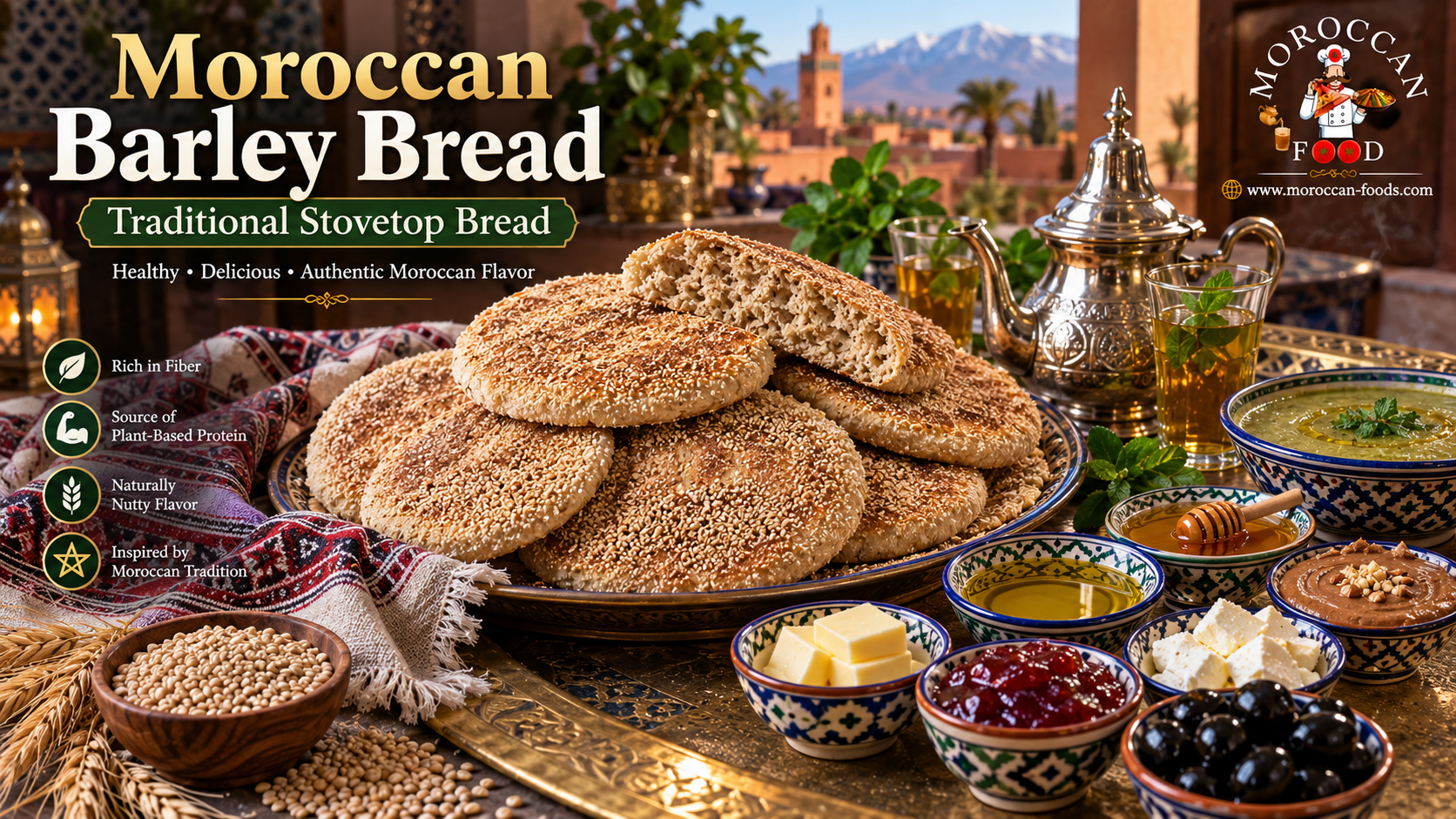
Moroccan Barley Bread is a rustic and flavorful Moroccan stovetop bread made primarily with barley flour and cooked on a hot skillet until tender, lightly browned, and beautifully puffed.
Known in Morocco as a hearty variation of Batbout, this bread has a pleasant nutty and earthy flavor from the barley flour and a soft yet slightly rustic texture. Because barley contains much less gluten than regular wheat flour, this recipe combines barley flour with a smaller amount of wheat flour to create a dough that is easier to knead, shape, and cook while keeping the characteristic taste of barley.
Moroccan barley bread is especially delicious when served warm with extra-virgin olive oil, honey, amlou, soft cheese, jam, black olives, bissara, or Moroccan mint tea. It can also be sliced open and filled with vegetables, cheese, eggs, tuna, chicken, or other savory ingredients.
Recipe Information
Prep Time: 20 minutes
Resting & Rising Time: 55–65 minutes
Cook Time: 20–25 minutes
Total Time: About 1 hour 40 minutes
Servings: 8–10 medium breads
Difficulty: Easy–Medium
Cooking Method: Stovetop / Dry Skillet
Cuisine: Moroccan
Ingredients
For the Moroccan Barley Bread Dough
- 350 g barley flour
- 150 g whole wheat flour or all-purpose flour
- 60 g barley groats, for coating the bread
- 7 g instant dry yeast (about 2 1/4 teaspoons)
- 1 teaspoon granulated sugar
- 1 1/2 teaspoons salt
- 360–390 ml lukewarm water, added gradually
- Extra barley flour for dusting

Important Dough Note
Barley flour absorbs water differently from wheat flour and contains much less gluten.
Begin with approximately 360 ml of lukewarm water, then add more gradually if necessary.
The finished dough should feel soft, moist, flexible, and slightly tacky, rather than dry or stiff.
Avoid adding too much extra flour while kneading, as this can make the bread dense.
How to Make Moroccan Barley Bread
Step 1: Combine the Flours
Place the barley flour and wheat flour in a large mixing bowl.
Mix thoroughly until the two flours are evenly distributed.
This helps create a consistent texture throughout the dough.
Step 2: Add the Yeast, Sugar, and Salt
Add the instant dry yeast and sugar to the flour mixture.
Add the salt and mix all the dry ingredients thoroughly.
The sugar helps activate the yeast while the salt adds flavor and strengthens the dough structure.
Step 3: Gradually Add the Water
Slowly pour approximately 360 ml of lukewarm water into the flour mixture while mixing with your hand or a wooden spoon.
Continue mixing until the ingredients begin to come together into a soft dough.
If dry flour remains, add additional lukewarm water 1 tablespoon at a time.
Do not add all the water at once, because different brands of barley flour may absorb different amounts.
Step 4: Allow the Dough to Hydrate
Cover the bowl with a clean kitchen towel and allow the dough to rest for approximately 10 minutes.
This short resting period allows the barley flour to absorb the water more fully and makes the dough easier to knead.
Step 5: Knead the Dough
Transfer the dough to a clean work surface.
Knead for approximately 8–10 minutes, until the dough becomes smoother, softer, and more cohesive.
Barley dough will not become as stretchy or elastic as dough made entirely with wheat flour, so do not expect the same gluten development.
If the dough feels dry, wet your hands lightly or add a very small amount of lukewarm water.
Step 6: First Rise
Shape the dough into a ball and place it back in the bowl.
Cover and allow it to rise in a warm place for approximately 25–30 minutes.
The dough does not necessarily need to double in size. It should become noticeably softer and slightly puffed.
Step 7: Roll Out the Dough
Lightly dust the work surface with barley flour.
Place the dough on the surface and gently roll it out to approximately 7–9 mm thick.
Keeping the dough slightly thicker helps Moroccan barley bread remain tender and improves its chances of puffing during cooking.
Step 8: Cut the Bread
Using a round cutter, bowl, or wide glass, cut the dough into circles approximately 10–12 cm in diameter.
Place the circles on a clean kitchen towel or lightly floured tray.
Gather the remaining dough gently, allow it to rest for approximately 5 minutes, then roll it again and cut additional rounds.
Avoid repeatedly kneading the scraps, as this may make the dough tighter.
Step 9: Second Rise
Cover the bread rounds with a clean kitchen towel.
Allow them to rest for approximately 25–30 minutes.
The rounds should become slightly thicker and puffier before cooking.
Step 10: Preheat the Skillet
Heat a heavy skillet, cast-iron pan, or Moroccan griddle over medium heat.
Allow the pan to become evenly hot before adding the bread.
Do not add oil or butter.
Moroccan Batbout-style barley bread is traditionally cooked on a dry cooking surface.
Step 11: Cook the Moroccan Barley Bread
Place a few bread rounds in the hot skillet without overcrowding the pan.
Cook for approximately 1–2 minutes, then turn them over.
Continue turning the bread frequently as it cooks.
Regular flipping helps the heat distribute evenly and encourages the bread to puff.
Cook each piece for approximately 5–7 minutes in total, depending on its thickness and the heat of the skillet.
The bread is ready when:
- Both sides have golden-brown spots.
- The exterior feels cooked and dry.
- The inside is fully cooked.
- Some pieces may puff completely while others may puff partially.
Adjust the heat if the surface browns too quickly before the inside is cooked.
Step 12: Keep the Bread Soft
Transfer the cooked barley bread to a clean kitchen towel.
Cover it while the remaining pieces are cooking.
The trapped steam helps keep the bread soft and tender.
Serve warm or allow it to cool completely before storing.

Serving Suggestions
Serve Moroccan Barley Bread warm with:
- Extra-virgin olive oil
- Moroccan honey
- Amlou
- Butter
- Soft cheese
- Jam
- Black or green olives
- Bissara
- Moroccan mint tea

You can also slice the bread open and use it for Moroccan-style sandwiches filled with eggs, tuna, grilled vegetables, cheese, chicken, or meat.
Show Nutritional Value
Estimated nutrition per 1 medium Moroccan Barley Bread
Based on a batch of 10 breads.
| Nutrient | Approx. Amount |
|---|---|
| Calories | 197 kcal |
| Protein | 6.7 g |
| Carbohydrates | 42.1 g |
| Dietary Fiber | 6.4 g |
| Total Fat | 1.1 g |
| Sodium | 354 mg |

Frequently Asked Questions
1. What is Moroccan Barley Bread?
Moroccan Barley Bread is a traditional-style Moroccan bread made primarily with barley flour and cooked on a hot, dry skillet. This version combines barley flour with a smaller amount of wheat flour to improve the dough structure while preserving the characteristic nutty flavor of barley.
2. What is barley bread called in Morocco?
Barley bread is commonly prepared in different forms throughout Morocco. A small, skillet-cooked version can be described as Moroccan Barley Batbout, while larger barley breads may be baked or cooked on traditional Moroccan griddles.
3. Why is wheat flour added to Moroccan barley bread?
Barley contains much less gluten than wheat. Adding a modest amount of wheat flour makes the dough easier to knead, shape, and handle and helps the bread develop a softer texture and better rise.
4. Can I make Moroccan barley bread with 100% barley flour?
Yes, but the result will be denser, more fragile, and less likely to puff because barley flour contains very little gluten. For a softer and easier-to-handle bread, combining barley flour with some wheat flour generally gives better results.
5. What are barley groats used for in this recipe?
Barley groats are used to lightly coat the outside of the bread before the final rise and cooking. They add a rustic Moroccan appearance, extra texture, and a stronger barley character.
6. Are barley groats the same as bulgur?
No. Barley groats are made from barley, while traditional bulgur is generally made from cracked wheat. For this recipe, use barley groats if you want an authentic barley coating.
7. How much barley groats should I use for coating the bread?
Approximately 60 g of barley groats is usually enough to lightly coat a batch of 8–10 medium Moroccan barley breads. The exact amount may vary depending on how heavily you coat each piece.
8. Why is my barley bread not puffing?
Barley bread may not puff as dramatically as wheat Batbout because barley contains less gluten. Make sure the dough is soft rather than dry, allow enough rising time, roll the dough evenly, and cook it on a properly preheated skillet while turning it regularly.
9. How thick should Moroccan barley bread be?
Roll the dough to approximately 7–9 mm thick before cutting. A slightly thicker dough helps the bread stay tender and gives it a better chance of puffing during cooking.
10. Should Moroccan barley bread be cooked with oil?
No. This Batbout-style barley bread is best cooked on a hot, dry skillet or griddle without oil. Olive oil can be served alongside the bread after cooking.
11. How do I keep Moroccan barley bread soft?
Transfer the cooked bread to a clean kitchen towel and cover it while the remaining pieces cook. The retained steam helps keep the bread soft and tender.
12. What can I serve with Moroccan barley bread?
Moroccan barley bread pairs well with extra-virgin olive oil, natural honey, amlou, butter, soft cheese, jam, black olives, bissara, and Moroccan mint tea. It can also be sliced open and used for savory sandwiches.
13. Is Moroccan barley bread high in fiber?
Barley naturally contains dietary fiber, including soluble beta-glucan fiber. When made with barley flour and whole wheat flour, this bread can provide more fiber than many breads made only with refined white flour.
14. How many calories are in one Moroccan barley bread?
Based on this recipe divided into 10 medium breads, one bread contains approximately 197 calories. The exact value can vary depending on flour brands, bread size, and how much barley coating adheres to each piece.
15. How should I store Moroccan barley bread?
Allow the bread to cool completely, then store it in an airtight container or sealed food bag at room temperature for about 1–2 days. For longer storage, freezing is a better option.
16. Can Moroccan barley bread be frozen?
Yes. Allow the bread to cool completely, place pieces in a freezer-safe bag with parchment paper between them if needed, and freeze. Reheat directly in a skillet, toaster oven, or regular oven until warm and soft.
17. Can I use whole wheat flour instead of all-purpose flour?
Yes. Whole wheat flour works very well with barley flour and gives the bread a more rustic flavor and higher fiber content. All-purpose flour can also be used for a slightly lighter and softer texture.
18. Why should the water be added gradually?
Different barley flours absorb different amounts of water. Adding the lukewarm water gradually allows you to control the dough consistency and prevents it from becoming excessively wet or too dry.
19. What should Moroccan barley bread dough feel like?
The dough should feel soft, moist, flexible, and slightly tacky, but it should still hold its shape. A dry or stiff dough can produce dense bread.
20. Can Moroccan barley bread be used for sandwiches?
Yes. Once cooked and slightly cooled, the bread can be sliced open and filled with eggs, tuna, cheese, vegetables, chicken, meat, or other savory fillings.


Leave a Reply