
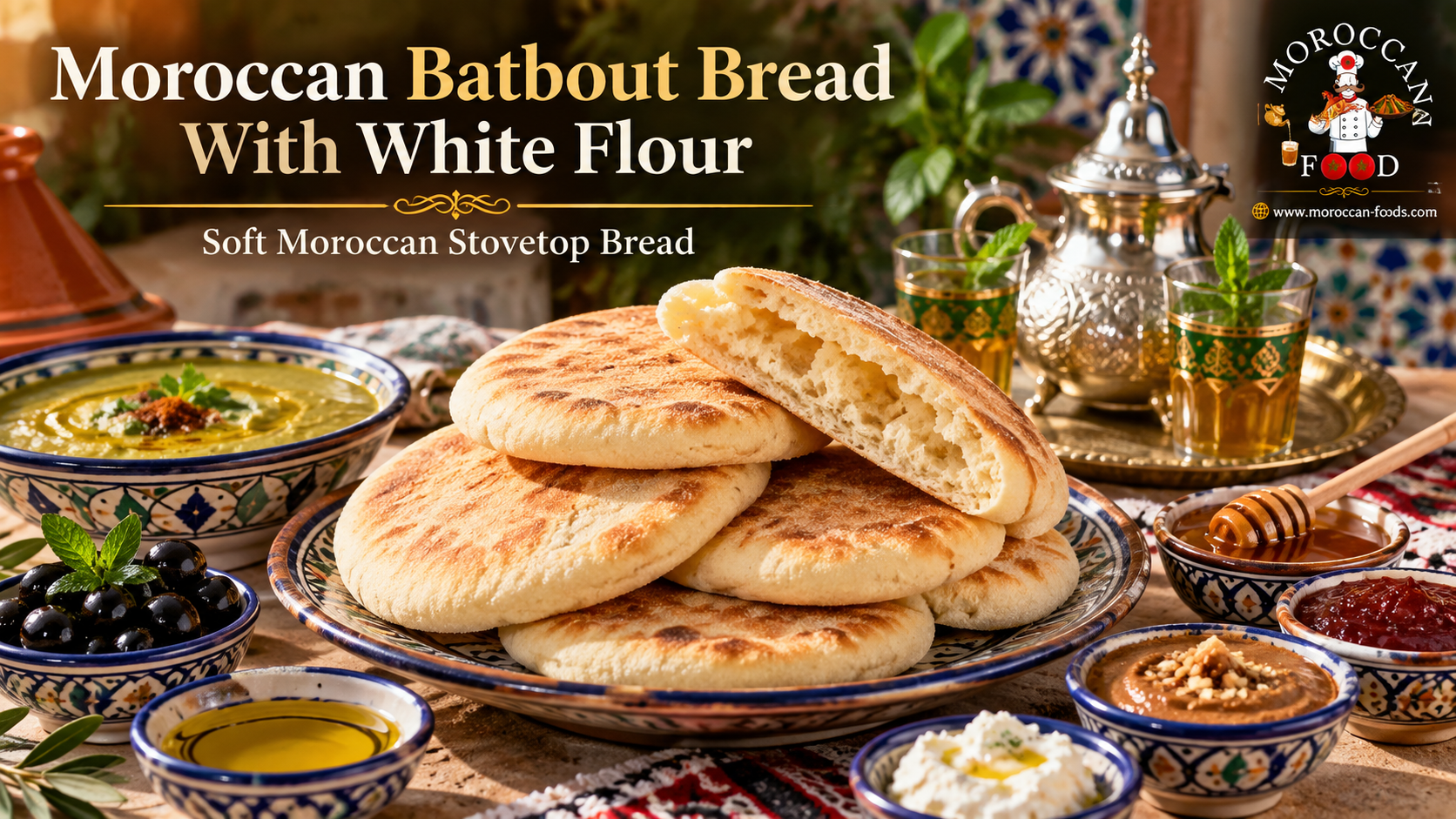
Moroccan Batbout Bread With White Flour is a soft, light, and versatile Moroccan stovetop bread traditionally cooked in a dry skillet rather than baked in the oven. Made with simple ingredients including white flour, yeast, salt, sugar, and warm water, batbout develops a tender interior and a lightly golden surface while cooking.
Also known as Moroccan pan bread or Moroccan stovetop bread, batbout can be served warm at breakfast with butter, honey, olive oil, cheese, or jam. It can also be opened and filled with savory ingredients to make small Moroccan-style sandwiches.
This version uses white flour only, without semolina, creating a smooth and soft dough that is easy to shape and cook at home.
Recipe Information
Prep Time: 20 minutes
Resting Time: 30–40 minutes
Cook Time: 15–20 minutes
Total Time: About 1 hour 10 minutes
Servings: 8–10 medium batbout breads
Difficulty: Easy
Cooking Method: Stovetop / Skillet
Ingredients
For the Batbout Dough
- 500 g (about 4 cups) all-purpose flour / white flour
- 7 g (2 1/4 teaspoons) instant dry yeast
- 1 teaspoon granulated sugar
- 1 1/2 teaspoons salt
- 300–330 ml (1 1/4–1 1/3 cups) lukewarm water, added gradually
- A little extra flour for dusting the work surface
Important Note
The exact amount of water can vary slightly depending on the flour. Add it gradually until you obtain a soft, smooth, and slightly supple dough that does not feel excessively sticky.

How to Make Moroccan Batbout With White Flour
Step 1: Combine the Dry Ingredients
Place the white flour in a large mixing bowl.
Add the instant yeast and sugar to one side of the bowl and the salt to another side.
Mix the dry ingredients together until evenly distributed.
Step 2: Add the Warm Water
Gradually pour in the lukewarm water while mixing with your hand or a wooden spoon.
Continue adding water little by little until the flour comes together into a soft dough.
Avoid adding all the water at once because different types of flour absorb different amounts of liquid.
Step 3: Knead the Dough
Transfer the dough to a lightly floured work surface.
Knead for approximately 8–10 minutes, until the dough becomes:
- Smooth
- Elastic
- Soft
- Easy to stretch
If the dough feels very sticky, dust it with a small amount of flour. Avoid adding too much flour because this can make the finished batbout dense.
Step 4: Rest the Dough Briefly
Shape the dough into a ball and cover it with a clean kitchen towel.
Allow it to rest for approximately 10 minutes.
This short rest relaxes the gluten and makes the dough easier to roll.
Step 5: Roll Out the Dough
Lightly flour the work surface.
Roll the dough evenly to approximately 5–7 mm thick.
For softer, thicker batbout, keep the dough slightly thicker. For smaller sandwich-style batbout, you can roll it a little thinner.
Step 6: Cut the Batbout
Use a round cookie cutter, bowl, or drinking glass to cut the dough into circles.
For medium batbout, make each circle approximately 10–12 cm (4–5 inches) wide.
Collect the remaining dough scraps, knead them together gently, allow them to rest for a few minutes, then roll and cut again.
Step 7: Let the Batbout Rise
Place the dough circles on a clean kitchen towel or lightly floured tray.
Cover them with another towel and allow them to rest for approximately 20–30 minutes, or until slightly puffed.
They do not need to double completely in size.
Step 8: Heat the Pan
Heat a heavy skillet, griddle, or nonstick pan over medium heat.
Do not add oil.
Allow the pan to heat thoroughly before adding the batbout.
Step 9: Cook the Batbout
Place several dough rounds in the hot skillet without overcrowding the pan.
Cook for approximately 1–2 minutes, then turn them over.
Continue turning the batbout every 30–60 seconds so both sides cook evenly.
As they cook, they should gradually puff and develop light golden-brown spots.
Cook each batbout for approximately 4–6 minutes total, depending on its thickness and the heat of the pan.
Step 10: Keep Them Soft
Transfer the cooked batbout immediately to a clean kitchen towel and cover them.
Keeping them covered while warm traps a little steam and helps maintain their soft texture.
Repeat with the remaining dough.

How to Serve Moroccan Batbout
Serve Moroccan batbout warm with:
- Moroccan olive oil
- Butter
- Honey
- Jam
- Soft cheese
- Amlou

Batbout can also be sliced open and filled with savory ingredients for breakfast, lunch, snacks, or Moroccan-style sandwiches.
Show Nutritional Value
Nutritional Value — Per 1 Medium Batbout
| Nutrient | Approximate Amount |
|---|---|
| Calories | 185–190 kcal |
| Protein | 5–6 g |
| Carbohydrates | 38–39 g |
| Dietary Fiber | 1.5–2 g |
| Total Fat | 0.5–1 g |
| Saturated Fat | <0.2 g |
| Sugars | ≈1 g |
| Sodium | ≈350 mg |
| Iron | ≈2 mg |
| Calcium | ≈10–15 mg |

Frequently Asked Questions
1. What is Moroccan Batbout bread?
Moroccan Batbout is a soft, round Moroccan bread traditionally cooked on a dry skillet or griddle instead of being baked in the oven. It has a tender interior, a lightly golden surface, and can be served with both sweet and savory accompaniments.
2. Can I make Batbout with white flour only?
Yes. This recipe is made entirely with white flour and does not require semolina. Using white flour creates a soft, smooth dough and a light, tender Batbout.
3. What type of flour is best for Moroccan Batbout?
All-purpose white flour works very well for this recipe. Bread flour can also be used, but it may produce a slightly chewier texture.
4. Why does Batbout puff while cooking?
Batbout puffs because steam builds up inside the dough as it cooks on the hot skillet. Proper kneading, resting, even rolling, and sufficient pan heat help create this effect.
5. Why is my Batbout not puffing?
Batbout may not puff if the dough is rolled too thin or too thick, if it has not rested long enough, or if the skillet is not hot enough. Uneven dough thickness can also prevent proper puffing.
6. How thick should Batbout dough be rolled?
For medium Batbout, roll the dough to approximately 5–7 mm thick. Keeping the thickness even helps the bread cook and puff more consistently.
7. Do I need oil to cook Batbout?
No. Traditional Batbout can be cooked in a dry skillet without oil. Simply preheat the pan over medium heat before adding the dough rounds.
8. How long should Batbout cook?
Each Batbout usually takes approximately 4–6 minutes total, depending on its thickness and the heat of the skillet. Turn it regularly so both sides cook evenly and develop light golden-brown spots.
9. How do I keep Batbout soft after cooking?
Place the cooked Batbout inside a clean kitchen towel and keep it covered while it is still warm. The trapped steam helps maintain a soft texture.
10. What can I serve with Moroccan Batbout?
Batbout can be served with olive oil, honey, jam, soft cheese, amlou, black olives, Moroccan mint tea, or bissara as part of a traditional Moroccan breakfast.
11. Can Batbout be used for sandwiches?
Yes. Batbout can be sliced open and filled with savory ingredients such as cheese, vegetables, chicken, tuna, eggs, or other fillings, making it ideal for small Moroccan-style sandwiches.
12. Can I prepare Batbout dough in advance?
Yes. You can prepare the dough in advance and refrigerate it after the first rise. Bring it back toward room temperature before shaping, resting, and cooking.
13. Can Moroccan Batbout be frozen?
Yes. Allow the cooked Batbout to cool completely, then store it in freezer-safe bags or containers. Separate the pieces if necessary so they do not stick together.
14. How do I reheat Batbout?
Reheat Batbout briefly in a dry skillet over low to medium heat, or warm it in the oven for a few minutes. Avoid overheating it, as this can dry out the bread.
15. Is Batbout the same as Moroccan pita bread?
Batbout is sometimes compared with pita because it can puff and form a pocket, but it is a distinct Moroccan bread traditionally cooked on a stovetop rather than baked in a very hot oven.
16. What is the difference between Batbout and Msemen?
Batbout is a soft, round yeast bread cooked on a skillet, while Msemen is a layered Moroccan flatbread made by folding and flattening dough with oil and is known for its flaky texture.
17. Can I make small Batbout for appetizers?
Yes. You can cut the dough into smaller circles to make mini Batbout. These are excellent for appetizers, lunchboxes, parties, or small filled sandwiches.
18. How should Batbout be stored?
Once completely cooled, keep Batbout in an airtight bag or container at room temperature for short-term storage. For longer storage, freezing is usually the better option.
19. Is this Batbout recipe baked or cooked on the stove?
This recipe is cooked on the stovetop in a dry skillet, which is the traditional method used to prepare Moroccan Batbout.
20. What is the best way to serve Batbout for a Moroccan breakfast?
Serve warm Batbout with Moroccan mint tea, olive oil, honey, jam, soft cheese, amlou, black olives, and bissara for a traditional and varied Moroccan breakfast spread.


Leave a Reply