
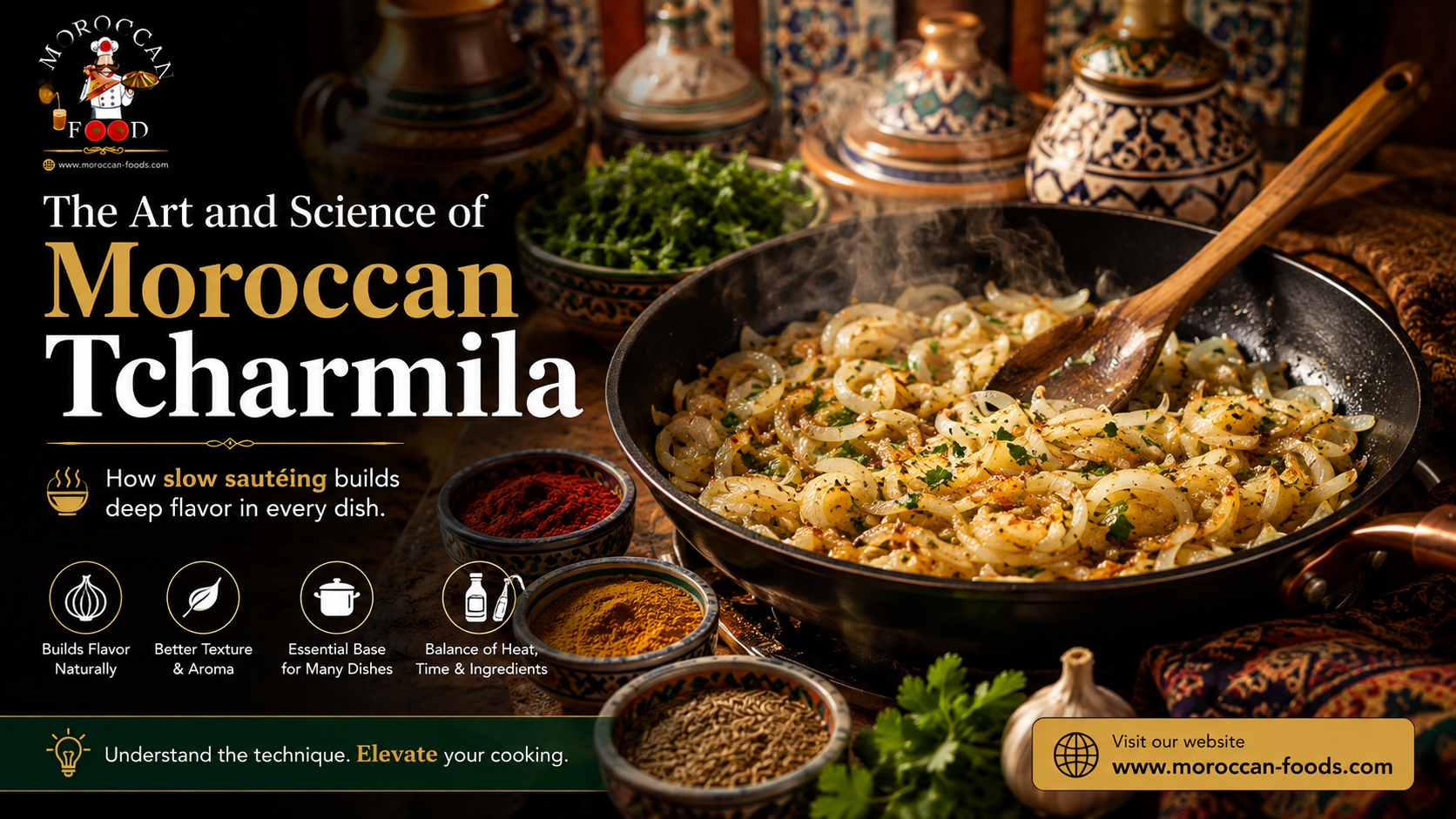
In Moroccan cuisine, some of the most important cooking techniques are also among the simplest. One of them is tcharmila—a method of gently cooking onions, garlic, herbs, spices, and oil to create a deeply aromatic foundation for many dishes.
Tcharmila is not simply a matter of frying ingredients. The cook is carefully controlling heat, moisture, time, and fat to transform raw ingredients into a richer and more complex flavor base.
Understanding this technique can make a noticeable difference when preparing Moroccan tagines, fish dishes, sauces, and other traditional preparations.
What Is Tcharmila?
The term tcharmila can refer to different preparations depending on the Moroccan region and dish, but it commonly describes a flavorful mixture built around ingredients such as onions, garlic, herbs, spices, and olive oil.
In many preparations, the ingredients are cooked gently until the onions become soft and aromatic. Depending on the recipe, the mixture may then develop a deeper color and more concentrated flavor.
The important principle is controlled cooking rather than aggressive frying.
Why Does Slow Cooking Matter?
Raw onions contain a large amount of water. When they are placed in a pan with oil and heated, several things happen.
First, the onions release moisture and begin to soften. As cooking continues, their sharp raw flavor gradually becomes milder. If the temperature and cooking time allow sufficient moisture to evaporate, the onions can begin to brown and develop more complex aromas.
This transformation is one of the reasons a properly prepared onion base can taste dramatically different from freshly chopped onions.
The process can be summarized simply:
Raw ingredients → Moisture loss → Softening → Flavor development → Browning and concentration
The exact result depends on temperature, cooking time, moisture, and the ingredients being used.
Tcharmila Is About Control, Not High Heat
One of the most common mistakes is using excessive heat.
High heat can quickly brown or burn the outside of the onions while the inside remains insufficiently softened. Garlic and delicate herbs can also burn easily, producing bitter flavors.
A moderate or low-to-medium heat gives the ingredients time to soften and release their aromas gradually.
This is particularly useful when preparing a Moroccan tagine, where the goal is usually to build a layered flavor rather than create a heavily browned base in a short period.
The Role of Oil
Oil is more than a cooking medium.
It helps distribute heat around the ingredients and carries many aromatic compounds released from herbs and spices. Olive oil is particularly important in Moroccan cooking because of its distinctive flavor and traditional use.
The quantity should be sufficient to coat the ingredients without turning the mixture unnecessarily greasy.
Too little oil can cause ingredients to stick or brown too quickly. Too much can make the final dish heavy and mask the natural flavors.
When Should Spices Be Added?
Timing matters.
Many Moroccan dishes use spices such as cumin, paprika, turmeric, ginger, black pepper, and cinnamon, depending on the recipe.
Adding spices directly to a controlled amount of warm oil can help release their aromatic compounds. However, spices can also burn if exposed to excessive heat for too long.
For this reason, experienced cooks pay attention not only to which spices they use, but also to when and how they introduce them.
The objective is to gently awaken their aromas without scorching them.
Why Onions Are So Important
Onions are particularly valuable in Moroccan cooking because they provide several layers of flavor.
At the beginning, they contribute sharpness and aroma. As they cook, their structure breaks down and their flavor becomes softer and sweeter.
When enough moisture is removed and browning occurs, additional flavor compounds are produced.
This explains why a tagine prepared with properly softened onions can have a much deeper flavor than one in which onions are added and cooked too quickly.
Tcharmila and Moroccan Tagines
Tcharmila can serve as an important flavor foundation for Moroccan tagines.
A typical sequence may involve gently cooking onions with oil and selected aromatics before introducing the main ingredients. Depending on the recipe, the meat, poultry, fish, or vegetables then cook together with the aromatic base.
The result is not simply an ingredient sitting in a sauce. Over time, the flavors interact and become integrated.
This is one reason Moroccan cooking often rewards patience.
Tcharmila for Fish
The technique is particularly interesting when used with Moroccan fish preparations.
Fish has a delicate flavor, so the aromatic base needs to provide depth without overpowering it.
A combination of onions, garlic, herbs, olive oil, and appropriate spices can create a balanced foundation. Depending on the dish, ingredients such as tomatoes, lemon, paprika, cumin, or fresh herbs may also be incorporated.
The key is to develop the aromatic mixture before allowing the fish to finish cooking in it.
The Difference Between Softening and Browning
This distinction is important for anyone learning to cook.
Softening means that the onions become tender and translucent as their structure changes.
Browning occurs when surface moisture has been reduced sufficiently for browning reactions to become more significant.
These are not the same process.
A Moroccan recipe may require deeply softened onions without significant browning, while another preparation may benefit from a more developed golden color.
The desired result should therefore be determined by the recipe rather than by the assumption that darker always means better.
How to Avoid Burning the Aromatic Base
There are several practical ways to prevent bitterness.
Keep the heat controlled, stir when necessary, and pay attention to the moisture level in the pan.
If the onions begin sticking aggressively before they have softened, the heat may be too high.
Garlic deserves particular attention because it can burn much faster than onions.
Spices should also not be left exposed to intense dry heat for an extended period.
Good cooking is often less about adding more heat and more about knowing when to reduce it.
The Importance of Patience
Traditional Moroccan cooking often demonstrates an important culinary principle: time can be an ingredient.
Slowly developing the aromatic base allows flavors to become integrated instead of remaining separate.
This does not mean every Moroccan dish must be cooked for a long time. Rather, each stage should be given enough time to achieve its intended transformation.
A few extra minutes of controlled cooking at the right stage can make a significant difference to the final dish.
A Practical Method for Beginners
When learning the technique, start with a simple combination:
- Warm olive oil over moderate heat.
- Add finely chopped or thinly sliced onions.
- Cook gently until they begin to soften.
- Add garlic and selected herbs according to the recipe.
- Introduce spices carefully and avoid excessive heat.
- Continue cooking until the desired aroma, texture, and color are achieved.
- Add the remaining ingredients according to the recipe.
The important point is not to memorize a single cooking time. Instead, learn to recognize the visual, aromatic, and textural signals that indicate each stage is complete.
The Deeper Lesson Behind Tcharmila
Tcharmila teaches an important principle that applies far beyond Moroccan cuisine:
Flavor is built through controlled transformation.
The quality of the final dish depends not only on the ingredients but also on what happens to them during cooking.
Temperature changes their structure. Time changes their texture. Moisture affects browning. Oil transfers heat and carries aromas. Spices contribute fragrance and complexity.
Once these relationships become clear, cooking becomes less about following instructions mechanically and more about understanding what is happening in the pan.
Final Thoughts
Moroccan tcharmila may begin with humble ingredients—onions, garlic, herbs, spices, and oil—but careful cooking can transform them into a remarkably complex flavor foundation.
The technique rewards patience, observation, and temperature control.
For beginners, mastering tcharmila is an excellent way to improve fundamental cooking skills. For experienced cooks, understanding the science behind the process provides greater control over flavor, texture, and consistency.
And perhaps that is one of the most valuable lessons of Moroccan cuisine: great flavor does not always come from adding more ingredients. Sometimes, it comes from giving simple ingredients the time and conditions they need to become something better.
FAQ
What is Moroccan tcharmila?
Tcharmila is a traditional Moroccan flavor-building technique or preparation based on ingredients such as onions, garlic, herbs, spices, and olive oil. Depending on the dish and region, its exact ingredients and preparation can vary.
Why are onions cooked slowly in Moroccan cuisine?
Slow cooking allows onions to release moisture, soften gradually, and develop a sweeter, deeper flavor. This creates a more balanced foundation for tagines, sauces, and other Moroccan dishes.
Is tcharmila the same as frying onions?
Not exactly. Tcharmila generally focuses on gently developing the flavors of several aromatic ingredients rather than simply frying onions at high heat.
What type of oil is traditionally used for tcharmila?
Olive oil is widely used in Moroccan cooking and works particularly well because it contributes its own flavor while helping transfer heat and distribute aromatic compounds.
When should garlic be added to tcharmila?
Garlic can be added after the onions have begun to soften, depending on the recipe. This helps reduce the risk of burning it, as garlic generally cooks faster than onions.
When should Moroccan spices be added?
Spices are usually added at a stage where they can gently warm in the oil and aromatic mixture. Excessive heat can scorch delicate spices and create bitter flavors.
Why is low or moderate heat important when preparing tcharmila?
Controlled heat gives onions and other aromatics enough time to soften and release their flavors without burning. High heat can cause uneven cooking and unwanted bitterness.
Can tcharmila be used with fish?
Yes. Tcharmila is particularly useful in Moroccan fish preparations because its aromatic base can add depth while allowing the delicate flavor of the fish to remain noticeable.
Can tcharmila be used for Moroccan tagines?
Yes. A gently cooked mixture of onions, oil, garlic, herbs, and spices can form an important flavor foundation for many Moroccan tagines.
How do I know when the onions are properly cooked?
Look for the texture and aroma rather than relying only on time. The onions should be soft and aromatic, with a color appropriate to the recipe. They should not have a burnt smell or taste.
What is the difference between softening and browning onions?
Softening occurs as onions lose moisture and their structure breaks down. Browning requires further moisture reduction and higher surface temperatures, producing additional color and complex flavors. A recipe may require one stage or both.
What are the most common mistakes when preparing tcharmila?
Common mistakes include using excessive heat, burning garlic or spices, adding too little or too much oil, cooking the onions too quickly, and assuming that darker always means more flavorful.
Why does slow sautéing improve the flavor of Moroccan dishes?
It gives aromatic ingredients time to transform and release their flavors. This creates a more integrated and complex base than simply adding raw ingredients directly to the dish.
Can I prepare tcharmila in advance?
Yes, depending on the specific recipe. Preparing the aromatic base in advance can make cooking easier, but it should be cooled and stored safely and used according to appropriate food-storage practices.


Leave a Reply