
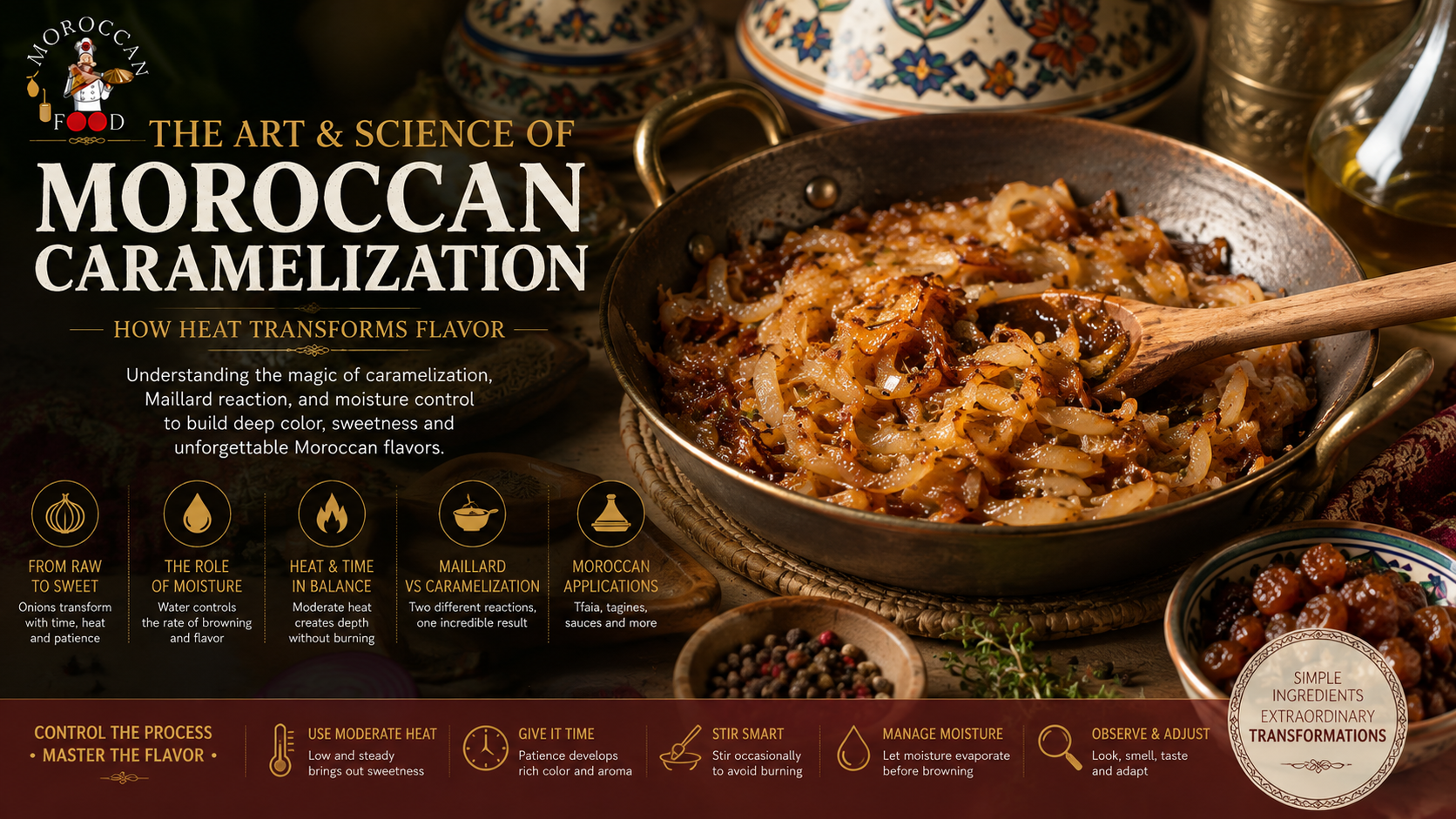
In Moroccan cuisine, some of the deepest flavors are not created by adding more spices. They are developed through time, controlled heat, and careful cooking.
One excellent example is the gradual transformation of onions, fruits, and other ingredients as they cook. Their sharpness can soften, their color can deepen, and their flavor can become sweeter, richer, and more complex.
This process is often described simply as caramelization, but there is more happening in the pan than meets the eye. Understanding the difference between caramelization, browning, moisture loss, and the Maillard reaction can help cooks control flavor rather than simply hope for it.
What Is Caramelization?
Caramelization is a series of chemical changes that occur when sugars are exposed to sufficiently high temperatures.
As sugars break down, they form new compounds responsible for deeper color, toasted aromas, and complex flavors ranging from nutty and buttery to slightly bitter.
However, caramelization should not be confused with simply making food brown.
In many cooked foods, several reactions can happen at the same time.
This distinction is particularly important when cooking onions.
Caramelization vs. the Maillard Reaction
These two processes are frequently confused.
Caramelization involves the thermal breakdown of sugars.
The Maillard reaction occurs primarily between reducing sugars and amino compounds, such as those found in proteins.
Both can contribute to browning and complex aromas, but they are chemically different.
When onions are slowly cooked, for example, their natural sugars contribute to sweetness and caramelized flavors, while Maillard reactions can also contribute to their deeper color and roasted aromas.
So when a cook sees a beautifully browned onion, the result is not necessarily the product of caramelization alone.
A useful distinction
Caramelization → sugar transformation
Maillard reaction → sugar + amino compounds
Moisture loss → concentration and texture changes
Together, these processes can create the rich flavors associated with well-developed cooked ingredients.
Why Do Onions Become Sweeter?
Raw onions contain water, sugars, sulfur-containing compounds, and other components responsible for their characteristic sharpness.
When onions are cooked gradually, several things happen.
Water is progressively removed, the onion softens, its pungent character decreases, and its natural sugars become more concentrated.
As cooking continues, heat-driven reactions create additional flavor compounds.
The result can be an onion that is:
- Softer
- Darker
- More aromatic
- Less pungent
- Naturally sweeter
- More complex in flavor
This transformation is a good example of why time itself can be considered a cooking ingredient.
The Hidden Role of Water
Water is one of the most important factors in understanding browning.
While an ingredient contains a large amount of free water, much of the heat energy is initially used to evaporate that water. This keeps the surface temperature relatively limited.
As water is removed, the surface can become hotter, allowing browning reactions to progress more effectively.
This explains why an onion can spend a considerable amount of time becoming soft before it begins developing a noticeably deeper color.
The process can therefore be viewed as a progression:
Raw ingredient → Water loss → Softening → Concentration → Browning → Deeper flavor
The exact sequence varies according to the ingredient and cooking conditions, but the principle is extremely useful.
Why High Heat Is Not Always Better
A common mistake is to increase the heat in an attempt to accelerate the process.
High heat can certainly brown food quickly, but fast browning is not the same as controlled flavor development.
The outside may become dark before the interior has softened properly, creating burnt or bitter flavors.
With onions and similar ingredients, moderate heat and patience often provide much greater control.
The objective is to develop color and flavor without allowing the surface to burn.
The Importance of Time
Time allows several transformations to happen gradually.
During slow cooking, moisture continues to evaporate, the structure of the ingredient changes, and different flavor compounds develop.
This is why two onions cooked with the same ingredients can taste completely different if one is rushed over high heat and the other is cooked slowly with careful temperature control.
The professional cook is not simply asking:
“How long has this been cooking?”
A better question is:
“What stage has the ingredient reached?”
The Moroccan Culinary Connection
The principle of controlled browning and sweetness appears in several Moroccan preparations.
One of the most interesting examples is tfaia, a preparation of slowly cooked onions often combined with raisins and spices. It is traditionally associated with dishes such as couscous and can also appear in other Moroccan preparations.
The goal is not simply to brown onions.
The cook gradually develops their sweetness and aroma while balancing them with spices and, in some versions, the natural sweetness of dried fruit.
This creates a distinctive combination of:
Sweetness + spice + aromatic depth + gentle acidity or savory contrast
It demonstrates an important principle of Moroccan cuisine: complexity can come from transforming a small number of simple ingredients rather than continually adding more ingredients.
Why Raisins Behave Differently
Dried fruits such as raisins already contain concentrated sugars because much of their original water has been removed.
When they are cooked with onions, they contribute sweetness and a characteristic fruity depth.
However, their concentrated sugar content also means that they can burn relatively quickly if exposed to excessive heat.
This is another reason controlled cooking is important.
A skilled cook manages the temperature so that the onions soften and develop their flavor while the raisins become tender and aromatic without burning.
How Moroccan Cooks Build Flavor Gradually
The deeper lesson is that Moroccan cooking often relies on layering flavor.
A cook may begin with onions and oil, allowing the onions to soften and develop their natural sweetness.
Spices can then contribute aromatic complexity.
Other ingredients are introduced according to their cooking requirements.
The final result is not simply the sum of the ingredients. It is the result of when and how each ingredient is exposed to heat.
This is one of the most important differences between following a recipe mechanically and understanding a cooking technique.
The Role of Oil
Oil helps transfer heat efficiently and allows ingredients to cook more evenly.
It also carries fat-soluble aromatic compounds from spices and other ingredients.
However, oil does not itself cause caramelization.
Its role is primarily related to heat transfer, cooking environment, and flavor distribution.
Using excessive oil can also make it harder to judge the actual cooking stage of ingredients.
The goal is to use enough to support the cooking process without allowing it to dominate the preparation.
How to Recognize Properly Caramelized Onions
Color is useful, but it should not be the only indicator.
Well-developed onions generally show several characteristics:
- A significantly softer texture
- Reduced pungency
- Deeper golden to brown color
- Concentrated sweetness
- Richer aroma
- A moist but not watery consistency
The desired degree of browning depends on the dish.
A lightly browned onion and a deeply browned onion can both be correct—they simply produce different flavors.
Common Mistakes
Cooking at Excessively High Heat
This can cause the surface to burn before the onions have developed the desired texture.
Adding Too Much Liquid
Excess liquid can delay browning because energy is spent evaporating water before the surface becomes hot enough for significant browning reactions.
Stirring Too Frequently
Constant stirring can interfere with the development of surface contact and browning. The correct amount of stirring depends on the pan, heat, quantity, and stage of cooking.
Ignoring the Bottom of the Pan
Browned residues can contribute valuable flavor when managed correctly. However, if they become black and burnt, they can introduce bitterness.
Confusing Dark Color With Good Cooking
Very dark does not automatically mean well caramelized.
Golden brown and aromatic can be far more desirable than dark brown and bitter.
How to Control the Process Like a Professional
To improve your results, focus on five variables:
1. Heat
Use enough heat to drive moisture away and encourage browning, but not so much that the ingredient burns.
2. Time
Give the ingredient enough time to soften and develop flavor.
3. Moisture
Understand how much water is present and how quickly it is being removed.
4. Surface Area
Thinly sliced ingredients behave differently from large pieces because their exposed surface area changes the rate of cooking and moisture loss.
5. Observation
Watch the color, aroma, texture, and consistency rather than relying exclusively on a timer.
These five variables give the cook much more control than simply following a fixed cooking time.
A Technique Worth Learning
The real value of understanding caramelization is that the technique can be transferred to many ingredients.
Once you understand how heat, moisture, sugar, and time interact, you can apply the same principles when cooking onions, certain fruits, vegetables, and other ingredients.
You begin to understand why one pan produces a beautifully sweet and aromatic result while another produces something burnt and bitter.
That is the difference between simply cooking an ingredient and controlling its transformation.
Final Thoughts
Caramelization is a fascinating example of the science hidden inside traditional cooking.
In Moroccan cuisine, the gradual development of sweetness, color, and aroma can play an important role in creating depth, particularly in preparations involving slowly cooked onions and sweet-savory combinations such as tfaia.
The most important lesson is not to chase dark color or use maximum heat.
It is to understand the relationship between temperature, moisture, time, and the ingredient itself.
Great browning is not about cooking faster. It is about controlling the transformation.
Once you learn to recognize that transformation, techniques that once seemed mysterious become much easier to understand—and much easier to master.
FAQ
What is caramelization in cooking?
Caramelization is a series of heat-driven changes that occur when sugars are exposed to sufficiently high temperatures. It creates deeper color, richer aromas, and more complex flavors.
Is caramelization the same as the Maillard reaction?
No. Caramelization involves the thermal transformation of sugars, while the Maillard reaction primarily involves reactions between reducing sugars and amino compounds. Both can contribute to browning and complex flavor.
Why do onions become sweeter when slowly cooked?
Slow cooking reduces moisture, softens the onions, concentrates their natural sugars, and allows heat-driven reactions to develop deeper aromas and flavors. Their sharpness also becomes less pronounced.
Why does water affect caramelization?
Water limits the surface temperature while it is evaporating. As moisture decreases, the surface can become hotter, allowing browning and caramelization-related reactions to progress more effectively.
Does high heat caramelize onions faster?
High heat can accelerate browning, but it also increases the risk of burning. Moderate, controlled heat usually gives better control over texture, color, and flavor.
How long does it take to caramelize onions?
There is no universal cooking time. It depends on the quantity and thickness of the onions, heat level, pan, moisture, and desired degree of browning. The appearance and texture of the onions are more useful indicators than time alone.
How can I tell when onions are properly caramelized?
Look for a soft texture, reduced pungency, a deeper golden-brown color, concentrated sweetness, and a rich aroma. The desired level of browning depends on the dish.
Why shouldn’t caramelized onions be very dark?
Very dark onions may have crossed from desirable browning into burning. Good caramelization should produce complex, sweet, aromatic flavors rather than a predominantly bitter taste.
What is the role of oil when caramelizing onions?
Oil helps transfer heat and provides an effective cooking medium. It also helps distribute aromatic compounds, but oil itself does not cause caramelization.
Can caramelization happen in Moroccan cuisine?
Yes. Controlled cooking of onions and other ingredients contributes to the development of sweetness, color, and depth in various Moroccan preparations. Tfaia is a particularly good example of the sweet-savory character that can result from slowly developed onions and dried fruit.
What is tfaia in Moroccan cuisine?
Tfaia is a Moroccan preparation commonly based on slowly cooked onions, often combined with raisins and spices. It is associated with dishes such as couscous and illustrates how controlled cooking can develop complex sweet and aromatic flavors.
Why do raisins need careful cooking?
Raisins contain concentrated sugars because much of their water has already been removed. Excessive heat can therefore cause them to burn relatively quickly.
Does stirring affect caramelization?
Yes. Constant stirring can reduce surface contact and affect browning, while too little stirring can increase the risk of burning. The appropriate amount depends on the heat, pan, quantity, and cooking stage.
Can other ingredients be caramelized besides onions?
Yes. Caramelization and browning-related processes can occur in various ingredients containing sugars. Different ingredients require different temperatures, moisture levels, and cooking times.
What are the most common mistakes when caramelizing onions?
Common mistakes include using excessive heat, rushing the process, adding unnecessary liquid, stirring constantly, ignoring the pan bottom, and assuming that darker color always means better flavor.
What is the most important principle when learning caramelization?
The key is to control heat, moisture, time, and surface contact. The goal is not simply to make an ingredient brown, but to guide its transformation toward the desired flavor, aroma, and texture.


Leave a Reply