
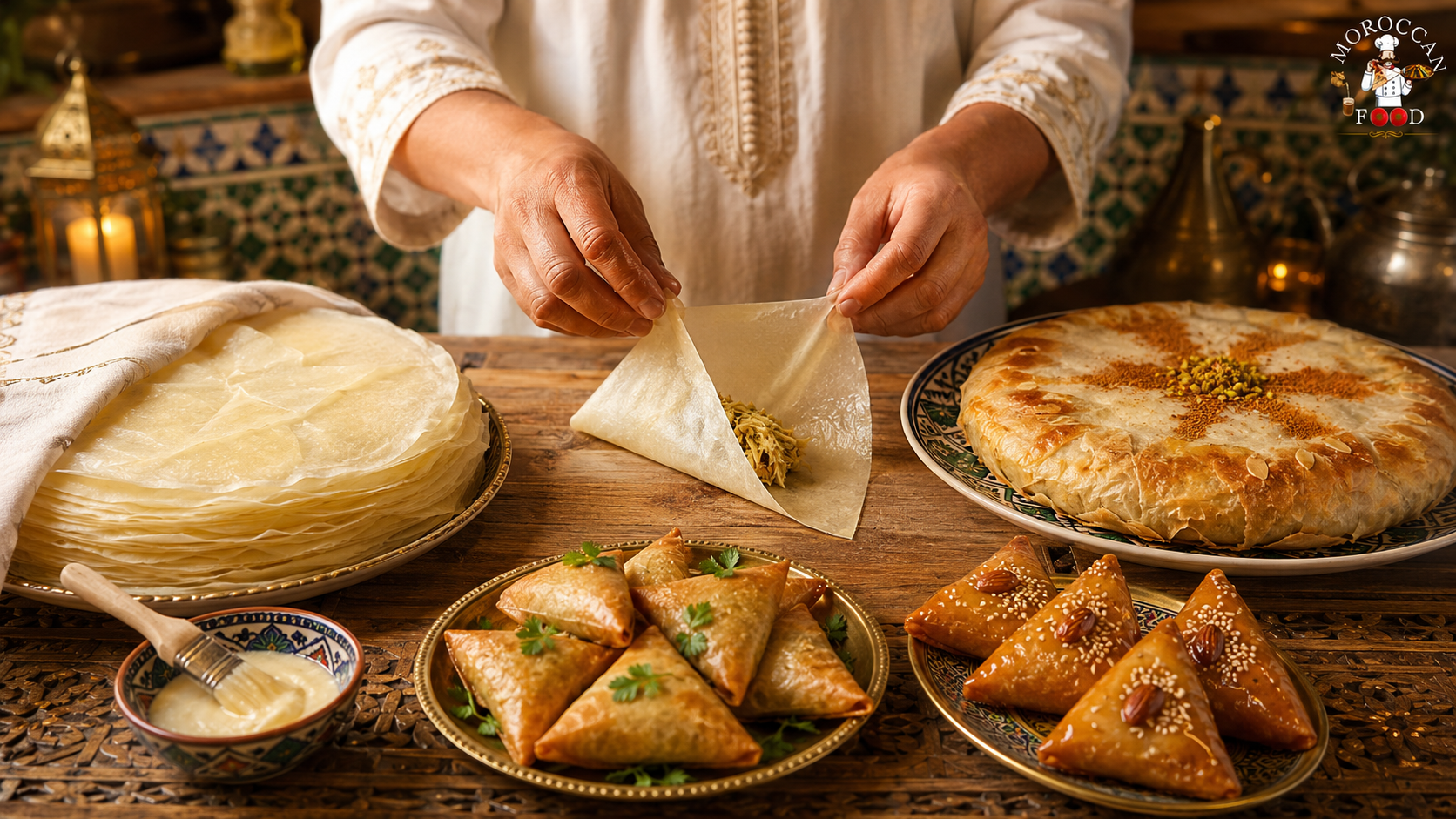
Moroccan warqa pastry, also spelled warka, is one of the most delicate and versatile elements of Moroccan cuisine. Its name means “leaf” in Arabic, an appropriate description for pastry sheets that are exceptionally thin, light, and almost translucent.
Warqa is traditionally used to prepare iconic Moroccan dishes such as chicken pastilla, seafood pastilla, sweet almond pastilla, savory briouats, and honey-coated almond briouats. Once baked or fried, it becomes beautifully golden and crisp while remaining light enough to showcase the filling.
This guide explains how to prepare homemade Moroccan warqa, handle it without tearing, arrange it inside a pastilla pan, and fold it correctly for both savory and sweet recipes.
What Is Moroccan Warqa Pastry?
Warqa is a paper-thin Moroccan pastry traditionally prepared by repeatedly tapping a soft, elastic dough against a heated metal surface. Each contact leaves behind a very thin film that cooks almost instantly and forms a delicate circular sheet.
The traditional technique requires considerable experience. For home cooks, a fluid batter can be brushed onto a warm nonstick pan to produce thin sheets with a similar texture and appearance.
Warqa is generally more flexible than phyllo pastry and thinner than most spring-roll wrappers. This flexibility makes it suitable for enclosing moist fillings and creating round pastillas or tightly folded triangular briouats.
Recipe Information
| Information | Details |
|---|---|
| Preparation Time | 15 minutes |
| Resting Time | 30–45 minutes |
| Cooking Time | 25–35 minutes |
| Total Time | Approximately 1 hour 20 minutes |
| Yield | Approximately 18–22 sheets |
| Cuisine | Moroccan |
| Category | Pastry and Recipe Basics |
| Difficulty | Intermediate |
| Cooking Method | Stovetop |
| Best Uses | Pastilla, briouats and Moroccan pastries |
Homemade Moroccan Warqa Pastry
Ingredients
- 250 g all-purpose flour
- 50 g very fine semolina
- ½ teaspoon salt
- 1 tablespoon white vinegar
- 1 tablespoon neutral vegetable oil
- 400–500 ml lukewarm water, added gradually
- Vegetable oil for separating and storing the sheets
The precise amount of water may vary according to the flour. The finished batter should be fluid, completely smooth, and slightly more elastic than ordinary crêpe batter.

Necessary Equipment
- A blender or food processor
- A fine-mesh strainer
- A wide nonstick frying pan
- A saucepan slightly smaller than the frying pan
- A clean, soft pastry brush
- A clean kitchen towel
- A flat tray or large plate
How to Make Moroccan Warqa at Home
1. Prepare the Batter
Place the flour, fine semolina, salt, vinegar, oil, and approximately 400 ml of lukewarm water in a blender.
Blend for two to three minutes until the mixture becomes completely smooth. Add additional water gradually if the batter appears too thick.
The batter should spread easily with a pastry brush without creating heavy or uneven layers.
2. Strain and Rest the Batter
Pass the batter through a fine-mesh strainer to remove any remaining lumps.
Cover the bowl and allow the batter to rest for approximately 30–45 minutes. Resting hydrates the flour and semolina and improves the flexibility of the finished sheets.
Stir the batter gently before using it. If it thickens considerably during resting, add one or two tablespoons of water.
3. Prepare a Gentle Double-Boiler
Fill a saucepan approximately one-third full with water and bring it to a gentle simmer.
Position the nonstick frying pan over the saucepan without allowing its base to touch the water. The steam creates gentle, even heat and reduces the risk of burning the delicate pastry.
The pan should feel hot but should not smoke.
4. Brush the Batter onto the Pan
Dip the pastry brush lightly into the batter. Starting around the outer edge, brush a very thin layer onto the pan using quick overlapping strokes.
Continue toward the center until the entire surface is covered. Fill any visible gaps with a little additional batter, but avoid making the sheet unnecessarily thick.
5. Cook the Warqa Sheet
Cook the sheet on one side only. After approximately one or two minutes, the surface will become dry and the edges will begin to lift away from the pan.
The sheet should remain pale and flexible. Do not allow it to become brown or crisp.
6. Remove and Separate the Sheet
Lift one edge carefully and peel the sheet away from the pan.
Place it cooked-side up on a clean towel or flat tray. Brush the surface very lightly with vegetable oil before placing another sheet over it.
Continue preparing the remaining batter, stacking and lightly oiling the sheets as you work.

=>There are shops in Morocco that prepare phyllo dough; you can buy it ready-made. In America, Europe, Asia, China, India, and Australia, I don’t know if it’s sold ready-made or if there are alternatives that are used.
How to Keep Warqa Soft and Flexible
Warqa dries quickly when exposed to air. Keep the following points in mind:
- Cover prepared sheets immediately with a clean towel or plastic wrap.
- Apply only a very light coating of oil between the sheets.
- Keep unused sheets covered while assembling pastilla or briouats.
- Do not expose the sheets to direct sunlight or strong heat.
- If a sheet begins to dry, cover it briefly with a clean, slightly damp cloth.
- Do not allow the damp cloth to touch the pastry for too long, as excess moisture can make it sticky.

Note
Discover the recipes prepared with phyllo pastry in Morocco:
- Moroccan Chicken Pastilla (Authentic Bastilla Recipe)
- Moroccan Seafood Pastilla (Authentic Fish Bastilla Recipe)
- Moroccan Beef Pastilla with T-Bone Steak
- Moroccan Chicken Breast Pastilla and Briouats
- Moroccan Shrimp Pastilla with Vermicelli and Chermoula
- Moroccan Chicken Briouats with Warqa Pastry
- Moroccan T-Bone Steak Briouats with Warqa Pastry
- Moroccan Mixed Fish Briouats with Shrimp and Calamari
- Moroccan Shrimp Briouats with Warqa Pastry
- Moroccan Seafood Cigars with Warqa Pastry – Fish, Calamari & Shrimp
- Moroccan Chicken Cigars with Warqa Pastry
- Moroccan T-Bone Steak Cigars with Warqa Pastry
How to Use Warqa for a Round Moroccan Pastilla
Warqa is traditionally layered to create a strong base capable of enclosing the filling while producing a crisp, golden exterior.
1. Prepare the Pan
Brush a round baking pan generously with melted butter or a mixture of melted butter and neutral oil.
A pan measuring approximately 28–30 cm is suitable for a large family-size pastilla.
2. Arrange the Base Sheets
Place five or six warqa sheets around the pan in an overlapping circular pattern.
Approximately half of each sheet should cover the base while the remaining portion hangs over the edge. The sheets should overlap sufficiently to prevent the filling from escaping.
Brush each sheet lightly with melted butter before adding the next one.
3. Reinforce the Center
Place one additional buttered sheet flat in the middle of the pan. This reinforces the base and helps protect it from moisture.
4. Add the Filling
Allow every cooked filling to cool completely before placing it over the pastry.
Spread the filling evenly and keep a small border around the edge. If the recipe contains several layers, add them separately—for example:
- Seasoned chicken and egg filling
- Sweetened almond mixture
- Seafood, vermicelli, herbs, and olives
- Cooked meat and vegetables
The filling should be flavorful but not watery. Excess moisture can soften the pastry and cause tearing.
5. Fold the Overhanging Sheets
Fold each overhanging sheet inward over the filling, working around the pan.
Brush the pastry lightly with melted butter during folding. Press gently so the sheets remain close to the filling without crushing it.
6. Cover and Seal the Pastilla
Place two or three additional buttered warqa sheets over the top.
Tuck their edges carefully underneath the assembled pastilla to create a smooth, round shape. Seal loose edges with beaten egg yolk or a thick flour-and-water paste.
Brush the surface lightly with melted butter before baking.
7. Bake Until Golden
Bake the pastilla in a preheated oven at 180°C (350°F) until the pastry is crisp and evenly golden.
A large pastilla generally requires 35–45 minutes, although the exact time depends on its size, filling, and oven.
Allow it to rest for approximately 10 minutes before transferring it to a serving platter.

How to Fold Triangular Moroccan Briouats
The triangular fold is suitable for chicken, beef, seafood, cheese, vegetable, almond, and other fillings.
1. Cut the Warqa
Cut the warqa sheets into long strips approximately 8–10 cm wide.
Keep the strips covered while working.
2. Position the Filling
Place one strip vertically on the work surface and brush it lightly with melted butter.
Put approximately one or two tablespoons of filling near the lower end. Avoid overfilling because excessive filling can tear the pastry or escape during cooking.
3. Make the First Fold
Bring one lower corner diagonally across the filling to create a triangle.
Press gently around the filling to remove empty spaces without flattening it.
4. Continue Folding
Fold the triangle upward toward the opposite side of the strip.
Continue folding from side to side, maintaining the triangular shape, until only a small piece of pastry remains.
5. Seal the Final Edge
Brush the remaining edge with beaten egg yolk or flour paste.
Tuck it securely into the final fold and place the briouat seam-side down.

Flour Paste for Sealing Briouats
Ingredients
- 2 tablespoons all-purpose flour
- 2–3 tablespoons water
Mix the flour and water until a thick, smooth paste forms. It should be sticky enough to secure the pastry without dripping.
This paste is particularly useful for briouats that will be fried or frozen.

How to Fold Cigar-Shaped Briouats
Briouats can also be prepared in a cylindrical shape.
- Place a small line of filling near the lower end of a rectangular warqa strip.
- Fold the two side edges inward over the filling.
- Roll the pastry upward firmly but gently.
- Apply flour paste to the final edge.
- Seal and place the briouat seam-side down.
The cigar shape works particularly well with cheese, minced meat, seafood, and vegetable fillings.

Using Warqa for Savory Briouats
Savory briouats may contain:
- Seasoned chicken, onions and eggs
- Shrimp and rice vermicelli
- Mixed seafood and chermoula
- Minced beef or lamb
- T-bone steak filling
- Cheese and fresh herbs
- Cooked vegetables
Before filling the pastry, make sure the mixture is:
- Fully cooked when required
- Completely cooled
- Moist but not watery
- Finely chopped
- Properly seasoned
- Free from excessive oil or sauce
Hot filling creates steam and quickly damages warqa. Watery filling also prevents the pastry from becoming crisp.
Savory briouats can be baked at 180°C (350°F) for 20–25 minutes or fried in moderately hot oil until golden.

Using Warqa for Sweet and Honey-Coated Briouats
Sweet Moroccan briouats are commonly filled with an almond mixture flavored with cinnamon and orange blossom water.
Traditional Almond Filling
A typical filling may contain:
- Finely ground or crushed almonds
- Powdered or granulated sugar
- Ground cinnamon
- Orange blossom water
- Melted butter
- A small quantity of gum arabic, if desired
The mixture should hold together when pressed without becoming wet.
Fold the briouats into triangles and seal them carefully. They may then be fried or baked until evenly golden.
How to Coat Briouats with Honey
Warm the honey gently without bringing it to a strong boil.
Place the hot briouats directly into the warm honey and allow them to absorb it briefly. Remove them, drain the excess honey, and garnish with toasted sesame seeds or crushed almonds if the recipe calls for them.
The briouats should be hot and the honey warm—not excessively hot—for good absorption without making the pastry too soft.
Baking Versus Frying
| Method | Result | Advantages | Points to Consider |
|---|---|---|---|
| Baking | Light, crisp and evenly golden | Uses less fat and is convenient for large quantities | Brush the pastry evenly with butter or oil |
| Frying | Deeply golden and exceptionally crisp | Traditional texture and rapid cooking | Requires careful oil-temperature control |
| Air Frying | Crisp with minimal added fat | Fast and convenient for small batches | Briouats may need turning during cooking |
For baking, arrange briouats seam-side down with space between them. Brush the tops and sides lightly with butter or oil.
For frying, use moderately hot oil. Oil that is too cool makes the pastry greasy, while excessively hot oil browns it before the interior is properly heated.

How to Store Warqa Pastry
Refrigerating Fresh Warqa
Stack the sheets with a light layer of oil between them. Wrap them tightly in plastic wrap or place them in an airtight bag.
Refrigerate for approximately two to three days.
Freezing Warqa
Place parchment paper between manageable groups of sheets, wrap them carefully, and freeze them in an airtight bag.
Thaw the pastry overnight in the refrigerator while keeping it wrapped. This prevents condensation from forming directly on the sheets.
Avoid repeatedly freezing and thawing warqa because it becomes fragile.

How to Freeze Prepared Pastilla and Briouats
Unbaked pastilla and briouats can be frozen successfully.
- Place briouats separately on a tray and freeze until firm.
- Transfer them to an airtight freezer container.
- Wrap a prepared pastilla securely to protect it from freezer burn.
- Bake briouats directly from frozen, adding several minutes to the cooking time.
- A frozen pastilla may require a longer baking time to heat the center thoroughly.
For best texture, freeze the pastries before baking or frying.

Warqa, Phyllo and Spring-Roll Wrappers: What Is the Difference?
| Pastry | Texture | Flexibility | Best Uses |
|---|---|---|---|
| Moroccan Warqa | Extremely thin, light and crisp | Very flexible | Pastilla and traditional briouats |
| Phyllo Pastry | Dry, fragile and layered | Less flexible | Baked pastilla and layered pastries |
| Spring-Roll Wrappers | Stronger and slightly thicker | Flexible | Briouats and fried appetizers |
If using phyllo instead of warqa, work with two lightly buttered layers when necessary because individual phyllo sheets tear easily.
Spring-roll wrappers are convenient for briouats but do not reproduce the exact delicate texture of traditional Moroccan warqa.

Common Mistakes to Avoid
Using Hot Filling
Hot filling creates steam and can tear or soften the pastry. Always cool it completely.
Adding Excess Liquid
Drain sauces, cooked vegetables, seafood, and meat before assembling the pastries.
Leaving Warqa Uncovered
Warqa dries quickly and becomes difficult to fold. Keep it covered throughout preparation.
Overfilling the Pastry
Excess filling makes sealing difficult and may cause the briouats or pastilla to open during cooking.
Applying Too Much Butter or Oil
A light, even coating is sufficient. Excess fat can make the pastry heavy and greasy.
Folding Too Loosely
Loose folding creates empty spaces and irregular shapes. Fold firmly without pressing hard enough to tear the pastry.
Cooking at the Wrong Temperature
Very low heat can make the pastry greasy, while excessive heat can burn the exterior before the filling becomes hot.

Common Mistakes to Avoid
Using Hot Filling
Hot filling creates steam and can tear or soften the pastry. Always cool it completely.
Adding Excess Liquid
Drain sauces, cooked vegetables, seafood, and meat before assembling the pastries.
Leaving Warqa Uncovered
Warqa dries quickly and becomes difficult to fold. Keep it covered throughout preparation.
Overfilling the Pastry
Excess filling makes sealing difficult and may cause the briouats or pastilla to open during cooking.
Applying Too Much Butter or Oil
A light, even coating is sufficient. Excess fat can make the pastry heavy and greasy.
Folding Too Loosely
Loose folding creates empty spaces and irregular shapes. Fold firmly without pressing hard enough to tear the pastry.
Cooking at the Wrong Temperature
Very low heat can make the pastry greasy, while excessive heat can burn the exterior before the filling becomes hot.
Final Tips for Perfect Moroccan Warqa
- Keep the sheets thin, soft, and pale during preparation.
- Cover both homemade and store-bought warqa immediately.
- Cool and drain every filling before assembly.
- Use flour paste or egg yolk to secure the edges.
- Brush baked pastries lightly and evenly with butter or oil.
- Fry sweet briouats before soaking them briefly in warm honey.
- Arrange briouats seam-side down to prevent them from opening.
- Serve savory pastries warm and sweet briouats after the excess honey has drained.
Conclusion
Moroccan warqa is the foundation of many of Morocco’s most elegant dishes. Its delicate texture transforms simple ingredients into crisp round pastillas, savory triangular briouats, and fragrant honey-coated pastries.
Although preparing homemade warqa requires patience, the process becomes easier with practice. The essential principles remain the same: create thin flexible sheets, protect them from drying, use a cooled and well-drained filling, fold them securely, and cook them until beautifully golden and crisp.
Frequently Asked Questions
1. What is Moroccan warqa pastry?
Moroccan warqa is an exceptionally thin, flexible pastry used to prepare traditional dishes such as pastilla, savory briouats, and honey-coated almond briouats. It becomes light, crisp, and golden after baking or frying.
2. What is warqa made from?
Homemade warqa is generally made from all-purpose flour, fine semolina, salt, water, vinegar, and a small amount of vegetable oil. The ingredients are blended into a smooth, fluid batter.
3. Is warqa the same as phyllo pastry?
No. Warqa is generally more flexible and has a delicate handmade texture. Phyllo is dry, fragile, rectangular, and usually requires several buttered layers.
4. Can I substitute phyllo for warqa?
Yes. Use two lightly buttered phyllo sheets when necessary because a single sheet can tear easily. The result will be layered and crisp but slightly different from traditional warqa.
5. Can I use spring-roll wrappers instead?
Spring-roll wrappers work well for briouats because they are flexible and strong. However, they are thicker and do not produce the same delicate texture as authentic warqa.
6. Why is my warqa batter too thick?
The flour may have absorbed more water than expected. Add lukewarm water one tablespoon at a time and blend until the batter becomes smooth, fluid, and easy to spread with a pastry brush.
7. Why should the batter be strained?
Straining removes flour lumps and produces smoother, more uniform sheets. It also prevents thick patches from forming during cooking.
8. How long should warqa batter rest?
Allow the batter to rest for approximately 30–45 minutes. Resting hydrates the flour and semolina and improves the flexibility of the finished sheets.
9. Why is warqa cooked over a double boiler?
Gentle steam provides even heat and reduces the risk of browning or burning the delicate pastry. The frying pan should sit above the simmering water without touching it.
10. Should warqa be cooked on both sides?
No. Cook each sheet on one side only. Remove it when the surface becomes dry and the edges begin to lift while the pastry remains pale and flexible.
11. Why does homemade warqa tear?
Warqa may tear if the batter is too thin, the sheet is uneven, the pan is excessively hot, or the pastry has dried out. Apply an even layer and keep prepared sheets covered.
12. How can I keep warqa soft and flexible?
Cover prepared sheets immediately and brush a very light film of oil between them. Keep unused sheets covered with a clean towel or plastic wrap while assembling the pastries.
13. Can dry warqa be softened again?
Cover it briefly with a clean, slightly damp cloth. Remove the cloth quickly because excessive moisture can make the sheets sticky.
14. Why must the filling be completely cool?
Hot filling releases steam, which softens and weakens the pastry. Always allow cooked fillings to cool completely before assembling pastilla or briouats.
15. How can I prevent soggy warqa?
Drain cooked meat, seafood, vegetables, and sauces thoroughly. The filling should be moist and flavorful but never watery or excessively oily.
16. How do I seal briouats?
Use a thick paste made from 2 tablespoons of flour and 2–3 tablespoons of water. Apply a small amount to the final flap, fold it securely, and place the briouat seam-side down.
17. Can warqa briouats be baked instead of fried?
Yes. Brush them lightly with butter or oil and bake at 180°C (350°F) for 20–25 minutes, or until crisp and evenly golden.
18. Can I use an air fryer?
Yes. Lightly brush the briouats, arrange them in one layer, and air-fry until golden and crisp. Turn them during cooking if necessary for even browning.
19. How long does fresh warqa keep in the refrigerator?
Fresh warqa can be refrigerated for approximately 2–3 days. Stack the sheets with a very light coating of oil, wrap them tightly, and store them in an airtight bag.
20. Can homemade warqa be frozen?
Yes. Place parchment paper between manageable groups of sheets, wrap them tightly, and freeze them in an airtight bag. Thaw overnight in the refrigerator while keeping them wrapped.
21. Can prepared pastilla and briouats be frozen?
Yes. Freeze unbaked briouats separately on a tray before transferring them to an airtight container. Wrap an assembled pastilla securely to protect it from freezer burn.
22. Should frozen briouats be thawed before baking?
No. Bake them directly from frozen and add several minutes to the normal cooking time. Arrange them seam-side down with space between each piece.
23. Can sweet almond briouats be made with warqa?
Yes. Fill the pastry with a cohesive almond mixture flavored with cinnamon and orange blossom water. Fry or bake the briouats until golden, then coat them briefly with warm honey.
24. Should the honey be boiling?
No. The briouats should be hot and the honey gently warmed. Boiling honey can soften the pastry excessively and may create a safety hazard.
25. What dishes can be prepared with warqa?
Warqa is suitable for round chicken or seafood pastilla, savory triangular briouats, cigar-shaped appetizers, sweet almond briouats, and other filled Moroccan pastries.


Leave a Reply