
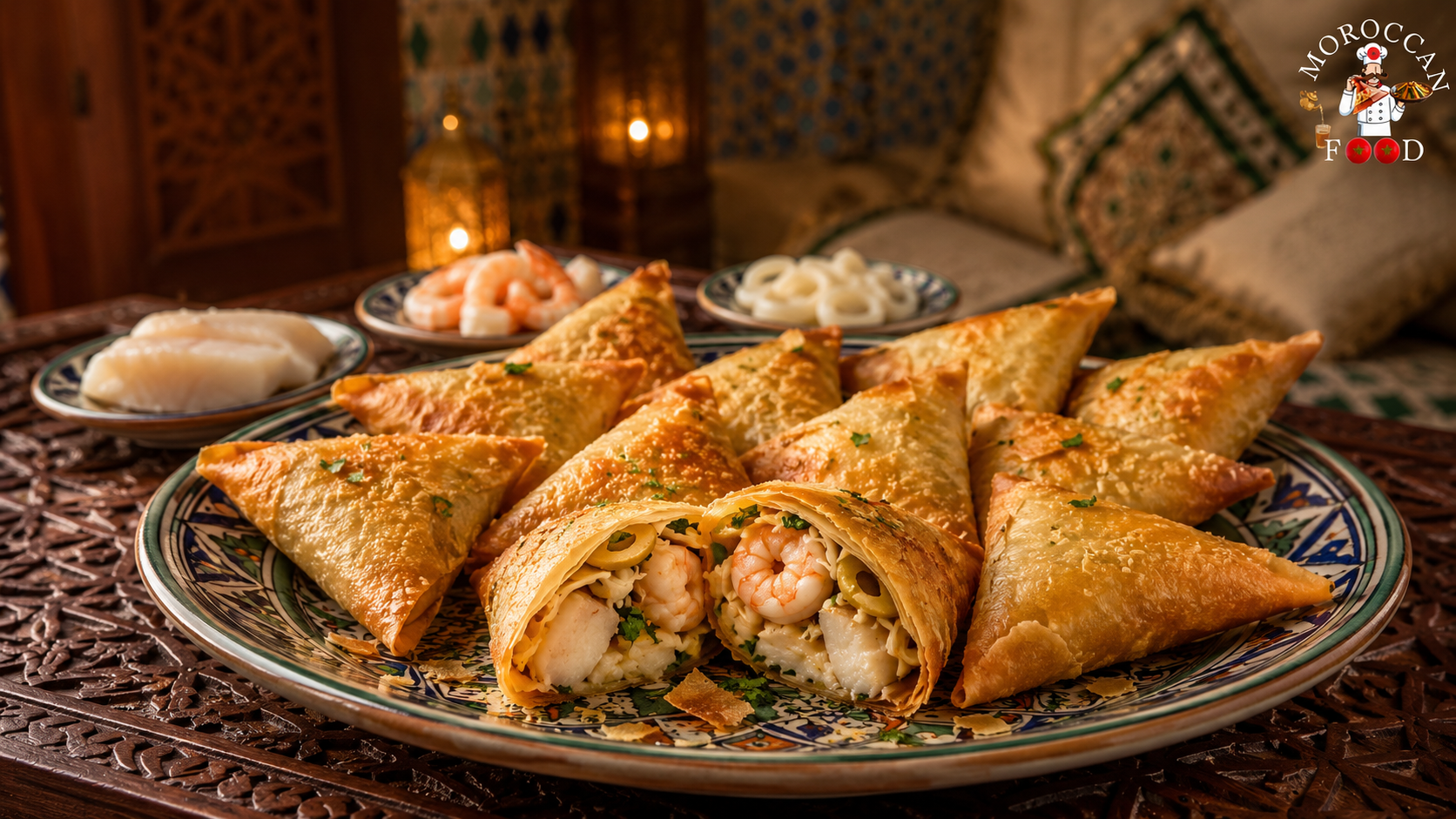
Moroccan Mixed Fish Briouats are crisp, golden triangular pastries filled with tender white fish, juicy shrimp, calamari, fine rice vermicelli, preserved lemon, green olives, fresh herbs, and aromatic Moroccan spices.
Wrapped in delicate warqa pastry and baked until beautifully crisp, these seafood briouats make an elegant appetizer for Ramadan, family gatherings, celebrations, or a traditional Moroccan meal. They can be prepared in advance and baked shortly before serving.
Recipe Information
| Information | Details |
|---|---|
| Cuisine | Moroccan |
| Recipe type | Appetizer / Savory pastry |
| Preparation time | 40 minutes |
| Marinating time | 20 minutes |
| Cooking time | 30 minutes |
| Baking time | 20–25 minutes |
| Total time | Approximately 1 hour 50 minutes |
| Quantity | Approximately 18–20 briouats |
| Servings | 6 people |
| Serving size | 3 briouats |
| Baking temperature | 180°C (350°F) |
| Difficulty | Medium |
| Cooking method | Stovetop and oven |
| Main ingredients | White fish, shrimp and calamari |
Ingredients
For the Mixed Fish Filling
- 500 g firm white fish fillets, skinless and boneless
- 250 g peeled and deveined shrimp
- 250 g cleaned calamari, cut into small pieces
- 100 g fine rice vermicelli
- 2 tablespoons olive oil
- 1 medium onion, finely chopped
- 4 garlic cloves, finely minced
- 1 preserved lemon, pulp removed and peel finely chopped
- 80 g pitted green olives, finely sliced
- 2 tablespoons chopped fresh parsley
- 2 tablespoons chopped fresh cilantro
- 2 tablespoons fresh lemon juice
- 1 teaspoon paprika
- 1 teaspoon ground ginger
- 1 teaspoon ground cumin
- ½ teaspoon turmeric
- ½ teaspoon black pepper
- A pinch of saffron threads soaked in 3 tablespoons warm water
- Salt to taste
For Assembling the Briouats
- 18–20 long strips of warqa pastry, approximately 8–10 cm wide
- 60 g melted butter, for brushing
- 2 tablespoons flour
- 2–3 tablespoons water, for preparing the sealing paste

Preparation Method
1. Prepare the Seafood
Check the white fish carefully and remove any remaining bones. Pat the fish, shrimp, and calamari dry with paper towels.
Cut the white fish and calamari into small, evenly sized pieces. Leave small shrimp whole and cut larger shrimp into two or three pieces.
2. Prepare the Rice Vermicelli
Place the rice vermicelli in a heatproof bowl and cover it with hot water.
Leave it to soften for approximately 5 minutes, then drain it thoroughly. Cut it into shorter strands using kitchen scissors and set it aside.
3. Prepare the Chermoula Mixture
In a large bowl, combine the minced garlic, parsley, cilantro, paprika, ginger, cumin, turmeric, black pepper, lemon juice, saffron infusion, and a suitable quantity of salt.
Mix until the herbs and spices are evenly combined.
4. Season the Seafood
Add the white fish, shrimp, and calamari to the chermoula.
Mix gently until every piece is evenly coated. Cover the bowl and leave the seafood to marinate for approximately 20 minutes.
5. Cook the Onion
Heat the olive oil in a large frying pan over medium heat.
Add the finely chopped onion and cook for approximately 5–7 minutes, stirring regularly, until soft and translucent.
6. Cook the Calamari
Add the marinated calamari to the softened onion. Cook for approximately 4–5 minutes, stirring occasionally.
Avoid overcooking it because calamari can become tough.
7. Add the White Fish
Add the seasoned white fish pieces to the pan.
Cook gently for approximately 4 minutes, carefully turning the pieces until they are nearly cooked through.
8. Add the Shrimp
Add the shrimp and cook for another 2–3 minutes, or until they become pink and opaque.
Do not cook the shrimp for too long, as they will continue cooking inside the briouats.
9. Add the Preserved Lemon and Olives
Stir in the finely chopped preserved lemon peel and sliced green olives.
Cook for approximately 1 minute to distribute their flavors throughout the seafood mixture.
10. Reduce the Cooking Liquid
Continue cooking uncovered until most of the liquid released by the seafood has evaporated.
The filling should remain moist and flavorful but must not be watery, as excessive moisture can soften or tear the warqa pastry.

11. Add the Rice Vermicelli
Add the drained and shortened rice vermicelli to the seafood mixture.
Mix gently until the vermicelli absorbs the remaining sauce and the ingredients are evenly distributed.
12. Adjust the Filling
Taste the filling and adjust the salt, lemon juice, or spices if necessary.
Break any large pieces of fish into smaller flakes, while leaving visible pieces of shrimp and calamari for texture.
13. Cool the Filling
Transfer the mixed fish filling to a wide plate or shallow dish.
Spread it into an even layer and allow it to cool completely before assembling the briouats. Warm filling can make the warqa pastry soft and difficult to fold.
14. Prepare the Sealing Paste
Place the flour in a small bowl.
Gradually add the water and mix until you obtain a smooth, thick paste. This paste will be used to seal the final edge of each briouat.
15. Prepare the Warqa Strips
Place one warqa strip vertically on a clean work surface.
Keep the remaining strips covered with a clean, slightly damp cloth to prevent them from drying out.
Brush the visible strip lightly with melted butter.
16. Add the Mixed Fish Filling
Place approximately 2 tablespoons of the cooled seafood filling near the lower end of the strip.
Do not overfill the pastry because this may make folding difficult and cause the warqa to tear.
17. Make the First Fold
Lift one lower corner of the pastry diagonally over the filling to form a compact triangle.
Press gently around the filling to remove large air pockets without crushing the delicate pastry.
18. Complete the Triangular Fold
Continue folding the triangle upward from one side to the other, following the length of the pastry strip.
Keep the edges aligned to obtain a neat and evenly shaped briouat.
19. Seal the Briouat
Apply a small quantity of flour paste to the final pastry flap.
Fold and tuck the flap securely against the briouat. Place it seam-side down while preparing the remaining pieces.
20. Arrange the Briouats
Preheat the oven to 180°C (350°F).
Line a large baking tray with parchment paper and arrange the briouats seam-side down, leaving a small space between them.
21. Brush with Butter
Brush the top and sides of every briouat lightly with melted butter.
Use only a thin, even coating to help the pastry become golden and crisp without making it greasy.
22. Bake the Briouats
Bake on the center rack for approximately 20–25 minutes, or until the briouats are crisp and evenly golden.
Turn them carefully during baking only if needed to obtain an even color on both sides.
23. Rest and Serve
Remove the baked briouats from the oven and allow them to rest for approximately 5 minutes.
Serve them warm with fresh lemon wedges and traditional Moroccan salads such as zaalouk, taktouka, carrot salad, or beet salad.

If you exercise, you can eat these briouats with traditional Moroccan salads after your workout as a protein-rich and nutritious meal.

You can serve these briouats with traditional Moroccan salads for lunch and dinner.

Discover traditional Moroccan salads that you can serve with these briouats
Moroccan Roasted Tomato, Onion & Pepper Salad Recipe
Traditional Moroccan Tomato Cucumber and Onion Salad Recipe
Moroccan salad with tomatoes, onions, and roasted green peppers
Moroccan salad with onions, tomatoes, and roasted red and yellow peppers
Moroccan Lettuce, Tomato, Onion & Cucumber Salad
show Nutritional Value
Estimated Nutritional Value
Based on approximately 18–20 mixed fish briouats, one serving equals 3 briouats:
| Nutrient | Per Serving (3 Briouats) |
|---|---|
| Calories | ≈ 480–560 kcal |
| Protein | ≈ 32–38 g |
| Carbohydrates | ≈ 38–45 g |
| Total Fat | ≈ 20–26 g |
| Saturated Fat | ≈ 7–10 g |
| Dietary Fiber | ≈ 2–4 g |
| Sugars | ≈ 2–4 g |
| Sodium | ≈ 700–950 mg |
| Cholesterol | ≈ 150–210 mg |
| Omega-3 Fatty Acids | ≈ 450–750 mg |
| Iron | ≈ 3–5 mg |
| Vitamin B12 | ≈ 3–6 µg |
Estimated Value per Briouat
- Calories: 160–185 kcal
- Protein: 11–13 g
- Carbohydrates: 13–15 g
- Total fat: 7–9 g
Main Nutritional Benefits
- High-quality protein: White fish, shrimp, and calamari support muscle maintenance and recovery.
- Vitamin B12: Contributes to normal red blood cell formation and nervous-system function.
- Omega-3 fatty acids: Help support normal heart and brain health.
- Iron and selenium: Seafood provides minerals involved in energy metabolism and antioxidant protection.
- Carbohydrates: Warqa pastry and rice vermicelli supply energy.
These values are estimates and may vary according to briouat size, seafood type, warqa pastry, butter, olive oil, olives, and salt used.

1. What are Moroccan Mixed Fish Briouats?
Moroccan Mixed Fish Briouats are crispy triangular pastries filled with seasoned white fish, shrimp, calamari, rice vermicelli, green olives, preserved lemon, fresh herbs, and aromatic Moroccan spices.
2. Which type of white fish is best for briouats?
Use a firm, mild white fish that holds its shape during cooking, such as cod, hake, haddock, pollock, or sea bass. Ensure that the fillets are completely boneless.
3. Can I use frozen seafood?
Yes. Thaw the fish, shrimp, and calamari completely in the refrigerator. Drain and pat them thoroughly dry before seasoning to prevent a watery filling.
4. Can I change the seafood combination?
Yes. You may adjust the proportion of white fish, shrimp, and calamari while maintaining approximately the same total weight. This helps preserve the filling-to-pastry ratio.
5. How should I clean the shrimp?
Remove the shells and heads, then make a shallow cut along the back of each shrimp and remove the dark digestive vein. Rinse briefly and pat thoroughly dry.
6. How do I prevent calamari from becoming tough?
Cook it briefly over medium heat and avoid leaving it in the pan for too long. The calamari will continue cooking slightly when the briouats are baked.
7. Why is rice vermicelli added to the filling?
Rice vermicelli absorbs the flavorful seafood juices and helps bind the filling. It also gives the briouats a satisfying texture without making them excessively heavy.
8. Should the rice vermicelli be cooked first?
Soak it in hot water for approximately five minutes, drain it thoroughly, and cut it into shorter strands. It does not need to be fully boiled before being added to the filling.
9. Why must the seafood liquid be reduced?
Excess liquid can make the warqa pastry soggy and may cause the briouats to split during baking. The filling should be moist but never watery.
10. Should the filling be cold before assembling the briouats?
Yes. Allow the filling to cool completely. Warm filling produces steam, softens the warqa, and makes the pastry more difficult to fold.
11. What is warqa pastry?
Warqa is an extremely thin Moroccan pastry traditionally used for pastilla and briouats. When lightly brushed with butter and baked, it becomes crisp, flaky, and golden.
12. Can I replace warqa with phyllo pastry?
Yes. Phyllo pastry is a practical substitute when Moroccan warqa is unavailable. Depending on its thickness, you may need to use two layers to prevent tearing.
13. How wide should the pastry strips be?
Cut the warqa into long strips approximately 8–10 cm wide. Equal-sized strips help produce briouats with a consistent triangular shape.
14. How much filling should I use for each briouat?
Use approximately two tablespoons of filling per strip. Avoid overfilling because the pastry may tear or open during baking.
15. How do I fold a briouat correctly?
Place the filling near the bottom of the strip. Fold one lower corner diagonally over the filling to form a triangle, then continue folding the triangle upward from side to side.
16. How do I seal the final edge?
Mix flour with a little water to obtain a smooth, thick paste. Apply a small amount to the final pastry flap, then tuck and press it firmly against the briouat.
17. How do I keep warqa pastry from drying out?
Keep unused sheets and strips covered with a clean, slightly damp cloth. The cloth should not be wet, as excessive moisture can make the pastry sticky.
18. Can mixed fish briouats be baked instead of fried?
Yes. Arrange them seam-side down on a parchment-lined tray, brush them lightly with melted butter, and bake at 180°C (350°F) for approximately 20–25 minutes.
19. Can I cook the briouats in an air fryer?
Yes. Arrange them in a single layer without overlapping, brush them lightly with butter, and air-fry at approximately 180°C (350°F) until crisp and evenly golden.
20. Can I prepare the briouats ahead of time?
Yes. Assemble them several hours in advance, cover them tightly, and refrigerate them until baking. Brush them with melted butter immediately before placing them in the oven.
21. Can uncooked fish briouats be frozen?
Yes. Freeze the assembled briouats in a single layer until firm, then transfer them to a freezer-safe container with baking paper between the layers. Store them for up to two months.
22. Should frozen briouats be thawed before baking?
No. Bake them directly from frozen after brushing them with melted butter. Add a few extra minutes to the usual baking time.
23. How should leftover briouats be stored?
Allow them to cool completely, then refrigerate them in an airtight container for up to two days because the filling contains cooked seafood.
24. What is the best way to reheat seafood briouats?
Reheat them in a preheated oven or air fryer until thoroughly hot and crisp. Avoid using a microwave because it can make the warqa pastry soft.
25. What can I serve with mixed fish briouats?
Serve them with Moroccan zaalouk, taktouka, cumin-spiced carrot salad, beet salad, or cucumber-and-tomato salad. They are suitable as an appetizer, party dish, Ramadan starter, or light main course.


Leave a Reply