
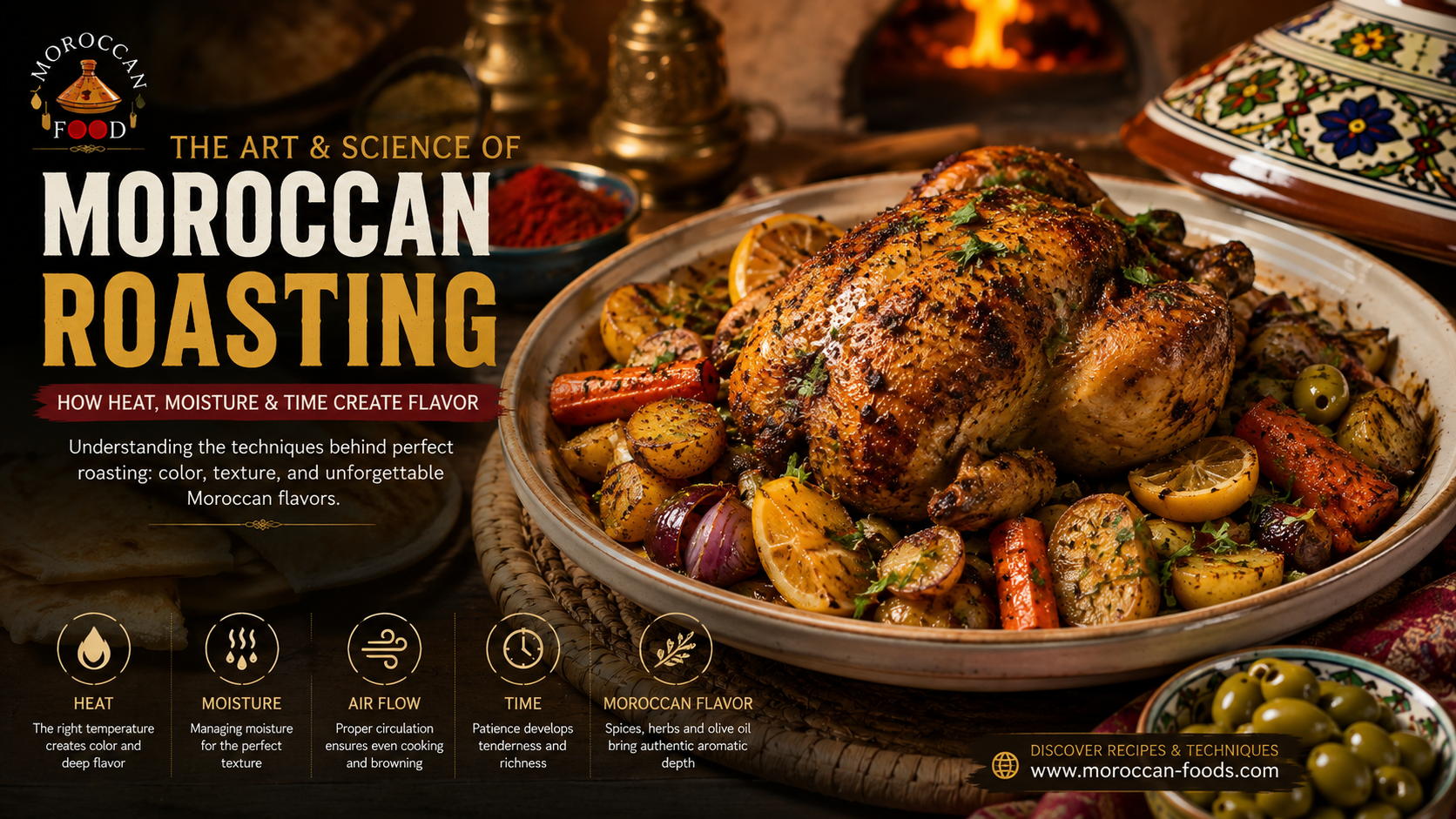
Roasting may seem like one of the simplest cooking techniques: place food in a hot oven and wait. But achieving a beautifully browned exterior while keeping the inside tender requires a careful balance of heat, moisture, time, and surface exposure.
In Moroccan cuisine, this principle can be seen in roasted chicken, fish, vegetables, potatoes, peppers, and many oven-baked preparations. Understanding what happens during roasting allows the cook to move beyond following cooking times and begin controlling the transformation of food.
What Is Roasting?
Roasting is a cooking method in which food is exposed to relatively high, dry heat, usually in an oven.
Unlike boiling or steaming, where water plays a major role in transferring heat, roasting relies primarily on hot air and the heated surfaces surrounding the food.
The objective is often to create two contrasting characteristics:
A well-developed, flavorful exterior + a properly cooked, moist interior.
Achieving this balance is what makes roasting more than simply “cooking something in the oven.”
How Does Heat Reach the Food?
Three forms of heat transfer can contribute to oven cooking:
Conduction
Conduction occurs when heat moves through direct contact.
For example, the bottom of a piece of food touching a hot roasting tray receives heat through that contact.
Convection
Convection occurs when hot air circulates around the food.
In a conventional oven, naturally circulating hot air transfers heat to the food’s surface. In a fan-assisted oven, air movement can be stronger and more consistent.
Radiation
Hot oven walls and heating elements also emit thermal radiation, which contributes to surface heating and browning.
These three mechanisms work together, although their relative importance depends on the oven, cookware, food, and position inside the oven.
Why Does Food Become Brown?
One of the most desirable results of roasting is a golden or deep-brown exterior.
This happens through heat-driven chemical reactions, particularly the Maillard reaction, along with caramelization in ingredients containing suitable sugars.
The Maillard reaction occurs between reducing sugars and amino compounds and produces hundreds of flavor and aroma compounds.
This is why a roasted piece of chicken, potato, or vegetable can taste dramatically different from the same ingredient that has simply been boiled.
The important lesson is:
Browning is not merely a change in appearance. It is a major source of flavor.
The Hidden Role of Moisture
Moisture is one of the most important factors controlling browning.
As food heats, water near its surface begins to evaporate. While the surface contains substantial free moisture, much of the available heat is used to evaporate water.
This limits how hot the surface can become.
Once enough moisture has evaporated, the surface temperature can rise further, allowing browning reactions to become more significant.
This explains a common roasting principle:
A wet surface usually browns more slowly than a relatively dry surface.
This is particularly important when roasting chicken skin, potatoes, vegetables, and other ingredients where a browned exterior is desired.
Why Does a Crowded Baking Tray Cause Problems?
One of the most common roasting mistakes is placing too much food on a single tray.
When ingredients are packed tightly together, moisture released from the food can accumulate around neighboring pieces.
Instead of allowing the surface to dry and brown efficiently, the environment can become more humid.
The food may therefore steam more and brown less.
Giving ingredients enough space allows hot air to circulate and moisture to escape more effectively.
This simple principle can make a noticeable difference.
Why Does Temperature Matter?
Temperature determines how quickly moisture evaporates and how rapidly browning reactions develop.
A relatively low temperature can cook food gently but may produce limited surface browning.
A higher temperature can encourage stronger browning, but excessive heat can cause the exterior to burn before the interior is properly cooked.
Therefore, the best temperature depends on the ingredient and the desired result.
The goal is not:
“Use the highest temperature possible.”
The goal is:
“Use the temperature that allows the interior and exterior to reach the desired stages at the right time.”
Moroccan Roasting: Building Flavor With Spices
Moroccan roasting often involves more than heat alone.
Ingredients may be seasoned with combinations of spices, herbs, garlic, olive oil, preserved lemon, or other aromatic ingredients before entering the oven.
Common Moroccan flavor profiles can include:
- Cumin
- Paprika
- Ginger
- Turmeric
- Black pepper
- Garlic
- Parsley
- Cilantro
- Olive oil
During roasting, these ingredients interact with the food and contribute aromatic depth.
However, spices can also burn if exposed to excessive direct heat for too long. Good roasting therefore requires attention not only to the food but also to the seasoning on its surface.
Roasting Moroccan Chicken
Chicken provides an excellent example of the balance between surface and interior.
The cook wants the exterior to become deeply golden and flavorful while the interior reaches a safe and desirable level of doneness without becoming excessively dry.
Several factors influence the result:
Size: Larger pieces require more time.
Surface moisture: A drier surface generally browns more effectively.
Fat: Fat can help with heat transfer and surface browning.
Oven temperature: Higher heat can encourage faster browning.
Position in the oven: The location can influence how strongly the surface is exposed to heat.
This is why professional cooking is rarely based on time alone.
Roasting Vegetables
Vegetables can undergo remarkable transformations in the oven.
Carrots, potatoes, onions, peppers, zucchini, and other vegetables can become softer inside while developing browned edges and concentrated flavors.
Roasting reduces some of their water content and concentrates their natural flavors.
For vegetables, size matters enormously.
Large pieces cook more slowly than small pieces. If pieces are cut unevenly, some may become overcooked while others remain firm.
Uniform cutting therefore improves consistency.
Why Potatoes Can Become Crispy
Crispy roasted potatoes require a combination of factors.
The surface must lose enough moisture for browning to occur, while the interior retains enough moisture to remain soft.
Oil can improve heat transfer and help create a more effective surface-cooking environment.
Overcrowding, excessive moisture, or insufficient heat can interfere with the development of a crisp exterior.
The desired contrast is:
Crisp outside + tender inside.
That contrast is one of the defining pleasures of successful roasting.
Roasting Fish
Fish requires a different approach because it generally cooks more quickly than dense meats.
Its delicate structure can dry out if exposed to excessive heat for too long.
Moroccan-style roasted fish may be combined with herbs, spices, garlic, olive oil, and chermoula-inspired flavors.
Here, the cook must balance two goals:
Developing surface flavor without overcooking the fish.
This is an excellent example of why the same roasting temperature cannot automatically be applied to every ingredient.
The Importance of Surface Area
The size and shape of food strongly influence roasting.
A thin piece has more surface area relative to its volume and can lose moisture and brown relatively quickly.
A thick piece takes longer for heat to travel toward its center.
This is why two pieces of meat with the same weight can require different cooking approaches if one is thick and compact while the other is thin and spread out.
Professional cooks therefore consider shape and thickness, not just weight.
Common Roasting Mistakes
Starting With a Cold Oven
Some preparations depend on immediate exposure to sufficient heat. Preheating the oven helps establish the intended cooking environment.
Overcrowding the Tray
Too many ingredients can trap moisture and reduce browning.
Cutting Ingredients Unevenly
Different sizes cook at different rates.
Using Excessive Liquid
Too much liquid can create a moist environment and delay surface browning.
Using Excessive Heat
Very high temperatures can burn spices or the exterior while leaving the interior undercooked.
Opening the Oven Too Frequently
Repeatedly opening the oven allows heat to escape and can interfere with consistent cooking.
Relying Only on Cooking Time
Oven performance, food size, starting temperature, and cookware can all affect cooking time.
Learning to observe the food is more reliable than blindly following the clock.
How to Roast Like a Professional
Professional roasting can be understood through five variables:
1. Heat
Control the oven temperature according to the ingredient.
2. Moisture
Allow excess surface moisture to escape when browning is desired.
3. Space
Give ingredients enough room for hot air to circulate.
4. Size
Keep pieces reasonably uniform so they cook at similar rates.
5. Time
Use cooking time as a guide while observing the actual condition of the food.
These principles are transferable to almost any roasted ingredient.
Roasting Is About Transformation
The deeper lesson of roasting is that the cook is controlling a series of transformations.
Heat changes the structure of the food.
Moisture moves and evaporates.
Proteins and sugars participate in browning reactions.
Fats help transfer heat and carry aromas.
Spices release and transform their aromatic compounds.
The final result is therefore not simply “food that has been heated.”
It is an ingredient that has undergone a carefully controlled transformation.
The Moroccan Culinary Perspective
Moroccan cuisine demonstrates that complex flavor does not always require complicated techniques.
A few ingredients, properly seasoned and exposed to controlled heat, can develop remarkable depth.
Whether roasting chicken with Moroccan spices, preparing vegetables with olive oil and herbs, or cooking fish with aromatic marinades, the fundamental principles remain the same:
Control the heat. Manage the moisture. Give the food enough space. Watch the transformation.
These principles allow the cook to adapt rather than simply follow instructions.
Final Thoughts
Roasting is one of the most useful techniques to master because its principles can be applied across countless Moroccan preparations.
The key is understanding that high heat alone does not create good roasting.
Excellent results come from the relationship between temperature, moisture, surface area, time, and the characteristics of the ingredient.
Once you understand these factors, you can predict how food will behave in the oven and make better decisions while cooking.
Great roasting is not about simply heating food. It is about controlling heat and moisture to create the right balance of color, texture, aroma, and flavor.
FAQ
What is roasting in cooking?
Roasting is a dry-heat cooking technique in which food is exposed to hot air and radiant heat, usually in an oven. It can create a browned, flavorful exterior while keeping the interior tender when properly controlled.
What makes roasting different from steaming or boiling?
Roasting relies primarily on dry heat, while steaming and boiling depend heavily on water or steam to transfer heat. Roasting encourages moisture loss and surface browning, creating flavors and textures that are difficult to achieve with moist-heat cooking.
Why does food become brown when roasted?
Browning mainly results from heat-driven reactions such as the Maillard reaction and, in suitable ingredients, caramelization. These reactions produce new aroma and flavor compounds as well as deeper color.
What is the Maillard reaction?
The Maillard reaction is a group of chemical reactions that occur mainly between reducing sugars and amino compounds when food is heated. It contributes to the characteristic roasted aromas, flavors, and brown color of many foods.
Why does moisture affect roasting?
Surface moisture can slow browning because heat is initially used to evaporate water. Once enough moisture has evaporated, the surface temperature can rise and browning reactions can develop more effectively.
Why shouldn’t I overcrowd a roasting tray?
Overcrowding can trap moisture between the ingredients and reduce air circulation. The food may steam instead of developing a well-browned exterior.
Does a higher oven temperature always produce better roasting?
No. High temperatures can encourage browning, but excessive heat can burn the exterior, spices, or oils before the interior is properly cooked. The ideal temperature depends on the ingredient and desired result.
Why is preheating the oven important?
Preheating establishes the intended cooking environment before the food enters the oven. This helps the food begin cooking at the expected temperature and can improve consistency.
Why do roasted vegetables taste more intense?
Roasting causes moisture loss and can concentrate the vegetables’ natural flavors. Browning reactions can also add deeper, toasted, and more complex flavors.
How can I make roasted potatoes crispy?
Use appropriately sized pieces, avoid excessive moisture and overcrowding, provide enough heat, and use an appropriate amount of oil. The goal is to allow the surface to dry and brown while keeping the interior tender.
Why does the size of the food matter when roasting?
Thickness and surface area influence how quickly heat reaches the center and how rapidly moisture escapes. Uniform pieces generally cook more evenly.
Can Moroccan spices be roasted in the oven?
Yes, Moroccan spices can contribute wonderful aromas during roasting, but they can also burn when exposed to excessive heat for too long. Temperature and cooking time should therefore be controlled carefully.
How is roasting used in Moroccan cuisine?
Roasting can be used for chicken, fish, potatoes, vegetables, peppers, and various oven-baked preparations. Moroccan herbs, spices, olive oil, garlic, and chermoula-style marinades can add additional layers of flavor.
How can I roast Moroccan chicken without drying it out?
Control the oven temperature, consider the size and thickness of the chicken pieces, avoid excessive cooking time, and monitor the internal doneness rather than relying only on a fixed cooking time.
Why does roasted fish require different treatment from meat?
Fish generally has a more delicate structure and cooks relatively quickly. Excessive heat or prolonged cooking can dry it out, so the cooking conditions should be adapted to its size and thickness.
What are the most common roasting mistakes?
Common mistakes include overcrowding the tray, using excessive heat, adding too much liquid, cutting ingredients unevenly, repeatedly opening the oven, and relying entirely on cooking time instead of observing the food.
What are the most important factors for successful roasting?
The five key factors are heat, moisture, space, size, and time. Understanding how these variables interact gives you much greater control over color, texture, aroma, and flavor.


Leave a Reply