
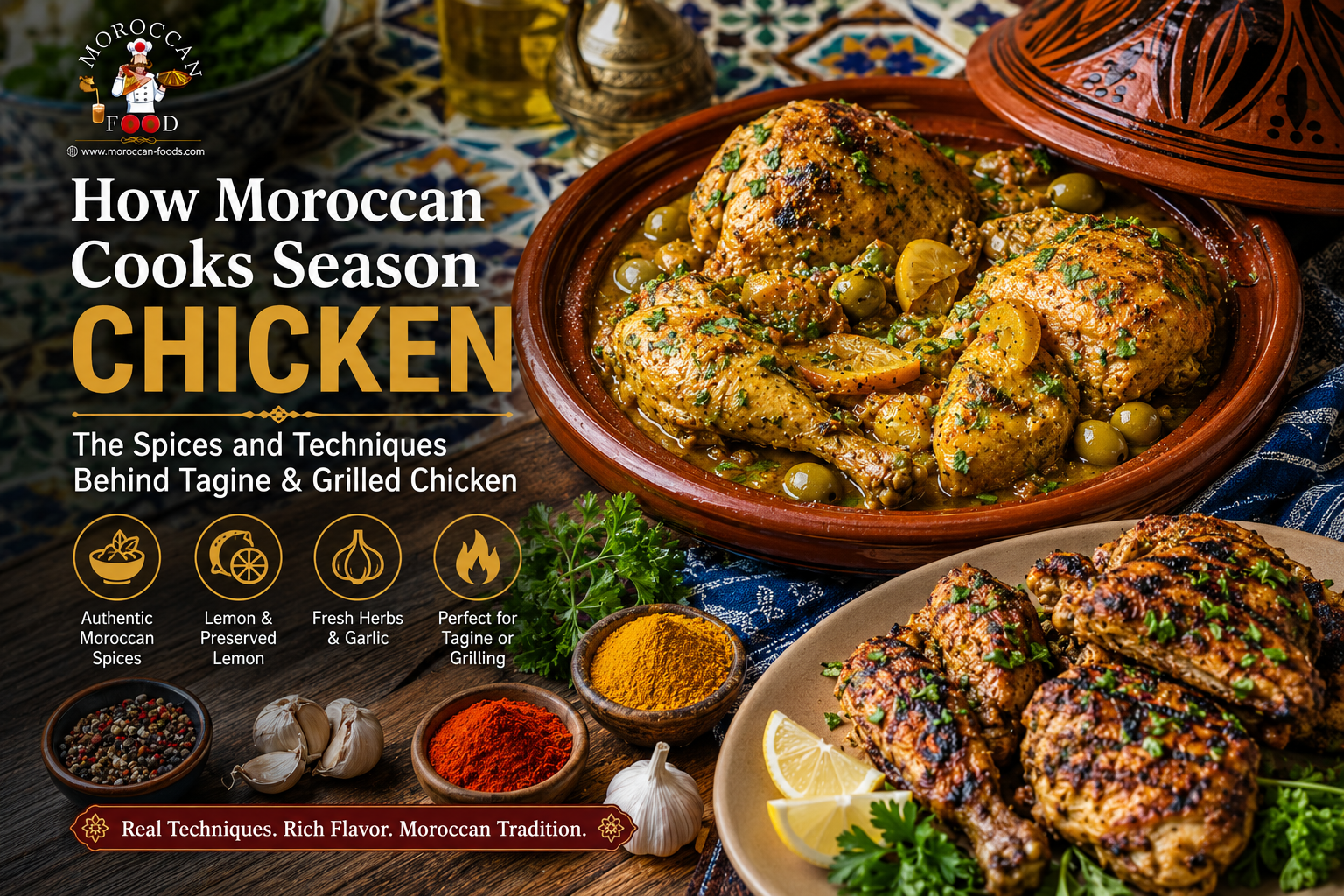
Moroccan chicken is rarely about a single spice or a complicated marinade. Its distinctive flavor comes from how the chicken is prepared, when the spices are added, how long it is seasoned, and—most importantly—the cooking method that follows.
The same chicken can taste completely different when prepared for a slow-cooked tagine, a grilled dish, or a Moroccan-style chermoula marinade.
Moroccan cuisine uses a broad range of spices and aromatic ingredients, including ginger, turmeric, cumin, coriander, saffron, cinnamon, garlic, preserved lemon, and fresh herbs. The Moroccan National Tourist Office also highlights spices such as cinnamon, coriander, saffron, cumin, and ras el hanout as important elements of the country’s culinary tradition.
So, how do Moroccan cooks season chicken, and why does the seasoning change depending on how the chicken will be cooked?
The First Step: Preparing the Chicken
Before thinking about spices, Moroccan cooks traditionally pay attention to the preparation of the chicken.
In some Moroccan households, chicken has traditionally been rubbed or rinsed with salt and lemon juice as part of preparation, particularly to remove unwanted odors and prepare the bird for seasoning.
However, there is an important distinction between traditional practice and modern food-safety guidance.
Washing raw chicken with water, salt, vinegar, or lemon does not make it safer or reliably remove harmful bacteria. The USDA recommends against washing raw poultry because splashing can spread bacteria to sinks, counters, utensils, and other foods. Proper cooking is what makes poultry safe.
For a modern kitchen, the safer approach is to:
- Remove any unwanted feathers or pieces if necessary.
- Pat the chicken dry with paper towels.
- Season or marinate it in a clean container.
- Keep the chicken refrigerated while marinating.
- Wash hands, utensils, and surfaces thoroughly after handling raw chicken.
This allows us to respect the traditional preparation while following modern food-safety principles.
The Moroccan Chicken Spice Palette
There is no single universal Moroccan chicken spice blend.
Different regions, families, and recipes use different combinations.
However, several ingredients appear frequently in Moroccan chicken dishes.
Ginger
Ground ginger provides warmth and a distinctive aromatic note. It is particularly common in chicken tagines.
Turmeric
Turmeric contributes an earthy flavor and golden color.
Black Pepper
Black pepper adds warmth and helps balance the other spices.
Saffron
Saffron is used in some preparations for its delicate aroma, color, and distinctive flavor.
Cumin
Cumin has a strong earthy character and is particularly useful in grilled chicken, chermoula, and other savory preparations.
Paprika
Paprika contributes color and a mild pepper flavor, especially in grilled or marinated preparations.
Cinnamon
Cinnamon is used selectively. It can appear in Moroccan dishes where a warmer, slightly sweet aromatic profile is desired.
Garlic
Garlic is not a dry spice, but it is one of the most important aromatic ingredients in many Moroccan chicken marinades.
Fresh Cilantro and Parsley
These herbs bring freshness and balance to the stronger spices.
The important lesson is that Moroccan cooking is not about using every Moroccan spice at once. It is about choosing a combination that suits the dish.
Chicken for Tagine: A Different Kind of Marinade
Chicken destined for a Moroccan tagine is prepared differently from chicken destined for the grill.
The tagine creates a slow, moist cooking environment, so the seasoning has time to combine with onions, cooking juices, herbs, and other ingredients.
A classic chicken tagine may combine ingredients such as:
- Garlic
- Ginger
- Turmeric
- Black pepper
- Saffron
- Salt
- Olive oil
- Parsley
- Cilantro
- Preserved lemon
Chicken with olives and preserved lemon is one of the best-known examples of this style of cooking. Moroccan culinary sources and representative traditional recipes commonly combine chicken with preserved lemon, olives, aromatic herbs, and spices such as ginger and saffron.
The marinade therefore does not work alone.
It becomes the first layer of flavor in a dish that continues developing during slow cooking.
Why Preserved Lemon Is Different From Fresh Lemon
This is one of the most important distinctions to understand in Moroccan chicken cooking.
Fresh lemon juice provides acidity and a bright citrus flavor.
Preserved lemon, on the other hand, has undergone a preservation process in salt, which changes its flavor and texture.
Instead of simply tasting sour, preserved lemon develops a more complex salty, fermented, and intensely citrus character.
That is why it works so well in dishes such as Moroccan chicken tagine.
The preserved lemon is not simply a replacement for fresh lemon juice.
They serve different culinary purposes.
Chicken for Grilling: Why the Marinade Changes
Grilled chicken faces a completely different cooking environment.
Instead of slow, moist cooking, the chicken is exposed to relatively intense direct heat.
The goal is therefore to develop:
- Strong surface flavor
- Aromatic crust
- Good browning
- Juicy interior
- Balanced seasoning
This is where Moroccan-style marinades containing garlic, herbs, cumin, paprika, lemon, olive oil, and sometimes chili become particularly useful.
Chermoula is a good example of a Moroccan aromatic mixture used with foods including fish and other preparations. The Moroccan National Tourist Office presents a chermoula made with parsley, coriander, lemon juice, garlic, paprika, ginger, cumin, chili, and salt.
The same flavor principles can inspire chicken marinades, but the exact ingredients and proportions depend on the recipe.
What Does Salt Actually Do?
Salt is much more than a seasoning.
It changes how food tastes and can influence the way meat retains moisture during cooking.
When poultry is salted as part of a brine or dry-brining process, salt can affect muscle proteins and reduce moisture loss during cooking. USDA guidance describes salt’s role in brining as helping poultry retain moisture while improving flavor.
This is why seasoning the chicken properly is important.
But more salt does not automatically mean better chicken.
Salt should be balanced with the other ingredients—especially when using preserved lemons or olives, which can already contribute significant saltiness.
What Does Lemon Juice Do?
Lemon juice brings acidity and freshness to a marinade.
Acid can affect the surface of poultry and contribute to changes in texture, but more acid is not necessarily better.
A very acidic marinade used for too long can negatively affect the surface texture of meat. USDA guidance notes that excessive acidity can have the opposite of the desired tenderizing effect.
For Moroccan cooking, lemon should therefore be considered part of the flavor balance, not simply a tenderizing ingredient.
Why Is Oil Added to Moroccan Marinades?
Oil serves several functions.
It helps spread spices and aromatic ingredients across the surface of the chicken and provides fat in which many aromatic compounds can disperse.
It can also help the surface develop color during grilling or roasting.
A Moroccan marinade therefore often combines three important elements:
Oil + Aromatics + Seasoning
Then an acidic ingredient such as lemon may be added to provide brightness and balance.
Fresh Herbs Make a Big Difference
Parsley and cilantro are especially important in Moroccan cooking.
They provide freshness that balances the warmer spices.
When combined with garlic, lemon, olive oil, and spices, they create a marinade that is aromatic without relying on one dominant flavor.
This is why Moroccan chicken can smell incredibly fragrant even before it starts cooking.
The flavor is built from layers rather than one strong ingredient.
Why Marinating Time Matters
Marinating is not simply about leaving chicken in a bowl for as long as possible.
Different marinades work differently.
A salt-based marinade can gradually season the chicken, while acidic ingredients primarily affect the surface and flavor.
USDA guidance recommends keeping poultry refrigerated during marination and states that poultry can be marinated in the refrigerator for up to two days.
For many Moroccan preparations, however, you do not necessarily need a very long marinade.
A shorter period can be enough to coat the chicken with a strongly aromatic mixture, especially when the cooking process itself will continue developing the flavor.
The Difference Between Tagine and Grilled Chicken
The easiest way to understand Moroccan chicken seasoning is to compare the two cooking methods.
| Tagine Chicken | Grilled Chicken |
|---|---|
| Slow, moist cooking | Direct, intense heat |
| Deep flavor development | Strong surface flavor |
| Onions and cooking juices are important | Marinade is more exposed to heat |
| Preserved lemon works beautifully | Fresh lemon can provide brightness |
| Ginger, turmeric, saffron often work well | Cumin, paprika, garlic and herbs work well |
| Sauce develops during cooking | Browning develops on the surface |
This is why using exactly the same marinade for every chicken dish is not always the best approach.
The marinade should support the cooking method.
Should You Marinate Chicken Before a Moroccan Tagine?
It depends on the recipe.
Some Moroccan chicken tagines use a dedicated marinade before cooking, while others season the chicken directly in the cooking vessel with onions, oil, herbs, and spices.
A classic chicken tagine can therefore develop flavor in several stages:
Seasoning → Onions → Chicken → Spices → Slow Cooking → Preserved Lemon & Olives
The exact order varies by recipe.
The important idea is that the chicken’s flavor is developed not only by the marinade but also by everything that happens afterward.
Why the Cooking Method Changes the Flavor
Imagine taking the same marinated chicken and cooking it in two different ways.
In a Tagine
The chicken slowly cooks with onions, spices, and moisture.
The aromas become integrated into the sauce.
The meat becomes tender.
The preserved lemon and olives can gradually influence the entire dish.
On the Grill
The surface becomes much hotter.
Moisture evaporates more rapidly.
The outside can brown and develop roasted aromas.
The marinade becomes part of the surface flavor rather than a sauce surrounding the chicken.
Same ingredient, different environment, different result.
That is one of the most important principles for anyone learning to cook.
A Simple Moroccan Chicken Marinade Formula
Rather than memorizing one recipe, beginners can understand a basic formula:
1. Salt
For seasoning and moisture management.
2. Oil
To carry and distribute aromatic ingredients.
3. Garlic
For a strong savory aroma.
4. Fresh Herbs
Parsley and cilantro for freshness.
5. Spices
Choose according to the cooking method.
6. Citrus
Fresh lemon for brightness, or preserved lemon when the recipe calls for its distinctive flavor.
This gives you a framework rather than a rigid recipe.
Common Mistakes When Seasoning Moroccan Chicken
Using Every Spice at Once
More spices do not necessarily mean more flavor.
A balanced combination is better than an overcrowded one.
Adding Too Much Lemon
Excessive acidity can affect texture and overwhelm the other flavors.
Forgetting About Salt
A beautifully aromatic marinade can still taste flat if it is inadequately seasoned.
Using Preserved Lemon Like Fresh Lemon
Preserved lemon is much more concentrated and salty, so it should be used according to the recipe.
Marinating at Room Temperature
Raw poultry should be marinated in the refrigerator, not left at room temperature.
Reusing Raw Chicken Marinade
Never use marinade that has been in contact with raw chicken as a sauce unless it is boiled first; USDA specifically advises against using it directly because of bacterial contamination.
Washing Chicken to Make It “Safer”
Washing with water, salt, or lemon does not eliminate the need for proper cooking and can spread bacteria around the kitchen.
What Temperature Should Chicken Reach?
Regardless of how beautifully the chicken is marinated, seasoning cannot replace proper cooking.
USDA guidance recommends cooking poultry to a minimum internal temperature of 165°F (74°C), measured with a food thermometer.
This is especially important when preparing whole chicken or thick pieces where the exterior may appear cooked before the center reaches a safe temperature.
The Moroccan Approach to Chicken in One Idea
If there is one lesson to take from Moroccan chicken cooking, it is this:
Season according to the dish, not according to a fixed spice list.
A chicken tagine needs a seasoning profile that works with slow cooking, onions, sauce, preserved lemon, and olives.
Grilled chicken needs a marinade that can withstand direct heat while developing an aromatic, browned surface.
The spices may overlap, but their purpose and balance change with the cooking technique.
Final Thoughts
Moroccan chicken seasoning is not about finding one “secret spice.”
It is about understanding how salt, spices, herbs, garlic, oil, lemon, and preserved lemon work together—and how the cooking method changes the final result.
Traditional Moroccan preparation may include rubbing or rinsing chicken with salt and lemon, but modern food-safety guidance recommends avoiding washing raw poultry because it can spread bacteria; proper cooking and careful handling are the safer approach.
For tagines, spices such as ginger, turmeric, black pepper, saffron, garlic, herbs, and preserved lemon can become part of a slow, deeply flavored sauce. For grilling, a more aromatic, surface-focused marinade can help produce the browned and fragrant exterior that makes grilled chicken so appealing.
And perhaps the most useful lesson for anyone learning Moroccan cooking is simple:
The best marinade is not just the one with the most spices—it is the one that matches the way you plan to cook the chicken.
Frequently Asked Questions About Moroccan Chicken Seasoning
How do Moroccan cooks traditionally season chicken?
Moroccan chicken is commonly seasoned with a combination of spices and aromatics such as ginger, turmeric, black pepper, cumin, paprika, garlic, cilantro, parsley, olive oil, and lemon. The exact combination depends on whether the chicken is prepared in a tagine, grilled, roasted, or cooked another way.
What spices are commonly used for Moroccan chicken?
Common spices include ginger, turmeric, black pepper, cumin, paprika, and saffron. Not every recipe uses all of them; Moroccan cooking focuses on balancing the spices according to the dish.
What is the difference between seasoning chicken for a tagine and for grilling?
Chicken for a tagine is usually seasoned to complement slow, moist cooking, onions, sauce, preserved lemon, and olives. Grilled chicken generally benefits from a more aromatic marinade designed to develop strong surface flavors and browning over direct heat.
Do Moroccan cooks wash chicken with salt and lemon?
In some Moroccan households, rubbing or rinsing chicken with salt and lemon has traditionally been part of preparation, often to reduce unwanted odors. However, modern food-safety guidance does not recommend washing raw chicken because it can spread bacteria around the kitchen; proper cooking is what makes poultry safe.
What is the purpose of lemon in Moroccan chicken marinades?
Fresh lemon adds acidity and a bright citrus flavor. It can complement garlic, herbs, and spices, but excessive acidity or very long exposure can negatively affect the surface texture of chicken.
What is the difference between fresh lemon and preserved lemon?
Fresh lemon provides acidity and a fresh citrus character, while preserved lemon has a deeper, salty, fermented citrus flavor. Preserved lemon is particularly important in Moroccan chicken tagines and should not simply be treated as a substitute for fresh lemon juice.
Why is garlic commonly used in Moroccan chicken marinades?
Garlic provides a strong savory aroma that works particularly well with cumin, paprika, herbs, lemon, and olive oil. It helps create the aromatic foundation of many Moroccan-style chicken marinades.
Why are cilantro and parsley used together?
Cilantro and parsley provide freshness and balance the warmer, earthier flavors of Moroccan spices. Together, they are frequently used in marinades and sauces.
Does marinating chicken make it more flavorful?
Yes. Marinating allows salt, herbs, spices, oil, and other flavoring ingredients to season the chicken’s surface and develop a more integrated flavor. However, a longer marinade is not always better, especially when the marinade contains a lot of acid.
How long can chicken be marinated?
Chicken should always be marinated in the refrigerator, not at room temperature. For food-safety purposes, USDA guidance allows poultry to remain in a marinade in the refrigerator for up to two days, although the ideal time depends on the specific marinade and recipe.
Can the marinade used for raw chicken be used as a sauce?
Not directly. Marinade that has been in contact with raw chicken may contain harmful bacteria. If you want to use it as a sauce, it should first be brought to a safe boil and cooked appropriately.
What makes Moroccan chicken taste different from ordinary seasoned chicken?
The distinctive character comes from the combination and balance of spices, herbs, aromatics, citrus, and cooking technique. Moroccan chicken is not defined by one particular spice but by how these elements work together.
Can the same Moroccan marinade be used for tagine and grilled chicken?
It can be adapted, but the best seasoning depends on the cooking method. A marinade designed for grilling may emphasize garlic, cumin, paprika, herbs, and surface browning, while tagine preparations often work with ginger, turmeric, saffron, preserved lemon, onions, and slow cooking.
What is the most important rule when seasoning Moroccan chicken?
Choose the seasoning according to the cooking method. The spices and marinade should complement what happens next—whether the chicken will cook slowly in a tagine or develop a browned, aromatic surface on the grill.


Leave a Reply