
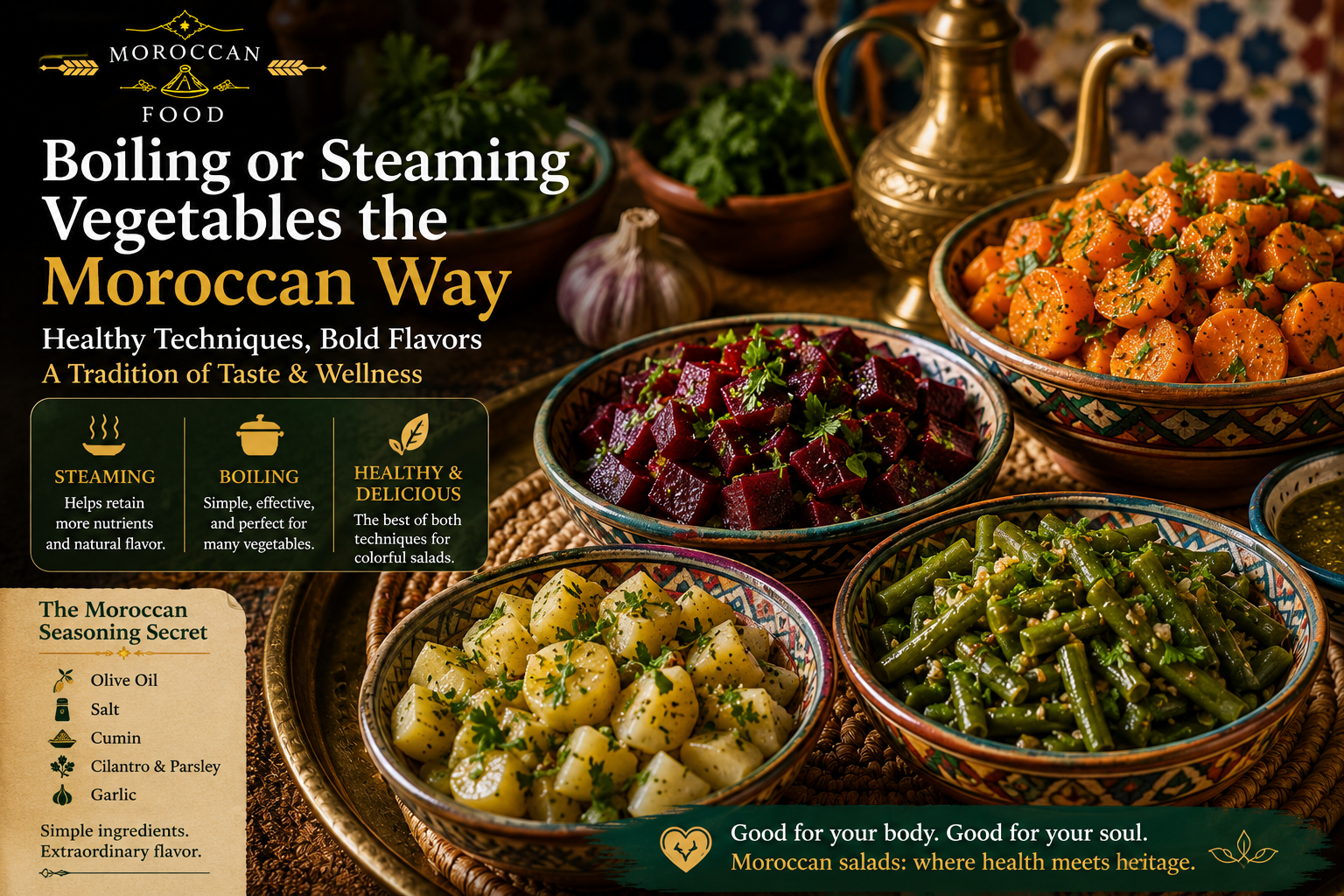
Moroccan cuisine is often associated with tagines, couscous, grilled meats, and fragrant spices. But there is another side of Moroccan cooking that deserves more attention: the art of turning simple cooked vegetables into flavorful salads.
Carrots, beets, zucchini, potatoes, cauliflower, green beans, eggplant, and other vegetables can be boiled or steamed until tender and then transformed with a remarkably simple combination of olive oil, cumin, salt, fresh cilantro, parsley, garlic, and sometimes lemon or vinegar.
At first, this may sound like a very simple way to cook vegetables.
But there is a technique behind it.
The secret is not necessarily in cooking the vegetables for a long time or covering them with a complicated sauce.
It is in controlling the cooking method and then building flavor with the right seasoning.
Moroccan carrot salad, for example, can be prepared by either parboiling or steaming the carrots before finishing them with chermoula-style seasoning. Moroccan beet salad can also be prepared with boiled or steamed beets before being dressed and allowed to absorb the flavors.
So, why do these two simple cooking methods work so well for Moroccan vegetable salads, and why can a few Moroccan seasonings completely transform their flavor?
Two Simple Techniques: Boiling and Steaming
There are two particularly useful ways to cook vegetables for Moroccan salads:
Boiling
and
Steaming
Both use moist heat, but they do not expose vegetables to moisture in exactly the same way.
Boiling
The vegetables are placed directly in hot water and cooked until tender.
Steaming
The vegetables are placed above simmering or boiling water, allowing hot steam to cook them without immersing them directly in the water.
Both techniques are practical, inexpensive, and suitable for many vegetables.
But when the goal is to preserve nutrients and flavor, how long the vegetables are cooked and how much water they contact matter greatly.
Does Cooking Destroy the Nutrients in Vegetables?
Cooking can change the nutritional composition of vegetables, but it is inaccurate to say that cooking simply “destroys all the nutrients.”
Different nutrients respond differently to heat, water, and cooking time.
Some nutrients are sensitive to heat.
Others can be lost when they dissolve into cooking water.
And in certain cases, cooking can actually make some compounds easier for the body to absorb.
A review from the British Nutrition Foundation notes that the nutritional effect of cooking varies according to the vegetable, nutrient, temperature, cooking time, and method. Methods involving prolonged exposure to water, such as boiling, can cause greater losses of some water-soluble nutrients, while steaming can help retain them.
This gives us a much more useful principle:
The goal is not to avoid cooking vegetables. The goal is to cook them appropriately.
Why Steaming Can Help Preserve Nutrients
Steaming has one major advantage:
The vegetables are not immersed directly in cooking water.
This reduces the opportunity for water-soluble compounds to leach into the cooking liquid.
Vitamin C is particularly sensitive to cooking conditions.
Research comparing cooking methods has found that vitamin C retention is often lower after boiling than after methods involving less contact with water, although the exact result depends on the vegetable and cooking conditions.
A study examining broccoli found that steaming produced particularly good retention of vitamin C and several other health-related compounds compared with other cooking methods studied.
So when Moroccan cooks steam vegetables such as carrots, greens, or other vegetables for salads, the technique has a practical culinary advantage:
The vegetables can become tender without being submerged in a large volume of water.
But Is Boiling Bad for Vegetables?
Not at all.
This is an important distinction.
Boiling remains a perfectly legitimate and useful cooking method.
The issue is how it is done.
Long cooking in a large quantity of water can increase the loss of some water-soluble nutrients.
But shorter cooking times and appropriate amounts of water can reduce losses. And when the cooking liquid is itself consumed—as in a soup—the nutrients that moved into the liquid are not necessarily discarded.
Research shows that nutrient retention varies significantly depending on the vegetable and cooking conditions.
So Moroccan cooks can use both methods intelligently:
Steam when you want minimal direct contact with water.
Boil when boiling suits the vegetable and the desired texture.
The Moroccan Secret: The Seasoning Comes After the Cooking
Here is where Moroccan vegetable salads become particularly interesting.
The vegetables themselves are often quite simple.
A boiled carrot is a carrot.
A steamed zucchini is still zucchini.
A cooked beet remains naturally sweet and earthy.
What transforms them into something distinctly Moroccan is the seasoning.
A traditional Moroccan flavor profile often combines:
- Extra-virgin olive oil
- Salt
- Ground cumin
- Fresh cilantro
- Fresh parsley
- Garlic
- Lemon juice or vinegar, depending on the salad
This combination appears in different forms across Moroccan cooked salads.
Moroccan carrot salad, for example, uses cumin, garlic, olive oil, and often chermoula-style herbs and spices.
Zaalouk also demonstrates the same flavor logic, combining vegetables with garlic, cumin, paprika, cilantro, parsley, and olive oil.
Why Does Cumin Work So Well With Vegetables?
Cumin has a warm, earthy aroma.
This makes it particularly useful with vegetables that have relatively mild flavors.
Think about a boiled carrot.
Its natural sweetness is pleasant, but it can taste simple.
Now add:
Cumin + Olive Oil + Salt + Garlic + Herbs
The character changes completely.
The cumin gives warmth.
The garlic gives intensity.
The herbs provide freshness.
The olive oil provides richness.
Salt brings the flavors into balance.
Suddenly, the vegetable tastes much more complex.
This is one of the most useful lessons from Moroccan cooking:
You do not always need more ingredients. Sometimes you simply need better seasoning.
Why Olive Oil Is So Important
Olive oil is more than a source of fat.
In Moroccan vegetable salads, it acts as part of the flavor system.
It carries aromatic compounds from ingredients such as garlic and herbs and gives the vegetables a smoother mouthfeel.
It also balances vegetables that are naturally:
- Sweet
- Earthy
- Bitter
- Watery
- Mild
A small amount of good olive oil can therefore make a simple vegetable taste much more complete.
Moroccan carrot and zucchini salads commonly use olive oil alongside fresh herbs and spices.
The Role of Garlic
Garlic is one of the strongest flavor-building ingredients in these salads.
It can be used raw, crushed, finely chopped, or gently cooked in oil.
The method changes the result.
Raw Garlic
Provides a sharper, more pungent flavor.
Gently Cooked Garlic
Becomes softer and more aromatic.
Garlic Cooked in Olive Oil
Can give the oil itself a deep garlic aroma that spreads throughout the salad.
This is particularly useful when you want the garlic flavor to be noticeable without having an intensely raw garlic taste.
However, there is an important technique:
Do not burn the garlic.
Burnt garlic can become bitter and overpower the vegetables.
Moroccan cooked salads such as bakkoula demonstrate how garlic can be gently sautéed with olive oil, parsley, cilantro, and spices before the cooked vegetable is incorporated.
The Moroccan Garlic-and-Oil Technique
One particularly useful technique for beginners is to gently heat olive oil and add finely chopped or crushed garlic.
The objective is not deep-frying.
Instead, the garlic is gently cooked until fragrant.
Then the oil becomes infused with garlic flavor.
Once combined with cooked vegetables, the result is much more aromatic than simply sprinkling raw garlic over the top.
This is a small technique, but it can make a significant difference.
The sequence is simple:
Olive oil → Garlic → Gentle heat → Aroma → Cooked vegetables → Spices and herbs
This is an excellent example of how Moroccan cooking builds flavor through infusion rather than complicated sauces.
Why Fresh Cilantro and Parsley Matter
Cilantro and parsley bring another dimension to the salad.
Vegetables cooked in water can develop a softer, more muted flavor.
Fresh herbs bring back brightness.
Cilantro contributes a distinctive aromatic character.
Parsley adds freshness and a clean herbal note.
Together, they balance:
Olive oil + Garlic + Cumin
This combination appears repeatedly in Moroccan cooked vegetable preparations.
Moroccan chermoula itself is built around fresh coriander, parsley, garlic, cumin, paprika, olive oil, and optional lemon juice or vinegar.
This is why chermoula can be understood not only as a marinade but also as a flavor system that works beautifully with cooked vegetables.
The Hidden Connection to Chermoula
One of the most interesting things about Moroccan vegetable salads is that many of them share the same flavor architecture as chermoula.
A basic chermoula profile may contain:
Cilantro + Parsley + Garlic + Cumin + Paprika + Olive Oil + Lemon
The exact ingredients vary.
The same basic idea can then be adapted to:
- Carrots
- Zucchini
- Potatoes
- Eggplant
- Cauliflower
- Green beans
- Greens
- Other vegetables
A Moroccan source on chermoula notes that the same seasoning mixture can be used with different cooked vegetables, while the timing of when the chermoula is added changes the final flavor.
This gives Moroccan cooks an incredibly flexible system.
Why the Same Seasoning Tastes Different With Different Vegetables
This is a fascinating culinary principle.
Suppose you use the same combination:
Olive oil + Cumin + Garlic + Cilantro + Parsley
on three vegetables.
Carrots
The seasoning meets natural sweetness.
Zucchini
The same seasoning meets a mild, watery vegetable.
Eggplant
The seasoning meets a soft vegetable capable of absorbing considerable oil and aroma.
The seasoning has not changed.
The vegetable has.
This is why one Moroccan seasoning can produce several completely different salads.
Moroccan Carrot Salad: A Perfect Example
Moroccan carrot salad is an excellent demonstration of this philosophy.
The carrots can be parboiled or steamed until tender but not completely falling apart.
They are then combined with a chermoula-style seasoning containing ingredients such as:
- Olive oil
- Garlic
- Cumin
- Salt
- Fresh herbs
- Paprika
- Lemon juice or vinegar
One traditional version described by Taste of Maroc parboils or steams the carrots until they remain slightly firm, then coats them with chermoula and spices.
The important word here is tender.
You want the carrot to be cooked enough to eat comfortably while still retaining some structure.
Why Texture Matters
A good Moroccan vegetable salad should not necessarily be soft and mushy.
Texture is part of the cooking technique.
Undercooked
Too firm and difficult to season evenly.
Perfectly cooked
Tender but still structured.
Overcooked
Soft, watery, and potentially difficult to hold together.
This is why traditional cooks often test vegetables with a knife or fork rather than relying exclusively on a fixed cooking time.
Vegetable size also matters.
Smaller pieces cook faster than larger ones.
Uniform pieces cook more evenly.
Moroccan Beet Salad: Boiling and Steaming Together
Beetroot provides another excellent example.
Moroccan beet salad can be made with beets that are boiled, steamed, or roasted before being cut and dressed.
A Moroccan recipe source specifically notes both boiling and steaming as suitable methods for cooking beets before preparing the salad.
Once tender, the beets can be combined with:
- Olive oil
- Lemon juice or vinegar
- Salt
- Parsley
- Other seasonings depending on the recipe
The result is a salad that combines the beet’s natural sweetness with acidity and aromatic seasoning.
Why Acidity Is Useful
Lemon juice or vinegar can play an important role in Moroccan vegetable salads.
Acidity creates contrast.
Think about a sweet carrot.
Without acidity, it can taste somewhat flat.
Add a little lemon juice and suddenly the sweetness becomes more noticeable.
The same principle works with earthy beets and mild zucchini.
This gives us another simple flavor equation:
Sweet or earthy vegetable + Olive oil + Salt + Acid + Aromatics
The result is much more balanced.
The Importance of Adding Lemon at the Right Time
Lemon juice does not always need to be added while the vegetables are cooking.
For many salads, adding it toward the end helps preserve its fresh, bright character.
This is particularly useful when the vegetables have already been cooked and cooled.
Moroccan carrot salad, for example, can be finished with lemon juice or vinegar after cooking.
This is another lesson in Moroccan cooking:
When you add an ingredient can matter almost as much as the ingredient itself.
Why Moroccan Vegetable Salads Can Be Both Simple and Flavorful
Look at the basic ingredients:
Vegetable
Olive oil
Salt
Cumin
Garlic
Parsley
Cilantro
Lemon
There is nothing complicated here.
But each ingredient has a role.
| Ingredient | Main contribution |
|---|---|
| Vegetable | Natural flavor, texture, fiber and micronutrients |
| Olive oil | Richness and aroma distribution |
| Salt | Enhances flavor |
| Cumin | Warm, earthy aroma |
| Garlic | Savory intensity |
| Cilantro | Fresh aromatic character |
| Parsley | Herbal freshness |
| Lemon | Brightness and acidity |
The secret is therefore balance, not complexity.
Boiling vs. Steaming: Which Should You Choose?
Both techniques can be useful.
| Boiling | Steaming |
|---|---|
| Vegetable contacts water directly | Vegetable contacts mainly steam |
| Simple and accessible | Requires a steamer or suitable setup |
| Works well for many root vegetables | Excellent for many vegetables and greens |
| Some water-soluble nutrients can move into cooking water | Often helps retain more water-soluble nutrients |
| Easy to control for large quantities | Can preserve texture and flavor well |
| Useful for potatoes, beets, carrots and others | Useful for greens, zucchini, carrots, beets and others |
Research consistently shows that the effect of cooking depends on the vegetable and nutrient, but steaming often performs well for retaining water-soluble nutrients compared with prolonged boiling.
So the answer is not:
“Always steam.”
The better lesson is:
Choose the cooking method according to the vegetable and the texture you want.
How to Preserve More Nutrients When Boiling Vegetables
If boiling is your preferred method, a few simple habits can help.
Use Only the Water You Need
Avoid unnecessarily large quantities of water.
Avoid Overcooking
Cook until tender rather than continuing far beyond that point.
Cut Vegetables Into Appropriate Sizes
Uniform pieces help vegetables cook evenly.
Serve Soon After Cooking
Extended holding and reheating can contribute to further nutrient losses, particularly for heat-sensitive vitamins.
Use the Cooking Liquid When Appropriate
If the cooking liquid is incorporated into a soup or sauce, some nutrients that migrated into the water remain part of the meal rather than being discarded.
How to Get Better Results When Steaming
Steaming also requires technique.
Don’t Overcrowd the Steamer
Steam needs to circulate around the vegetables.
Cut Vegetables Evenly
This helps everything finish cooking at approximately the same time.
Keep the Water Below the Food
The vegetables should be exposed to steam rather than sitting in the boiling water.
Avoid Excessive Cooking
The goal is tender vegetables with structure, not mush.
Season After or Near the End
This allows the natural flavor and texture of the vegetable to remain noticeable.
The Health Side of Moroccan Vegetable Salads
A Moroccan vegetable salad can be a very useful way to increase vegetable intake.
Vegetables provide a range of:
- Fiber
- Vitamins
- Minerals
- Carotenoids
- Polyphenols
- Other bioactive compounds
Cooking changes the availability and retention of some of these compounds in different ways.
For example, some heat-sensitive nutrients can decrease during cooking, while certain compounds may become more accessible after heating. The overall effect depends heavily on the vegetable and cooking method.
This is why it is better to think in terms of nutritional balance rather than claiming that one cooking technique preserves every nutrient.
Why Moroccan Salads Are a Smart Way to Eat More Vegetables
One reason these salads are practical is that they can be prepared in advance.
Cooked vegetables can be cooled, seasoned, and served later.
Moroccan carrot and beet salads, for example, can be prepared ahead and allowed to absorb the dressing.
This makes them particularly useful as part of a family meal.
Instead of serving one vegetable as a plain side dish, Moroccan cuisine can present several differently seasoned vegetable salads together.
The result is a table with different:
- Colors
- Textures
- Aromas
- Flavors
- Nutritional contributions
The Moroccan Table: Variety Through Small Salads
This is one of the most beautiful aspects of Moroccan food culture.
A Moroccan meal may include several small vegetable preparations rather than one large salad.
You might find:
Carrot salad
Beet salad
Zucchini salad
Zaalouk
Cooked greens
Potato salad
Each vegetable receives its own seasoning and cooking treatment.
The result is a meal where the cook can use the same basic flavor principles while creating completely different dishes.
A Simple Formula for Moroccan Cooked Vegetable Salads
If you are learning Moroccan cooking, you can remember the technique with this formula:
Step 1 — Choose the vegetable
Carrot, beet, zucchini, potato, cauliflower, green beans, eggplant, or greens.
Step 2 — Choose the cooking method
Boil or steam until tender but not mushy.
Step 3 — Build the aromatic base
Use olive oil and garlic.
Step 4 — Add the Moroccan spices
Cumin is often central, with paprika or other spices depending on the vegetable.
Step 5 — Add fresh herbs
Finely chopped cilantro and parsley.
Step 6 — Balance the flavor
Use salt and, when appropriate, lemon juice or vinegar.
Step 7 — Allow the flavors to combine
Some salads benefit from resting before serving so the vegetables absorb the dressing.
This is not a single recipe.
It is a method for thinking like a Moroccan cook.
One Important Detail: Garlic Should Be Gently Cooked
If you choose the garlic-in-oil method, pay attention to heat.
Garlic should become fragrant and lightly cooked.
It should not become dark brown or burnt.
The objective is to infuse the oil and soften the garlic’s sharpness.
This technique is particularly useful for cooked vegetable salads because the flavored oil can coat every piece of vegetable.
Moroccan bakkoula, for example, is traditionally finished by sautéing steamed greens with olive oil, garlic, parsley, cilantro, and spices.
What Makes a Moroccan Vegetable Salad Taste “Moroccan”?
There is no single ingredient that gives every Moroccan vegetable salad its identity.
It is the combination.
Think:
Olive oil
Cumin
Garlic
Cilantro
Parsley
Salt
Acidity when appropriate
These ingredients create a recognizable Moroccan flavor profile that can be adapted to many vegetables.
This same family of flavors is also closely related to chermoula, which is used as a marinade, sauce, condiment, and seasoning for vegetables and other foods.
The Bigger Culinary Lesson
The technique behind Moroccan cooked vegetable salads teaches a lesson that applies to cooking all over the world:
A healthy ingredient does not have to be boring.
Vegetables can be cooked simply.
They can then be transformed through:
Heat + Texture + Fat + Salt + Acid + Aromatics
The Moroccan approach demonstrates that healthy eating and flavorful cooking do not have to be opposites.
In fact, the right seasoning can make vegetables much more appealing, which can make it easier to include a wider variety of vegetables in everyday meals.
Final Thoughts
Boiling and steaming may look like simple cooking techniques, but they can be extremely useful tools in Moroccan cuisine.
Steaming reduces direct contact with water and can help retain more of certain water-soluble nutrients than prolonged boiling.
Boiling remains a practical and traditional method, particularly when carefully controlled and used for vegetables that benefit from it. The nutritional effect of either method depends on the vegetable, cooking time, temperature, and nutrient being considered.
But the real Moroccan secret comes after the cooking.
A simple cooked vegetable becomes something much more exciting when dressed with:
Good olive oil + cumin + salt + garlic + fresh cilantro + parsley + a touch of lemon when appropriate.
That combination turns carrots, beets, zucchini, potatoes, greens, and other vegetables into flavorful salads that can stand proudly alongside the main dishes of a Moroccan meal.
And perhaps the most important lesson is this:
Healthy cooking does not have to mean sacrificing flavor. In Moroccan cuisine, the technique keeps the vegetables simple—and the seasoning gives them their personality.
Frequently Asked Questions About Moroccan Boiled & Steamed Vegetable Salads
Is steaming vegetables healthier than boiling them?
Not necessarily in every situation, but steaming can help retain more of certain water-soluble nutrients because the vegetables are not immersed directly in water. The nutritional effect depends on the vegetable, cooking time, temperature, and nutrient involved.
Does boiling vegetables destroy their nutrients?
Boiling can reduce some heat-sensitive and water-soluble nutrients, particularly when vegetables are cooked for a long time in a large amount of water. However, boiling does not eliminate all nutritional value, and vegetables remain an important part of a healthy diet.
Why do Moroccan cooks boil or steam vegetables for salads?
Boiling and steaming soften vegetables while allowing them to retain their natural flavor and structure when properly controlled. Once cooked, the vegetables can be seasoned with Moroccan spices, herbs, olive oil, and other aromatics to create flavorful salads.
Which vegetables can be used for Moroccan cooked salads?
Many vegetables work well, including carrots, beets, zucchini, potatoes, cauliflower, green beans, eggplant, and leafy greens. The cooking method and seasoning can be adapted according to the vegetable.
What is the secret to making Moroccan vegetable salads flavorful?
The secret is often the seasoning rather than complicated cooking. A combination of olive oil, cumin, salt, garlic, fresh cilantro, parsley, and sometimes lemon juice or vinegar can transform simple cooked vegetables into flavorful Moroccan salads.
Why is cumin commonly used in Moroccan vegetable salads?
Cumin has a warm, earthy aroma that complements the natural sweetness, mildness, or earthiness of many vegetables. It is particularly effective with carrots, potatoes, cauliflower, and other cooked vegetables.
Why are cilantro and parsley used together?
Cilantro and parsley provide freshness and aromatic complexity. They help balance the richness of olive oil, the warmth of cumin, and the intensity of garlic.
Can garlic be cooked in olive oil for Moroccan vegetable salads?
Yes. Gently cooking chopped or crushed garlic in olive oil can infuse the oil with garlic flavor while reducing some of the sharpness of raw garlic. The garlic should be cooked gently and not allowed to burn.
Why should garlic not be burned?
Burnt garlic can develop a bitter, harsh flavor that can overpower delicate vegetables. The goal is to make the garlic fragrant and lightly cooked rather than dark and scorched.
Does lemon juice improve Moroccan vegetable salads?
Lemon juice can add brightness and acidity, helping balance sweet or earthy vegetables. It is particularly useful with vegetables such as carrots and beets, although some Moroccan salads use vinegar or no acidic ingredient at all.
Should vegetables be completely soft for Moroccan salads?
Usually, vegetables are best when they are tender but still retain some structure. Overcooking can make them watery or mushy and can make the finished salad less appealing.
How can I prevent vegetables from becoming mushy?
Control both cooking time and temperature. Cut vegetables into reasonably uniform pieces, check them regularly, and remove them from the heat as soon as they reach the desired tenderness.
Why can steaming help preserve the texture of vegetables?
Because the vegetables are not submerged in water, steaming allows them to cook with moist heat while reducing direct contact with liquid. This can help maintain a firmer texture when the cooking time is properly controlled.
Can boiled vegetables still be nutritious?
Absolutely. Boiled vegetables remain nutritious. To limit unnecessary nutrient losses, avoid excessive cooking times and large amounts of water when they are not needed. If appropriate, the cooking liquid can also be incorporated into soups or sauces.
Is olive oil healthy in Moroccan vegetable salads?
Olive oil can be part of a balanced diet and contributes unsaturated fats and flavor. However, it is still energy-dense, so the quantity used should be appropriate for the overall meal.
Can Moroccan vegetable salads be prepared in advance?
Yes. Many cooked vegetable salads can be prepared ahead of time and refrigerated. Allowing the vegetables to rest with their seasoning can also help the flavors become more integrated.
What is the connection between Moroccan vegetable salads and chermoula?
Many Moroccan vegetable salads use a flavor profile similar to chermoula, combining ingredients such as garlic, cilantro, parsley, cumin, olive oil, and sometimes paprika and lemon. The exact combination varies from one salad to another.
Are Moroccan vegetable salads always served cold?
No. Some can be served warm, at room temperature, or chilled depending on the specific preparation and personal preference.
What is the healthiest way to prepare Moroccan vegetables?
There is no single healthiest method for every vegetable. Steaming, quick boiling, and other appropriate cooking methods can all be part of a healthy diet. The most important factors are vegetable variety, cooking time, portion size, and the amount of added salt and fat.
What is the main lesson of Moroccan vegetable cooking?
The key lesson is that simple cooking and strong seasoning can work together. Moroccan cuisine often cooks vegetables gently and then uses olive oil, cumin, garlic, fresh herbs, and acidity to create salads that are both nutritious and full of flavor.


Leave a Reply