
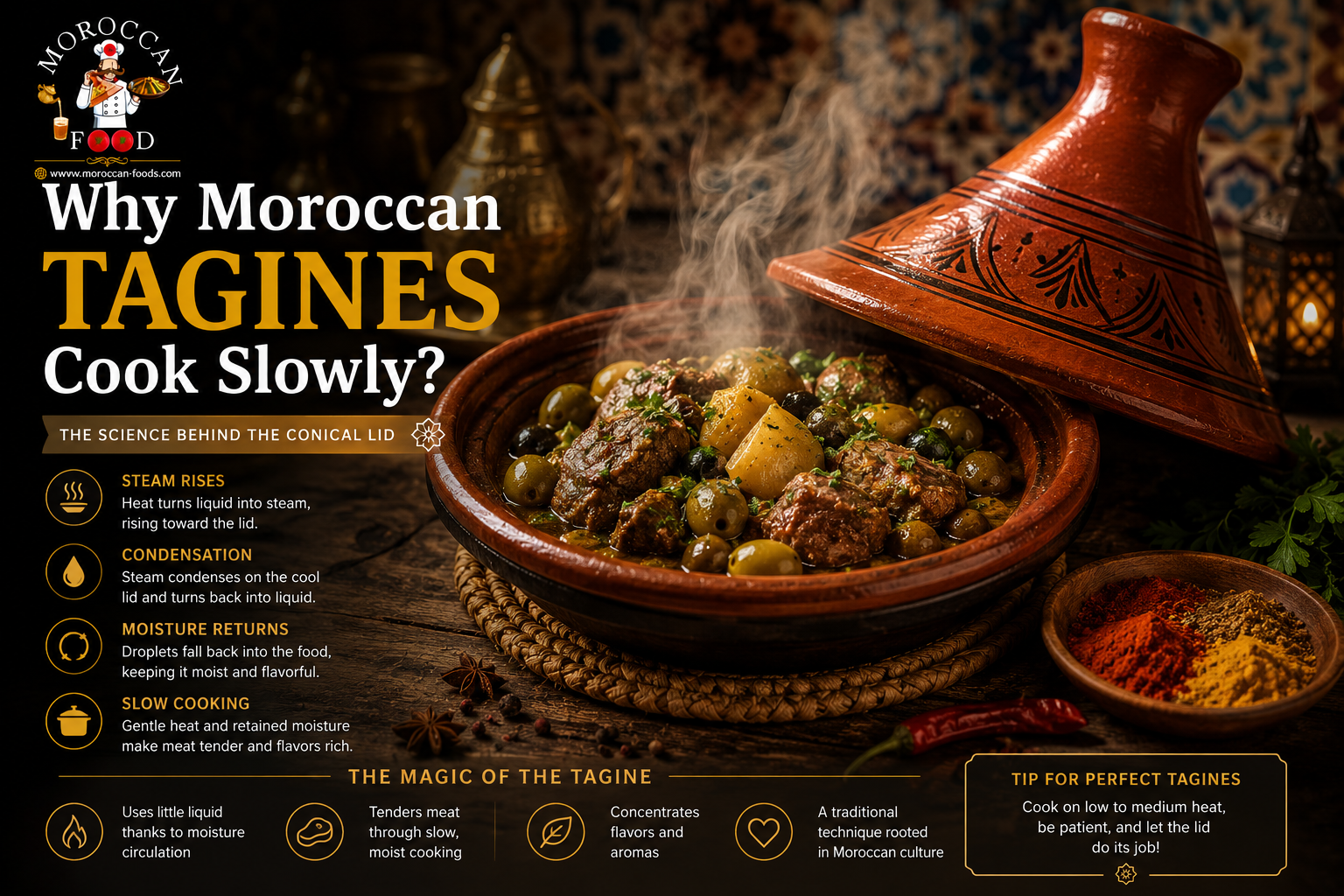
A Moroccan tagine is easy to recognize. Its round base and tall, cone-shaped lid have become one of the most iconic symbols of Moroccan cuisine.
But the unusual shape of the tagine is not simply decorative.
The conical lid plays an important role in how heat, steam, and moisture move during cooking. It helps create the slow, moist cooking environment that makes Moroccan tagines known for tender meat, flavorful vegetables, and concentrated sauces.
So, how does a Moroccan tagine actually work?
The answer can be found in the simple science of heat transfer, steam, and condensation.
What Is a Moroccan Tagine?
The word tagine refers both to the traditional cooking vessel and to the dish prepared inside it.
A traditional tagine consists of two main parts:
- A shallow, circular base where the ingredients are placed
- A tall, conical lid that covers the base
The base is usually designed to spread heat gradually, while the lid helps retain and redirect moisture.
Tagines can be prepared with chicken, lamb, beef, fish, vegetables, legumes, fruits, and a wide variety of Moroccan spices.
Although recipes vary considerably, the cooking principle remains similar: low heat, gradual cooking, and efficient moisture circulation.
Why Is the Tagine Lid Cone-Shaped?
The most distinctive feature of the tagine is its cone-shaped lid.
When food heats up, water contained in the ingredients begins to evaporate. The resulting steam rises toward the cooler interior surface of the lid.
Because of the shape of the lid, the steam moves upward, where it encounters a cooler surface and begins to condense.
The resulting droplets then travel back down toward the food.
This creates a continuous cycle:
Heat → Steam → Condensation → Return of Moisture
Instead of allowing much of the moisture to escape into the surrounding air, the tagine helps keep it inside the cooking vessel.
Why Does Condensation Matter?
Condensation is one of the key principles behind the tagine’s cooking environment.
As the food cooks, water naturally becomes vapor. If the cooking vessel were completely open, a significant amount of that moisture could escape.
The tagine’s lid limits this loss.
When steam touches the cooler inner surface of the lid, it changes back into liquid water. The droplets then return to the ingredients or the cooking juices.
This helps maintain a moist cooking environment.
That is particularly useful when cooking meat and vegetables slowly because the food can remain surrounded by moisture while developing deeper flavors.
Why Can Tagines Use Relatively Little Liquid?
One interesting characteristic of Moroccan tagine cooking is that recipes often begin with less liquid than you might expect.
This works because the ingredients themselves contain water.
Vegetables release moisture as they heat, while meat and other ingredients also contribute juices.
Instead of allowing this moisture to escape quickly, the covered tagine helps retain and recycle it.
The result is a cooking environment where the ingredients gradually cook in their own juices along with the added cooking liquid.
This is one reason a tagine can develop a rich sauce without always requiring large amounts of water or broth.
Why Is Tagine Cooking Slow?
Traditional tagine cooking is generally associated with relatively gentle heat.
The goal is not to cook the food as quickly as possible.
Instead, the ingredients are given time to heat gradually and cook together.
Slow cooking has several advantages.
Meat can become more tender as connective tissues gradually soften, while vegetables have time to absorb the flavors of the sauce and spices.
At the same time, the retained moisture reduces the risk of the food drying out during prolonged cooking.
The result is a dish where the ingredients become tender and the flavors have time to develop.
How Does Slow Cooking Affect Meat?
One of the reasons tagines are often used for tougher cuts of meat is the effect of prolonged moist cooking.
Some cuts contain connective tissue rich in collagen.
When exposed to suitable heat over time, collagen gradually breaks down and transforms into gelatin.
This process contributes to the tender texture associated with many slow-cooked meat dishes.
The important point is that tenderness does not simply come from using high heat.
In many slow-cooked dishes, time, moisture, and controlled temperature work together.
The tagine provides an environment well suited to this type of cooking.
Why Does the Food Taste So Flavorful?
A good Moroccan tagine is not simply about tender ingredients.
It is also about concentrated flavor.
The combination of slow cooking and moisture retention allows ingredients to cook together for an extended period.
Onions soften and become part of the sauce. Vegetables release their juices. Meat contributes its own flavor. Herbs and spices gradually infuse the cooking liquid.
Because the vessel is covered, fewer aromatic compounds and moisture escape compared with an uncovered pot.
The result is a sauce that can become rich and intensely flavored as the dish cooks.
Why Are Moroccan Spices Added Carefully?
Moroccan cooking is famous for its use of spices such as:
- Ginger
- Turmeric
- Cumin
- Black pepper
- Paprika
- Saffron
- Cinnamon
However, Moroccan cuisine is generally about balance rather than extreme heat.
Spices are combined to create layers of aroma and flavor.
During slow tagine cooking, these spices have time to interact with the cooking juices and other ingredients.
This is one reason a tagine can taste more complex after prolonged cooking than it might at the beginning.
Why Should You Avoid Constantly Opening the Lid?
This is a simple but important lesson for anyone learning to cook tagine.
Every time you remove the lid, heat and steam escape.
That interrupts the cooking environment created inside the vessel.
Opening the tagine occasionally to check the food is normal, but repeatedly lifting the lid can reduce heat and moisture retention and extend the cooking time.
If you want the tagine to cook efficiently, let the lid do its job.
Why Are Ingredients Arranged Carefully?
Traditional Moroccan tagine preparation often involves carefully arranging the ingredients inside the base.
For example, vegetables may be placed around or above the meat.
This is not only about presentation.
The arrangement can influence how ingredients are exposed to heat and cooking juices.
Vegetables positioned higher in the dish can slowly soften as steam rises, while ingredients closer to the base receive more direct heat.
The final arrangement also makes the tagine visually appealing when the lid is removed at the table.
Traditional Clay Tagine vs. Modern Cookware
Traditional Moroccan tagines are commonly associated with clay or ceramic construction.
Clay cookware has different heat-transfer characteristics from metal cookware.
It generally heats more gradually, which suits slow cooking.
However, not every tagine sold today is designed for direct stovetop use. Some traditional or decorative clay vessels may require special care or a diffuser to prevent thermal shock and cracking.
Modern tagines can be made from materials designed specifically for stovetop cooking and may behave differently from traditional unglazed clay vessels.
Therefore, the cooking instructions should always match the material and manufacturer recommendations.
Can You Get Similar Results Without a Traditional Tagine?
Yes.
A heavy, covered cooking vessel can reproduce some of the same principles.
What matters most is the cooking environment:
- Gentle heat
- A well-fitting lid
- Moisture retention
- Gradual cooking
- Enough time for flavors to develop
However, the traditional tagine remains special because its shape, materials, and cooking traditions are all part of Moroccan culinary heritage.
Using a regular pot may produce a delicious stew, but cooking in a traditional tagine provides a different experience.
Common Mistakes When Cooking Tagine
Understanding the science behind tagine cooking can help avoid several common mistakes.
Using Too Much Heat
High heat can cause the bottom of the tagine to overheat before the ingredients are properly cooked.
Adding Too Much Liquid
Because ingredients release their own moisture, adding excessive liquid can result in a thin sauce rather than the concentrated texture associated with many tagines.
Opening the Lid Too Often
Frequent opening releases heat and steam and interrupts the cooking cycle.
Overcrowding the Base
Ingredients should be arranged so that heat and moisture can circulate effectively.
Using an Unsuitable Clay Tagine
Some clay tagines are decorative rather than designed for direct cooking. Using the wrong vessel or exposing it to sudden temperature changes can cause cracking.
The Simple Science Behind the Tagine
The magic of a Moroccan tagine becomes easier to understand when we break it into a few basic principles.
1. Gentle heat
The food cooks gradually rather than being exposed to intense heat.
2. Steam production
Moisture from the ingredients and added liquid turns into steam.
3. Condensation
Steam reaches the cooler lid and turns back into liquid.
4. Moisture recycling
The condensed liquid returns to the food.
5. Long cooking time
The ingredients gradually soften and exchange flavors.
Together, these processes create the characteristic environment of tagine cooking.
What Makes the Tagine So Interesting for Home Cooks?
The tagine is a good example of how traditional cooking equipment can solve practical culinary problems through simple design.
There is no complicated technology inside the vessel.
Instead, its shape helps control the movement of heat and moisture.
This is an important lesson for anyone learning to cook: understanding why a technique works can help you cook better than simply following instructions.
Once you understand the role of heat, moisture, and time, you can apply the same principles to many other slow-cooked dishes.
Final Thoughts
The Moroccan tagine is much more than a beautiful traditional cooking vessel.
Its conical lid helps create a cooking environment where steam rises, condenses, and returns to the food. Combined with gentle heat and slow cooking, this helps maintain moisture while allowing meat, vegetables, spices, and other ingredients to develop deep, balanced flavors.
The shape of the tagine is therefore not an accident.
It represents a simple but effective piece of culinary engineering developed through generations of Moroccan cooking.
The next time you lift the lid of a Moroccan tagine, look at the steam—and remember that the shape of that lid is helping turn it back into part of the meal.
Frequently Asked Questions About Moroccan Tagine Cooking
Why do Moroccan tagines have a conical lid?
The conical lid helps create a moist cooking environment. Steam rises from the food, condenses on the cooler interior of the lid, and returns to the dish, helping retain moisture during slow cooking.
How does the Moroccan tagine lid work?
As the ingredients heat, moisture turns into steam and rises toward the lid. The steam cools, condenses into droplets, and flows back toward the food, creating a continuous cycle of moisture circulation.
Why are Moroccan tagines cooked slowly?
Slow cooking allows the ingredients to gradually become tender while giving spices, vegetables, and meat time to exchange flavors. It also helps maintain moisture throughout the cooking process.
Does a tagine need a lot of liquid?
Usually, no. Meat and vegetables naturally release moisture during cooking, while the covered tagine helps retain and recycle it. The exact amount of added liquid depends on the recipe and ingredients.
Why does meat become tender in a tagine?
Slow, moist cooking gives connective tissues such as collagen time to break down and become gelatinous. This contributes to the tender texture of meat in many traditional tagine dishes.
Why shouldn’t I open the tagine lid frequently?
Opening the lid releases accumulated heat and steam, interrupting the moist cooking environment. Keeping the lid closed as much as possible helps maintain consistent temperature and moisture.
Can I cook a Moroccan tagine on high heat?
Traditional tagine cooking generally works best over low to moderate heat. Excessive heat can cause the base to overheat, especially with some clay tagines, before the ingredients have cooked properly.
Can I make Moroccan tagine without a traditional clay tagine?
Yes. A heavy-bottomed pot with a well-fitting lid can reproduce some of the same slow-cooking and moisture-retention principles. However, the traditional tagine provides its own distinctive cooking environment and cultural experience.
What is the difference between a traditional clay tagine and a modern tagine?
Traditional clay tagines generally heat gradually and have characteristics that suit slow cooking. Modern tagines may be made from ceramic, cast iron, or other materials and can behave differently depending on their design and whether they are suitable for direct heat.
Why are vegetables often arranged around the meat in a Moroccan tagine?
The arrangement helps create an attractive presentation and can also influence how ingredients interact with heat, steam, and cooking juices. Different Moroccan recipes use different arrangements depending on the ingredients.
What spices are commonly used in Moroccan tagines?
Common spices include ginger, turmeric, cumin, black pepper, paprika, saffron, and cinnamon. Fresh herbs such as cilantro and parsley are also frequently used.
What makes Moroccan tagine different from an ordinary stew?
The distinctive cooking vessel plays an important role. Its conical lid helps circulate and retain moisture, while gentle heat and slow cooking allow the ingredients to develop deep flavors and tender textures.


Leave a Reply