
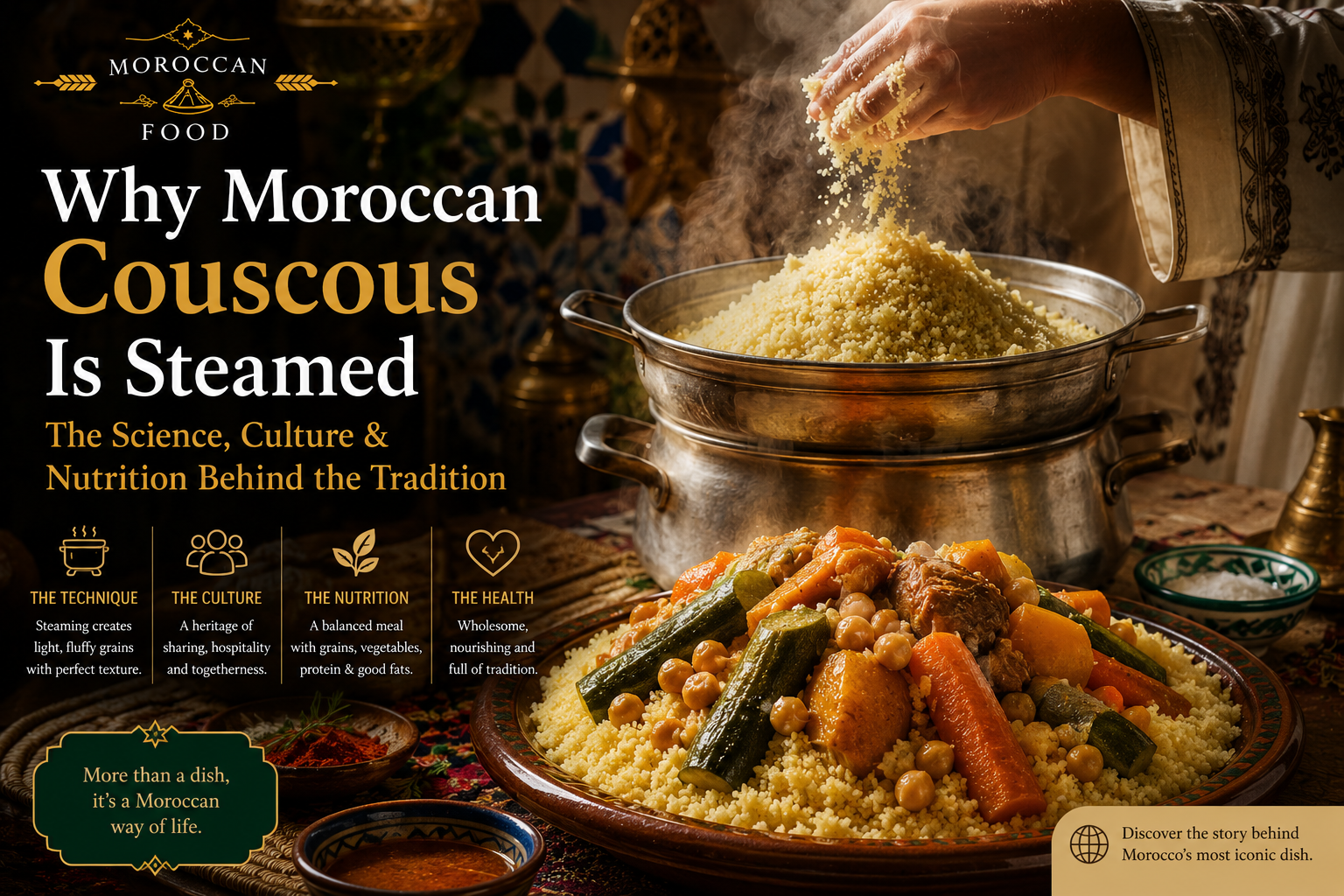
Moroccan couscous is often presented as a simple dish of steamed semolina topped with vegetables, meat, or legumes.
But behind that familiar plate lies a remarkably sophisticated cooking technique.
Traditional Moroccan couscous is not simply boiled like pasta or cooked directly in a pot of water. The grains are rolled from semolina, hydrated gradually, steamed, separated, and steamed again, creating the light and fluffy texture associated with traditionally prepared couscous.
This technique is more than a culinary preference. It connects food science, traditional knowledge, nutrition, Moroccan family life, and centuries of culinary practice.
In 2020, UNESCO inscribed the knowledge and practices surrounding the production and consumption of couscous on the Representative List of the Intangible Cultural Heritage of Humanity. The inscription recognizes not only the food itself, but also the preparation methods, specialized utensils, transmission of knowledge, and social practices surrounding couscous.
So, why is Moroccan couscous steamed instead of simply boiled?
What Makes Moroccan Couscous Different?
Couscous is made from semolina that is rolled into small grains.
In traditional preparation, the grains are not treated like rice or pasta.
Instead, they undergo a sequence of:
Hydration → Rolling → Steaming → Separation → Steaming Again → Finishing
This gradual process allows the grains to absorb moisture progressively while remaining separate.
UNESCO’s description of couscous traditions specifically identifies hand-rolling of semolina followed by steaming and cooking as part of the traditional knowledge and practices associated with couscous.
The result is very different from simply immersing the grains in water.
Why Doesn’t Traditional Couscous Touch the Water Directly?
This is perhaps the most interesting question.
When couscous is boiled directly in water, the grains are surrounded by liquid.
Steaming creates a different environment.
The couscous is positioned above boiling water, inside the upper part of a couscoussier, known in Morocco as a keskas, while the lower pot, or barma, contains the water or cooking liquid.
As the water boils:
Water → Steam → Couscous
The hot steam passes through the couscous grains and gradually cooks and hydrates them.
This allows the cook to control hydration without immersing the grains directly in water.
What Actually Happens to the Couscous During Steaming?
To understand the technique, we need to think about what happens to the semolina.
Semolina contains starch.
When exposed to sufficient heat and moisture, starch granules absorb water and swell. This process contributes to the characteristic cooked texture of grain-based foods.
With steaming, moisture reaches the couscous progressively.
The grains become hydrated and tender while remaining physically separate from a large volume of liquid.
This is one reason traditional steaming can produce couscous with a light, distinct grain structure.
The technique is therefore not simply about “cooking with steam.”
It is about controlling how moisture enters the grain.
Why Is Couscous Steamed More Than Once?
Traditional Moroccan preparation can involve several steaming stages.
After the first steaming, the couscous is removed and worked by hand to separate the grains.
It may then be moistened again and returned to the couscoussier for another steaming.
This process can be repeated depending on the recipe and household tradition.
Why?
Because the cook is progressively developing the texture.
The first steaming begins the cooking process.
The separation prevents the grains from sticking together.
Additional hydration and steaming allow the grains to continue absorbing moisture and becoming tender.
The result is a more developed texture than simply pouring boiling water over the grains once.
UNESCO describes traditional couscous preparation as involving several operations, including rolling, steaming, and cooking, with the knowledge transmitted through observation and practice.
The Importance of Separating the Grains
One of the most recognizable characteristics of well-prepared Moroccan couscous is that the grains remain relatively separate.
This is why traditional cooks do not simply leave the couscous untouched during preparation.
After steaming, the grains are loosened and separated.
Traditionally, this can be done by hand, allowing the cook to feel the texture and identify areas where the grains have clumped together.
This is a perfect example of sensory cooking.
A traditional cook does not rely exclusively on a timer.
They use:
- Touch
- Texture
- Moisture
- Aroma
- Appearance
These observations help determine whether the couscous needs more water, more steaming, or further separation.
Why Does Direct Boiling Produce a Different Result?
Boiling and steaming are fundamentally different cooking environments.
When grains are immersed in water, their surfaces are in direct contact with liquid.
With steaming, the grains are exposed primarily to hot vapor.
This difference affects how moisture reaches the food and how much water is available around each grain.
That is why two methods using the same semolina can produce noticeably different textures.
Direct boiling
Grain + large amount of liquid
Steaming
Grain + hot vapor + controlled hydration
Neither method is inherently “better” for every type of couscous.
But traditional Moroccan couscous developed around the steaming method because it produces the texture and cooking experience associated with the dish.
Why the Couscoussier Is So Important
The couscoussier is not simply a pot with a steamer attachment.
It is a cooking tool designed around the relationship between boiling water and steam.
The lower pot contains the liquid.
The upper perforated section holds the couscous.
As the liquid boils, steam rises through the perforations.
This creates a continuous flow of heat and moisture.
Traditional couscous preparation also uses specialized tools for rolling, separating, and steaming the grains. UNESCO specifically identifies the specialized utensils and tools associated with couscous preparation as part of the cultural practice.
In other words, the equipment itself is part of the culinary knowledge.
Why Does Moroccan Couscous Need Patience?
Modern cooking often focuses on speed.
Traditional couscous preparation takes a different approach.
The cook gradually builds the texture instead of trying to finish the grain as quickly as possible.
This requires:
Time → Observation → Adjustment → Re-steaming
The cook may notice that the grains are too dry and add a little moisture.
They may notice clumping and separate the grains.
They may determine that more steaming is necessary.
This makes couscous preparation an excellent example of adaptive cooking.
The recipe provides a framework, but the cook responds to the food.
The Role of Water: More Is Not Always Better
One of the easiest mistakes for beginners is assuming that adding more water will make couscous softer.
But traditional preparation is more controlled.
The goal is not to saturate the grains.
It is to hydrate them progressively.
Too much moisture can contribute to a heavy or clumped texture.
Too little can leave the grains dry or undercooked.
The experienced cook therefore adjusts hydration gradually.
This principle is useful far beyond Moroccan cuisine:
Good cooking is often about controlling moisture, not simply adding it.
Why Is Oil Sometimes Added?
In Moroccan couscous preparation, oil or another fat may be used during the process to help loosen and separate the grains, depending on the recipe and household tradition.
Fat can coat the grains lightly and reduce the tendency of cooked grains to stick together.
But this does not mean that adding large quantities of oil automatically improves couscous.
The quantity should match the recipe and the desired result.
This is particularly relevant when considering the nutritional side of the dish.
Is Moroccan Couscous Healthy?
The answer depends on the entire meal, not just the couscous grains.
Couscous is primarily a grain-based carbohydrate food.
Its nutritional contribution can change depending on:
- The type of semolina or grain used
- Portion size
- Amount of oil
- Vegetables
- Legumes
- Meat
- Sauce
- Salt
A plate containing couscous, a generous variety of vegetables, chickpeas or other legumes, and an appropriate amount of protein is nutritionally very different from a large serving of couscous accompanied by a heavy, salty sauce.
This is why it is more useful to evaluate the complete Moroccan couscous meal rather than labeling couscous itself simply “healthy” or “unhealthy.”
Why Are Vegetables Important in Moroccan Couscous?
Traditional Moroccan couscous is often served with a variety of vegetables, although the exact combination changes according to region, season, and occasion.
Vegetables can include ingredients such as:
- Carrots
- Turnips
- Pumpkin or squash
- Cabbage
- Zucchini
- Tomatoes
- Onions
These ingredients contribute fiber, vitamins, minerals, water, and different textures to the meal.
UNESCO notes that couscous is accompanied by different vegetables and meats depending on region, season, and occasion, highlighting the adaptability of the dish.
This seasonal flexibility is an important part of understanding Moroccan food culture.
What About Protein?
Moroccan couscous can be served with different protein sources.
Depending on the regional or family recipe, the dish may include:
- Chicken
- Lamb
- Beef
- Chickpeas
- Other legumes
This means the same basic couscous technique can support very different nutritional profiles.
A meal containing vegetables and legumes, for example, provides a different balance of nutrients from one centered primarily on meat.
The technique remains similar while the nutritional composition changes.
Why Is Couscous Traditionally Associated With Sharing?
This is where the story moves beyond cooking.
Couscous is deeply connected to Moroccan social life.
It is commonly associated with family gatherings, hospitality, communal meals, and special occasions.
UNESCO describes couscous traditions as carrying social and cultural meanings connected to solidarity, conviviality, sharing meals, and togetherness.
This is why understanding couscous only as a recipe misses an important part of the story.
The dish is also a social practice.
Couscous as Knowledge Passed Between Generations
Traditionally, much of the knowledge involved in preparing couscous was not learned from written recipes.
It was learned through observation.
A younger person watched an experienced cook:
- Roll the semolina
- Judge the moisture
- Steam the grains
- Separate them
- Adjust the hydration
- Recognize the correct texture
Then they repeated the process.
UNESCO specifically notes that couscous preparation knowledge has traditionally been transmitted informally through observation and imitation, while more formal forms of transmission have also developed.
This explains something important about traditional Moroccan cooking:
The recipe is only part of the knowledge.
The technique is learned through the senses.
The Role of Women in Couscous Tradition
Women have historically played an important role in transmitting and maintaining couscous-related knowledge within Moroccan communities and across the wider couscous tradition.
UNESCO’s inscription explicitly recognizes the important role played by women in the preparation, transmission, and safeguarding of couscous-related knowledge.
This makes the preparation of couscous an interesting example of how culinary knowledge can preserve social history.
A cooking technique can carry memories, family habits, regional identity, and cultural knowledge from one generation to another.
Why Does Couscous Taste Different From One Region to Another?
There is no single universal couscous.
Moroccan couscous changes according to:
Region + Season + Ingredients + Occasion + Family Tradition
The vegetables used in one area may differ from those used elsewhere.
The type of meat can change.
Some preparations emphasize vegetables and legumes.
Others use particular seasonal ingredients.
Even the texture and seasoning can vary.
This diversity is not a problem to be corrected.
It is part of what makes couscous a living culinary tradition.
UNESCO explicitly recognizes this regional and seasonal variation in the accompaniments served with couscous.
Why Steaming Is More Than a Cooking Method
At first glance, steaming may seem like a purely technical decision.
But in Moroccan couscous, the technique connects several dimensions of food:
Cooking Science
Steam provides heat and moisture without immersing the grains directly in water.
Texture
Repeated steaming, hydration, and separation help create the characteristic grain structure.
Nutrition
The final nutritional value depends on the grain and the ingredients accompanying it.
Culture
The technique is part of inherited culinary knowledge.
Social Life
Couscous is traditionally associated with sharing and communal meals.
This is what makes the subject so fascinating.
One cooking technique connects science, food, culture, and society.
Is Steaming Automatically Healthier Than Boiling?
It would be too simplistic to say that steaming automatically makes couscous healthier.
The nutritional outcome depends on many factors, including the grain itself, the cooking process, portion size, added fats, salt, and the ingredients served alongside it.
The real advantage of studying steaming is understanding how the technique controls moisture and texture.
Health should then be considered at the level of the complete meal.
A balanced couscous plate can include:
Couscous + Plenty of Vegetables + Appropriate Protein + Moderate Added Fat
This approach provides a much more useful nutritional perspective than declaring one cooking method universally “healthy.”
What Can Cooking Students Learn From Moroccan Couscous?
Couscous is an excellent lesson in culinary technique because it demonstrates several fundamental principles.
1. Moisture Control
Too little or too much water changes the final texture.
2. Steam Management
Steam provides both heat and moisture.
3. Repeated Cooking
Cooking in stages can produce a different result from a single cooking cycle.
4. Sensory Evaluation
Texture can be judged by touch and appearance rather than by time alone.
5. Cultural Technique
Cooking methods can be part of cultural heritage, not merely technical procedures.
6. Adaptability
The same basic technique can accommodate seasonal vegetables, different proteins, and regional traditions.
The Traditional Process in Simple Terms
For someone learning Moroccan couscous, the traditional process can be understood as:
1. Prepare the semolina
The grains are rolled and prepared for steaming.
2. Hydrate gradually
Moisture is introduced carefully rather than flooding the grains.
3. First steaming
The couscous is exposed to steam from the boiling water below.
4. Separate the grains
The steamed couscous is loosened and worked to reduce clumping.
5. Rehydrate
Additional moisture may be introduced according to the preparation.
6. Steam again
The grains continue cooking and developing their characteristic texture.
7. Finish and season
The couscous is prepared for serving with its vegetables, meat, legumes, or sauce.
The precise number and timing of steaming cycles can vary between recipes and traditions.
The Bigger Lesson Behind Moroccan Couscous
The most interesting thing about Moroccan couscous is not that it is steamed.
It is why the steaming technique survived and remained meaningful.
The technique works.
It produces a distinctive texture.
It can be adapted to different ingredients and seasons.
And it became embedded in family and community life.
Over generations, the method was not simply preserved as a written formula.
It was performed, observed, taught, adapted, and shared.
That is why UNESCO recognizes the knowledge and practices surrounding couscous as intangible cultural heritage rather than treating couscous simply as a dish.
Final Thoughts
Traditional Moroccan couscous is a beautiful example of how culinary technique can become cultural heritage.
Steaming allows the grains to cook progressively while giving the cook control over moisture and texture. Repeated steaming and separation help develop the characteristic structure of traditionally prepared couscous.
But the story does not end with the cooking process.
Couscous also reflects seasonality, regional diversity, nutrition, family knowledge, hospitality, and communal eating. UNESCO’s 2020 inscription recognizes precisely this broader combination of preparation knowledge, tools, transmission, and social practices.
For a cooking student, couscous teaches an important technical lesson:
Control the moisture, respect the process, and learn to read the food.
For someone interested in Moroccan culture, it teaches something even deeper:
A traditional dish can carry an entire way of life from one generation to the next.
And perhaps that is why Moroccan couscous is much more than a plate of steamed semolina.
It is a cooking technique, a shared meal, and a living piece of Moroccan culinary heritage.
Frequently Asked Questions About Moroccan Couscous Steaming
Why is Moroccan couscous traditionally steamed instead of boiled?
Traditional Moroccan couscous is steamed because the technique allows the grains to absorb moisture gradually while remaining separate. This contributes to the light, fluffy texture associated with traditionally prepared couscous.
How many times is Moroccan couscous steamed?
Traditional preparation can involve more than one steaming stage, with the couscous being separated and rehydrated between steaming sessions. The exact number and timing vary according to the recipe, region, and family tradition.
What is a couscoussier?
A couscoussier is a two-part cooking vessel used to prepare couscous. The lower pot holds boiling water or cooking liquid, while the perforated upper section holds the couscous and allows steam to pass through it.
What is a keskas in Moroccan cooking?
Keskas is the Moroccan term commonly used for the perforated upper part of the couscoussier. It holds the couscous above the boiling liquid so that steam can cook the grains.
Why is couscous separated between steaming stages?
Separating the grains helps reduce clumping and allows moisture to distribute more evenly. It is an important part of achieving a light and relatively fluffy texture.
What happens to couscous during steaming?
The grains absorb heat and moisture from the steam. Their starch absorbs water and swells, gradually transforming the dry semolina into tender cooked grains.
Why shouldn’t I add too much water to couscous?
Traditional preparation relies on controlled hydration. Excessive moisture can make the grains heavy, sticky, or clumped, while insufficient moisture can leave them dry or undercooked.
Is steaming couscous healthier than boiling it?
It is too simplistic to say that steaming automatically makes couscous healthier. The nutritional quality of the meal depends on the type and amount of couscous, vegetables, protein, oil, salt, and other ingredients served with it.
Is Moroccan couscous a healthy meal?
It can be part of a balanced diet, particularly when served with a generous variety of vegetables and an appropriate source of protein. Portion size and the amount of added fat and salt also influence the nutritional profile of the meal.
What vegetables are traditionally served with Moroccan couscous?
The combination varies by region, season, and recipe. Common vegetables include carrots, turnips, zucchini, pumpkin or squash, cabbage, tomatoes, and onions.
Can Moroccan couscous be made without meat?
Yes. Couscous can be prepared with vegetables and legumes such as chickpeas, providing a plant-based version of the dish. Moroccan couscous traditions vary considerably according to region, season, and occasion.
Why is couscous important in Moroccan culture?
Couscous is more than a food. It is associated with family gatherings, hospitality, sharing, celebrations, and communal meals. UNESCO recognizes the knowledge and practices surrounding couscous preparation and consumption as intangible cultural heritage.
How is couscous knowledge traditionally passed from one generation to another?
Much of the traditional knowledge is learned through observation and practice. Younger cooks observe experienced family members rolling, steaming, separating, and seasoning the couscous and gradually develop the ability to judge texture and moisture themselves.
Is couscous only Moroccan?
No. Couscous is a broader North African culinary tradition with regional variations. Moroccan couscous has its own distinctive preparation methods, ingredients, serving traditions, and cultural practices.
What is the biggest mistake beginners make when steaming Moroccan couscous?
One common mistake is treating couscous like a grain that simply needs to be boiled or flooded with water. Traditional preparation requires controlled hydration, steaming, separation, and careful attention to texture.
What is the most important lesson behind traditional Moroccan couscous?
The key lesson is moisture control and patience. Traditional couscous is developed gradually through hydration, steaming, separation, and repeated cooking rather than being rushed through a single cooking step.
Why is Moroccan couscous considered part of cultural heritage?
Because the tradition includes much more than the finished dish. It encompasses knowledge, preparation techniques, specialized utensils, regional variations, transmission between generations, and social practices surrounding communal eating. UNESCO inscribed these knowledge and practices on its Representative List of the Intangible Cultural Heritage of Humanity in 2020.


Leave a Reply