
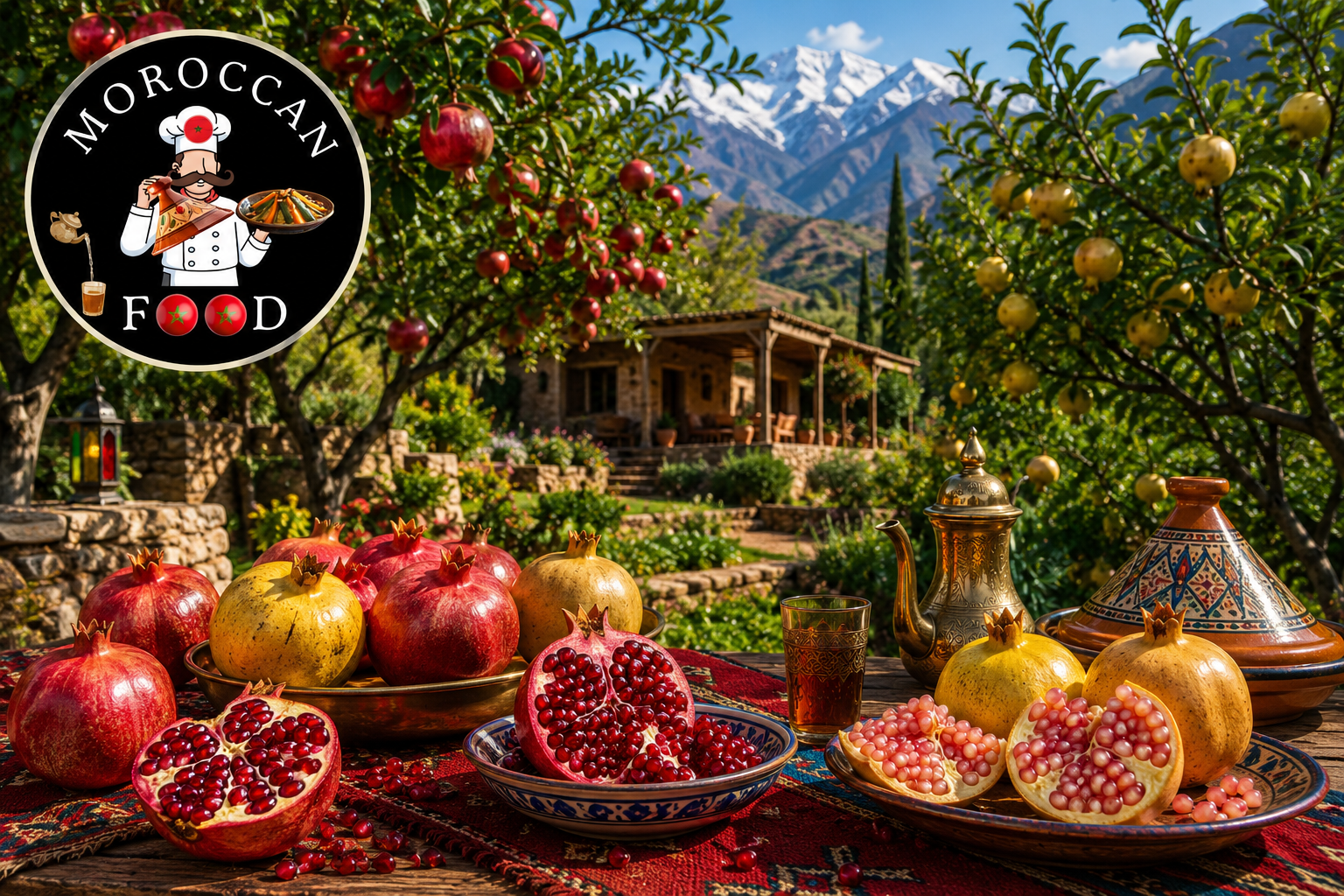
Pomegranate in Morocco: A Traditional Fruit Rich in Flavor and Nutritional Value
Pomegranate is one of the oldest fruits cultivated in the Mediterranean region and holds a special place in Moroccan food culture. Known for its distinctive taste, vibrant color, and impressive nutritional profile, pomegranate is enjoyed fresh, transformed into refreshing juices, and incorporated into various traditional recipes.
Pomegranate Cultivation in Morocco
Pomegranates are widely grown across Morocco, particularly in regions with moderate and semi-arid climates such as Beni Mellal, Khenifra, Marrakech, Taroudant, Souss, Sefrou, and Meknes. Several Moroccan regions are renowned for producing high-quality pomegranates that are consumed locally and exported internationally.

Popular Pomegranate Varieties in Morocco
1. Sweet Pomegranate
This variety is characterized by large juicy arils and a naturally sweet flavor, making it one of the most popular types in Morocco.
Harvest Season: September to November.
2. Sweet-Tart Pomegranate
A balanced variety combining sweetness with mild acidity, commonly used for fresh juice production.
Harvest Season: September to October.
3. Traditional Local Pomegranate
A traditional Moroccan variety known for its rich flavor and medium-sized fruits.
Harvest Season: Late August to October.

Pomegranate Season in Morocco
The pomegranate season in Morocco generally takes place during autumn, mainly from September through November. During this period, small street stalls dedicated to freshly pressed pomegranate juice become a common sight in many Moroccan cities and markets.
Both locals and tourists enjoy this seasonal beverage for its refreshing taste, vibrant color, and natural appeal. Fresh pomegranate juice has become an iconic autumn drink throughout Morocco.

Traditional Uses of Pomegranate Peel
In Morocco, the benefits of pomegranate extend beyond the fruit itself. After consumption, the peels are often preserved and dried under the sun for future use.
Dried pomegranate peels have long been used in traditional Moroccan practices and are commonly associated with digestive wellness. They are traditionally utilized to help support stomach comfort and general digestive health.

Best Pomegranate Variety for Juice
Sweet and sweet-tart pomegranates are generally considered the best choices for juice preparation because they offer:
- High juice yield.
- Balanced sweetness and freshness.
- Minimal bitterness.
- A rich ruby-red color that enhances the appearance of the juice.

List of Moroccan pomegranate drinks
This list contains some Moroccan drinks that include pomegranate as an ingredient.
Best Pomegranate Variety for Fresh Eating
Sweet pomegranates are often preferred for direct consumption due to:
- Large, plump arils.
- Naturally sweet flavor.
- Relatively softer seeds.
- Excellent eating quality when served fresh.

Nutritional Importance:
Pomegranates are appreciated worldwide for their nutritional richness and natural plant compounds. They are recognized as a valuable fruit in balanced diets and are widely associated with numerous health-promoting properties.
=>If you want to know how to prepare pomegranate juice, its health benefits, and its nutritional value, simply click on this link.pomegranate juice
note:
Pomegranates are beloved by Moroccans, and the reason for this is that this fruit is mentioned in the Holy Quran. For this reason, Muslims have long been aware of the health benefits of this fruit. In Moroccan society, some even say that it is a fruit found in Paradise.
Pomegranate and Milk: Is It a Good Combination?
Pomegranate and milk can be enjoyed together by most people who normally tolerate both foods. Fresh pomegranate arils can be eaten alongside milk or blended directly with cold milk to make a creamy pomegranate drink.
Many people search for questions such as whether pomegranate and milk can be eaten together, whether milk can be added to pomegranate juice, and whether the combination is good or bad. In general, there is no need for most healthy people to avoid combining the two. However, pomegranate is naturally acidic, so its acidity can affect the texture of milk and sometimes cause thickening or separation.
For a homemade pomegranate milk drink, blending fresh pomegranate arils directly with cold milk generally provides better control over the texture than pouring milk into concentrated pomegranate juice.
Can You Eat Pomegranate with Milk?
Yes. Fresh pomegranate arils and milk can be consumed together if you normally tolerate both ingredients. You can eat the arils while drinking milk, add them to milk-based foods, or blend them with milk to prepare a drink.
There is no general requirement to wait between eating pomegranate and drinking milk. Individual digestive tolerance can vary, however, just as it can with other fruit and dairy combinations.
People with a milk allergy should avoid dairy milk. Those with lactose intolerance can consider lactose-free milk or another suitable alternative.
Can You Mix Pomegranate with Milk?
Yes. Pomegranate can be mixed with milk, particularly when fresh pomegranate arils are blended directly with cold milk.
Because pomegranate contains natural acids, the mixture may occasionally become thicker or show some separation. Acid can cause milk proteins to aggregate, so this is primarily a food-chemistry effect rather than evidence by itself that pomegranate and milk are an unsafe combination.
For the smoothest result, use cold ingredients, blend until smooth, and serve the drink shortly after preparation.
Can You Add Milk to Pomegranate Juice?
Milk and pomegranate can be combined, but there is an important difference between blending fresh pomegranate arils with milk and simply adding milk to already extracted pomegranate juice.
Pomegranate juice is acidic, and adding it directly to milk may cause noticeable thickening or separation. If your goal is to make a creamy pomegranate milk drink, blending the fresh arils with cold milk is generally a more practical method.
This recipe uses pomegranate and milk together to create a fresh homemade drink rather than simply mixing two finished beverages.
Can You Make Pomegranate Juice with Milk?
Yes. A pomegranate milk drink can be prepared by blending fresh pomegranate arils with cold milk. Depending on the recipe, a small amount of honey can also be added for sweetness.
The result differs from traditional pomegranate juice. Pure pomegranate juice is primarily fruit juice, whereas a pomegranate milk drink contains nutrients from both pomegranate and milk and has a creamier texture.
Follow the complete recipe on this page for the exact ingredient quantities and step-by-step preparation.
Pomegranate Milk Juice vs. Pomegranate Milkshake or Smoothie
The terms pomegranate milk juice, pomegranate milkshake, and pomegranate smoothie are sometimes used for similar drinks online, but the ingredients can differ.
A simple pomegranate milk drink can be made primarily from fresh pomegranate and milk, with honey as an optional sweetener. A milkshake or smoothie may contain additional ingredients depending on the recipe, such as yogurt, banana, ice cream, or other fruits.
This recipe focuses on the natural flavor of pomegranate and milk without requiring those additional ingredients.
Is Pomegranate with Milk Good or Bad?
For most people who can normally consume pomegranate and dairy milk, combining them can be part of a balanced diet. There is no reason to label the combination itself as universally “good” or “bad.”
Its nutritional value depends on the ingredients and quantities used. Pomegranate contributes fruit-derived carbohydrates and polyphenols, while dairy milk supplies protein and several important vitamins and minerals.
It is also important not to interpret milk thickening or separating after contact with acidic pomegranate as proof that the combination is harmful. Texture changes and health effects are different questions.
What Are the Benefits of Pomegranate and Milk?
Pomegranate and milk bring different nutrients to the same drink. Rather than claiming that mixing them creates special medicinal properties, the nutritional benefit comes from the nutrients naturally provided by each ingredient.
Pomegranate provides carbohydrates, potassium, vitamin C in varying amounts, and polyphenol compounds with antioxidant activity.
Dairy milk provides high-quality protein and is an important source of calcium, phosphorus, vitamin B12, riboflavin, and other nutrients. Vitamin D content varies according to the milk and whether it has been fortified.
Together, they can make a nutrient-containing fruit-and-dairy drink that contributes protein, minerals, carbohydrates, and plant compounds to the diet.
What Are the Nutrients in Pomegranate Milk Juice?
The exact nutrient breakdown depends on the amount and type of milk, quantity of pomegranate, serving size, and whether honey or another sweetener is added.
The main nutrients can include:
- Protein from milk
- Calcium and phosphorus from milk
- Vitamin B12 and riboflavin from dairy milk
- Potassium from both pomegranate and milk
- Carbohydrates from pomegranate and milk
- Polyphenols from pomegranate
- Fat, with the amount depending largely on the type of milk used
- Additional carbohydrates and sugars if honey is added
For exact calories, protein, carbohydrates, fat, and other values, refer to the nutrition information calculated for the specific quantities used in this recipe.
Does Pomegranate Juice with Milk Contain More Calories Than Plain Pomegranate Juice?
It can. Adding milk introduces additional calories as well as protein, calcium, and other nutrients. The final calorie content depends strongly on the quantity and type of milk used.
Whole milk generally contributes more calories and fat than lower-fat milk, while adding honey or another sweetener further increases the total calorie and carbohydrate content.
For this reason, the most useful calorie figure is the per-serving nutrition information for the actual recipe, rather than a general estimate for all pomegranate-and-milk drinks.
How Do You Make Pomegranate Juice with Milk?
A simple method is to place fresh pomegranate arils and cold milk in a blender and blend until the desired consistency is reached. Honey can be added according to taste if the recipe calls for it.
For the best result:
- Use fresh, good-quality pomegranate.
- Use well-chilled milk.
- Blend the pomegranate and milk together rather than adding milk to highly concentrated juice.
- Add honey only if additional sweetness is desired.
- Serve the drink fresh for the best flavor and texture.
Continue to the recipe instructions below for the exact quantities, preparation time, serving size, nutritional value, and complete step-by-step method.
Is Pomegranate Milk Juice the Same as Anar Juice with Milk?
Yes, in this context. Anar is a commonly used name for pomegranate in several South Asian languages. Therefore, searches such as anar juice with milk or can we eat anar with milk generally refer to the same fruit-and-milk combination discussed here.
If you are looking for an anar milk drink, this pomegranate milk recipe provides a simple way to combine fresh pomegranate arils with cold milk.
Final Note
Pomegranate and milk can be combined in several ways: the fruit can be eaten with milk, fresh arils can be blended into milk, or the ingredients can form the base of a smoothie-style drink. Because pomegranate is acidic, some thickening or separation of milk can occur, especially when concentrated juice is mixed directly with dairy milk.
For a smoother homemade drink, use fresh pomegranate arils and cold milk and follow the preparation method in this recipe.
Conclusion
Combining exceptional flavor, cultural significance, and nutritional value, pomegranate remains one of Morocco’s most cherished autumn fruits. Whether enjoyed fresh, transformed into a refreshing juice, or valued through the traditional use of its dried peels, pomegranate continues to be an important part of Morocco’s culinary and agricultural heritage.


Leave a Reply