
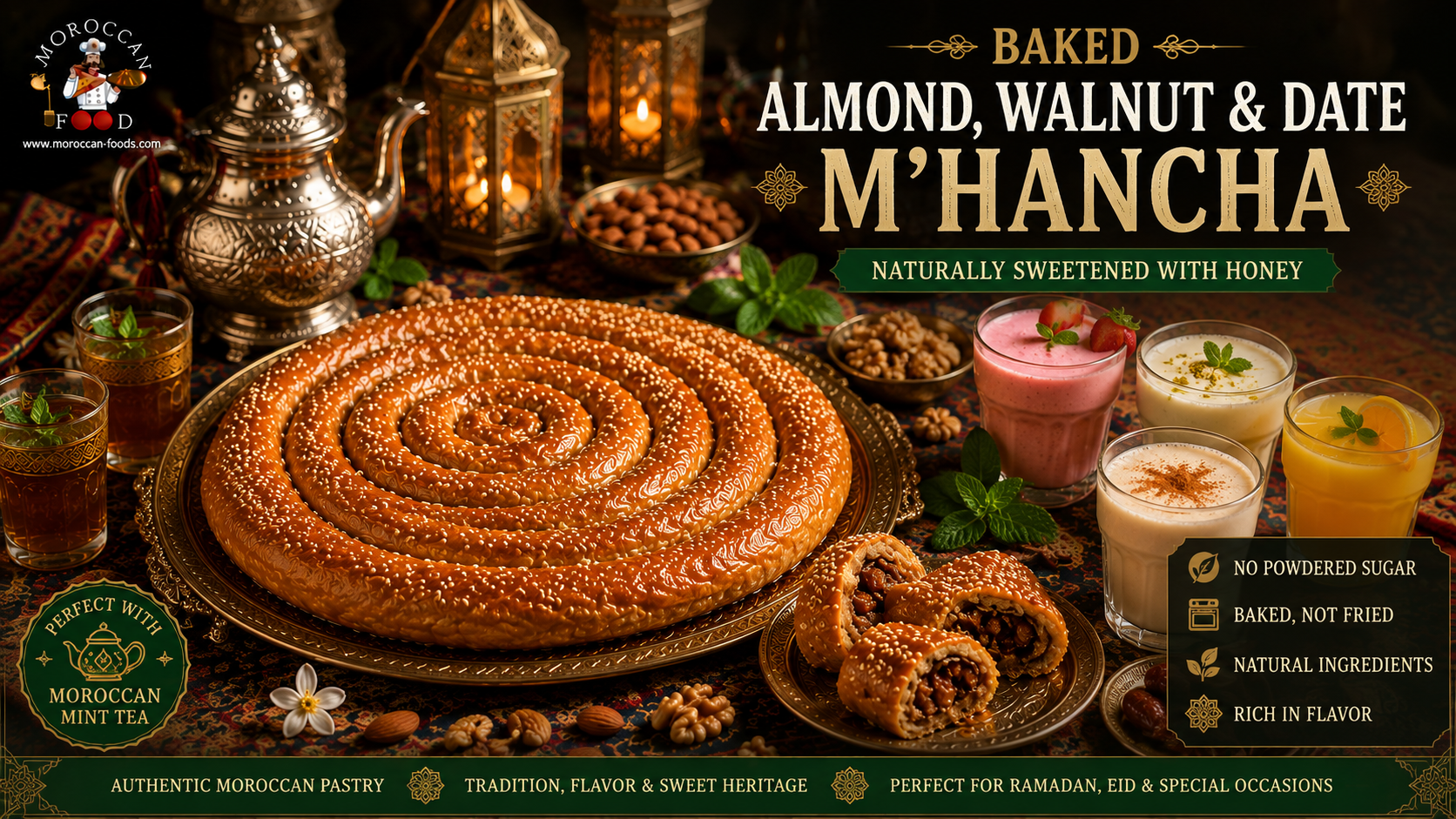
is a delicious twist on the traditional Moroccan pastry, combining finely ground almonds with walnuts and natural date paste for a naturally sweet and flavorful filling. Instead of powdered sugar, this version uses 100 g of date paste and 80 g of ground walnuts, creating a rich, nutty texture with gentle caramel-like sweetness. The M’hancha is baked until golden and crisp, then lightly coated with natural honey and orange blossom water. Served with Moroccan mint tea or a traditional milk-based drink, it offers a wholesome and satisfying way to enjoy the beloved flavors of Moroccan pastry.
Recipe Information:
| Information | Details |
|---|---|
| Prep Time | 40 minutes |
| Cook Time | 20–30 minutes |
| Total Time | 60–70 minutes |
| Servings | 8–10 |
| Cuisine | Moroccan |
| Difficulty | Medium |
Ingredients
For the Almond, Walnut & Date Filling
- 250 g blanched almonds
- 80 g ground walnuts
- 100 g natural date paste
- 1 teaspoon ground cinnamon
- 2 tablespoons orange blossom water
- 1 tablespoon melted butter
For the Pastry
- 8–10 sheets Moroccan warqa, brick pastry, or phyllo pastry
- 1 tablespoon flour
- 2 tablespoons water, for sealing
- 2–3 tablespoons melted butter or a small amount of neutral oil, for brushing
For the Natural Honey Coating
- 250–300 g natural honey
- 1 tablespoon orange blossom water
- 1–2 tablespoons toasted sesame seeds

Method
1. Grind the Almonds
- Place the blanched almonds in a food processor.
- Grind them until finely ground.
- Avoid processing them for too long, as you want a fine nut mixture rather than a completely oily almond butter.
2. Add the Walnuts and Cinnamon
- Add 80 g ground walnuts to the almonds.
- Add the ground cinnamon.
- Mix until the nuts and cinnamon are evenly distributed.
3. Incorporate the Date Paste
- Add 100 g natural date paste to the almond and walnut mixture.
- Process or knead gently until the date paste is evenly incorporated.
- Add the melted butter and orange blossom water gradually.
- Mix until you obtain a soft, fragrant, and cohesive filling.
Important: Because the date paste provides natural sweetness and moisture, there is no powdered sugar in this version.
4. Shape the Filling
- Divide the filling into equal portions.
- Roll each portion into a long, thin log.
- Try to keep the logs approximately the same thickness so the M’hancha cooks evenly.
5. Prepare and Fill the Pastry
- Cut the pastry sheets into long strips.
- Place a filling log along each strip.
- Fold the pastry over the filling and seal the edge with the flour-and-water paste.
- Continue until you have several long filled pastry rolls.
6. Create the M’hancha Spiral
- Carefully join the filled pastry rolls together if necessary.
- Starting from one end, gently coil the pastry into a large Moroccan-style spiral.
- Avoid pressing the spiral too tightly so the pastry can bake evenly.
- Transfer it carefully to a parchment-lined baking tray.
7. Brush and Bake
- Preheat the oven to 180°C (350°F).
- Brush the M’hancha lightly with melted butter or a small amount of neutral oil.
- Place it in the center of the oven.
- Bake for approximately 20–30 minutes, depending on its size.
- Bake until the pastry is golden brown, crisp, and fully cooked.
8. Prepare the Natural Honey
- Place the natural honey in a saucepan.
- Warm it gently over low heat.
- Add the orange blossom water.
- Stir gently until the honey becomes warm and fluid.
- Do not boil the honey.
9. Coat the Baked M’hancha
- Remove the M’hancha from the oven while it is still warm.
- Carefully drizzle or brush it generously with the warm natural honey.
- Alternatively, for a more traditional texture, cut the M’hancha into portions and dip each piece briefly into the warm honey.
- Allow the excess honey to drain.
- Sprinkle with toasted sesame seeds.

You can wrap it this way or in a smaller way.
Traditional Moroccan Serving
Arrange the M’hancha on a decorative Moroccan serving plate and serve it with Moroccan mint tea. The baked almond, walnut, and date version also pairs beautifully with Moroccan milk-based drinks such as Lben, Raib, or Sahlab

SHOW Nutritional Information
Nutritional Information – Baked Almond, Walnut & Date M’hancha
Approximate values per serving, assuming the recipe is divided into 10 medium portions. Values may vary depending on the amount of pastry, honey, and butter used.
| Nutrient | Approx. per serving |
|---|---|
| Calories | 360–400 kcal |
| Protein | 7–9 g |
| Total Fat | 18–21 g |
| Saturated Fat | 3–4 g |
| Carbohydrates | 42–48 g |
| Total Sugars | 25–30 g |
| Dietary Fiber | 4–5 g |
| Sodium | 50–100 mg |
🌰 Key Nutritional Benefits
- Almonds: Rich in plant-based protein, vitamin E, magnesium, fiber, and heart-friendly unsaturated fats.
- Walnuts: Provide healthy fats, plant-based protein, fiber, and naturally occurring omega-3 fatty acids.
- Date paste: Provides natural sweetness, carbohydrates, fiber, potassium, and other micronutrients.
- Sesame seeds: Add healthy fats, protein, fiber, calcium, and minerals.
- Natural honey: Provides carbohydrates and natural sugars for energy.
- Baking instead of deep-frying: This version avoids the substantial amount of oil absorbed during deep-frying, making it a lighter alternative to the traditional fried M’hancha.
⭐ Nutritional Highlight
This version contains no powdered sugar in the filling. The sweetness comes primarily from natural date paste and honey, while almonds and walnuts make the pastry particularly rich in protein, fiber, and healthy fats.
Note: Despite using nutrient-dense ingredients, M’hancha remains an energy-dense dessert because of the nuts, pastry, butter, dates, and honey. Portion size is therefore important.

Frequently Asked Questions (FAQ) – Baked Almond, Walnut & Date M’hancha
1. What is Moroccan Almond M’hancha?
Moroccan M’hancha is a traditional pastry made with thin pastry sheets wrapped around a flavorful nut filling and shaped into a beautiful spiral. This version combines almonds, walnuts, and natural date paste, then finishes the baked pastry with natural honey.
2. What makes this M’hancha different from the traditional version?
This version is baked instead of deep-fried and contains no powdered sugar in the filling. It uses 100 g of natural date paste for sweetness and 80 g of ground walnuts alongside the almonds.
3. Can I use natural date paste instead of powdered sugar?
Yes. Date paste adds natural sweetness, moisture, and a rich caramel-like flavor to the almond and walnut filling. Make sure the date paste is soft enough to blend easily with the ground nuts.
4. Why are walnuts added to the almond filling?
Ground walnuts give the filling a deeper nutty flavor and add a pleasant texture. They also complement the sweetness of the dates and honey.
5. Can I use phyllo pastry instead of Moroccan warqa?
Yes. Phyllo pastry or brick pastry can be used when Moroccan warqa is unavailable. For best results, keep the pastry covered with a clean, slightly damp cloth while working to prevent it from drying out.
6. How do I make the M’hancha spiral without breaking it?
Roll the filled pastry gently into long cylinders, then coil them gradually into a spiral. Do not press the coils too tightly, as this allows the pastry to bake evenly and helps maintain its crisp texture.
7. What size should the pastry strips be?
For a traditional M’hancha, use long, wide pastry strips of approximately 11 cm in width. The length can be adjusted according to the size of your filling logs and the desired spiral.
8. How do I prevent the filling from coming out during baking?
Avoid overfilling the pastry and seal the edges carefully with the flour-and-water paste. When forming the spiral, handle the filled pastry gently so the pastry does not tear.
9. What temperature should I bake the M’hancha at?
Bake it at 180°C (350°F) until the pastry becomes golden brown and crisp. Depending on the size and thickness of the M’hancha, this usually takes around 20–30 minutes.
10. Should I brush the M’hancha before baking?
Yes. Lightly brushing the pastry with melted butter or a small amount of neutral oil helps it develop a beautiful golden color and crisp texture.
11. Should the honey be boiled?
No. Warm the honey gently over low heat until it becomes fluid. Avoid boiling it. Add orange blossom water and stir gently before coating the warm M’hancha.
12. When should I add the honey?
For the best texture, coat the M’hancha while it is still warm after baking. You can drizzle or brush it with warm honey, or cut it into portions and briefly dip each piece.
13. Can I reduce the amount of honey?
Yes. If you prefer a less sweet dessert, use less honey or lightly brush the M’hancha instead of fully dipping it. Keep in mind that honey contributes significantly to the traditional flavor and glossy finish.
14. Can I prepare the M’hancha ahead of time?
Yes. You can prepare and shape the M’hancha in advance and keep it covered in the refrigerator until ready to bake. For the best texture, add the honey shortly after baking.
15. Can I freeze the M’hancha?
Yes. The shaped, unbaked M’hancha can be frozen well wrapped. Thaw it appropriately before baking, then bake until golden and finish with warm honey.
16. Is this version healthier than fried M’hancha?
It can be a lighter alternative because it is baked rather than deep-fried and does not require oil absorption during frying. However, it remains an energy-dense dessert because it contains almonds, walnuts, pastry, dates, butter, and honey.
17. What is the best way to serve Baked Almond, Walnut & Date M’hancha?
Serve it with Moroccan mint tea, or alongside Moroccan milk-and-fruit drinks such as date-and-milk or strawberry-and-milk drinks. It is especially suitable for Ramadan, Eid, family gatherings, and Moroccan tea time.


Leave a Reply